


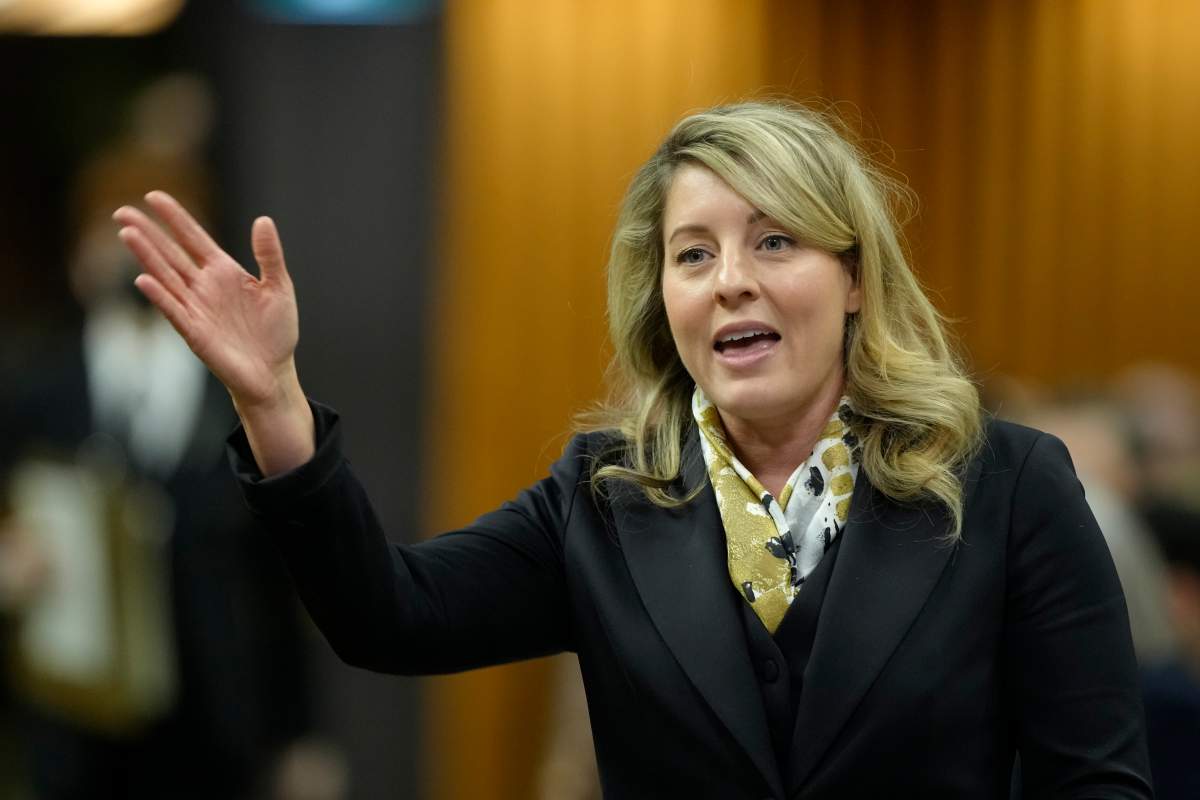
Expanded powers under the federal government’s proposed cybersecurity legislation won’t be used to kick Canadians off the internet for their online conduct, Industry Minister Melanie Joly told MPs on Tuesday.

Bill C-8 would amend the Telecommunications Act to ensure security is a stated priority of Ottawa’s telecommunications strategy and allow the government to compel service providers to act in the event of a cybersecurity incident.
Under the bill, the federal industry minister could issue orders to those companies — without judicial review and potentially with a non-disclosure clause — to remove equipment or services from their networks if it’s found to pose a security risk.
However, language in the bill that says the minister could order a service provider to prohibit or temporarily suspend providing “any service to any specified person” has raised concerns it could be used against individual Canadians, which Joly denied.
“It is important to be clear about what this bill does not do: it does not allow the government to shut down services for individuals. It does not allow the interception of private communications,” she said in her opening statement to the House of Commons public safety committee.
“Infrastructure security is not freedom of speech. This bill is about protecting networks, not regulating expression or ideas.”

Joly later said she would support amending the language in the bill to make clear it’s only addressing the telecommunications system and critical infrastructure, calling the concerns “a fair point.”

Get breaking National news
“The term ‘person’ was defined as basically ‘companies,’ and so I think it was just lost in translation,” she said. “But we can make sure that we can define that in a way that we’re not creating any form of misinterpretation.
“I’m willing to make sure that there’s even a section, if you bring in an amendment … to make sure that it is clear that this will not have any impact on freedom of speech online or anything linked to the type of content that could be put online.”
The minister added the bill is already clear about its focus on “the threats that could be done to, basically, the telecommunications networks — the wires, the towers, et cetera. It has nothing to do with what is being discussed online.”
Joly confirmed that the powers granted to her office under Bill C-8 would allow the government to ensure any remaining 5G technology from Chinese firms Huawei or ZTE, which were banned in 2022, are removed from Canada’s telecommunications networks.


She said any questions about addressing individual online conduct, including misinformation and disinformation, should be raised instead in studies of other proposed legislation, such as the Online Harms Act.
The bill would also allow the industry minister to force service providers to develop security plans and conduct reviews of their networks and facilities, or otherwise face penalties.
Bill C-8 was introduced last fall to replace the identical Bill C-26, which made it to the Senate before it was amended and sent back to the House of Commons, where it died when Parliament was prorogued last January.
Civil liberties groups and cybersecurity researchers at the University of Toronto’s Citizen Lab have raised concerns with lawmakers about the warrantless nature of the proposed ministerial powers under the bill.
In briefs to the public safety committee, they have also highlighted that personal information could be collected under those orders, though the bill says that information can be designated as confidential.
Federal privacy commissioner Philippe Dufresne has raised similar concerns, and testified in October that he wants his office to be informed of any major cybersecurity incidents and privacy breaches under the legislation, which Joly said she would consider.
Liberals on the committee sided with Joly on Tuesday in stating the government should be allowed to act quickly in the event of a cyberattack on critical infrastructure.
Joly said any oversight of actions taken under Bill C-8 would be up to Parliament and oversight bodies like the National Security and Intelligence Review Agency and the National Security and Intelligence Committee of Parliamentarians.
Asked by Conservative MP and public safety critic Frank Caputo why Canadians should trust the government with these expanded powers, Joly responded by pointing to the results of the most recent federal election.
“I think Canadians have already given trust in our government, and that’s why you’re sitting on the right side of (the) table,” she said, referring to the seating arrangement at committee for the official opposition.
“That’s a little inappropriate,” Caputo said as the questioning moved to the next speaker.


Comments
Want to discuss? Please read our Commenting Policy first.