

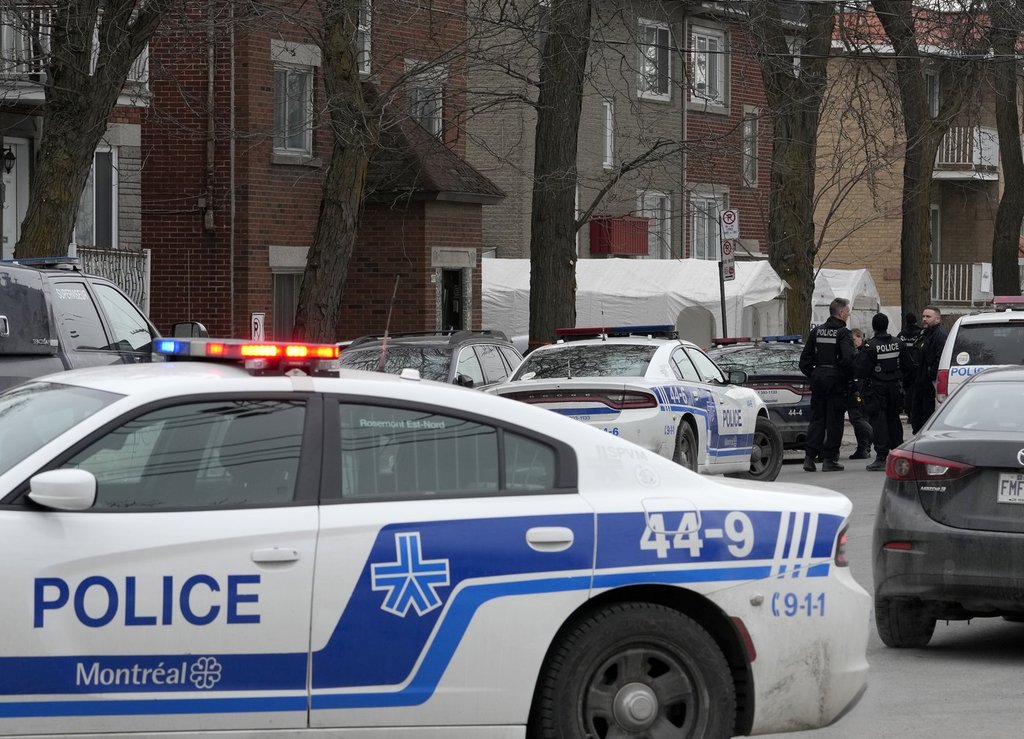
A Montreal man who stabbed his parents and grandmother a total of 212 times has been found not criminally responsible for their murders.

Arthur Galarneau, 22, was impassive as Quebec Superior Court Justice Annie Émond issued her decision on Thursday, agreeing with a joint submission from the Crown and defense that had been presented during a two-day trial in December.
Psychiatrists had recommended that Galarneau be found not criminally responsible for the crimes because at the time of the killings he was suffering from schizophrenia with delusions, hallucinations, and psychotic symptoms.
“This verdict means that Mr. Galarneau’s mental state was so disturbed that he lacked the capacity to rationally decide whether killing his family members was morally wrong or to fully grasp the nature and quality of his actions,” Émond said at the Montreal courthouse.
“Thus, he cannot be held responsible for causing the deaths of these three people.”
Galarneau had been charged with second-degree murder in the March 17, 2023, deaths of his mother Mylène Gingras, 53, father Richard Galarneau, also 53, and his grandmother Francine Gingras-Boucher, 75. The three were stabbed a total of 212 times in the family home.
Before issuing her decision, Émond read out the facts of the case in court.
On the day of the killings, Galarneau’s mother called 911 around 9 am from an apartment in Montreal’s Rosemont-La-Petite-Patrie borough, asking for an ambulance and yelling, “my son wants to kill me” before the line went dead.

Get breaking National news
Montreal police traced the call to a duplex on Bélanger Street, an address known to them for previous mental health-related calls. When they arrived, officers could see through the window that someone was being stabbed and there was a lot of blood on the ground; they kicked the door in and ordered Galarneau to stop.
Covered in blood, the accused said, “it’s good, it’s good, I’m finished,” to officers, but didn’t comply with an order to lay down. Police then pepper-sprayed him as he spat and tried to bite officers. He screamed his mother’s name, spoke of the devil, demons and Satan, and told police to kill him.
Galarneau’s parents had tried to get their son help before the fatal stabbings, having advanced the date of a psychiatric appointment because of his worsening condition. In the lead up to the attacks, he had heard his parents whispering and thought they were plotting to have him hospitalized — a big fear on the part of the accused.
The accused’s parents had split when he was five years old but had maintained a good relationship; his father had returned to the mother’s duplex recently to help with their son, whose schizophrenia symptoms had become progressively worse.
Galarneau’s mental health problems first emerged in 2020 when he was 16 years old, after he had delusions about a parasite. He was eventually diagnosed with schizophrenia and his mental state had fluctuated based on his adherence to medication.
- Fix up or fork out: Edmonton to hike taxes on neglected business properties
- Alberta man to spend 17 years in prison on child sex charges after Florida arrest
- RCMP in B.C. intercept meth hidden in pickle jars bound for Australia
- Man charged with bestiality, accused of sexually assaulting horse on Vernon farm


While he remains ill and requires treatment, Galarneau has shown some insight into his condition, the judge told the courtroom. During a 2025 meeting with the Crown’s psychiatrist, Gilles Chamberland, Galarneau expressed significant criticism of the health system, saying it had failed to provide the necessary intervention to prevent the tragedy.
The judge quoted a passage from Chamberland’s report saying the accused had noted that if the system had insisted on taking charge of his case, his parents would still be alive. He had acknowledged that he would not have consented to being treated, but had said that the system gave “too much space” for individuals suffering from psychosis.
“The man also says that his parents knew he was ill and did everything they could to get him help,” Émond said, citing Chamberland’s report.
“He adds that his parents didn’t know what to do anymore.”
The Crown has said it intends to seek a high-risk offender status for Galarneau, which would impose strict detention in a secure psychiatric facility, longer time between mental health reviews, and Superior Court oversight on any changes to his detention plan.
Émond ordered a psychiatric evaluation for Galarneau in relation to the application for high-risk offender status, with the case returning to court Feb. 23.
Galarneau’s lawyers said they would contest a high-risk offender designation.



Comments
Comments closed.
Due to the sensitive and/or legal subject matter of some of the content on globalnews.ca, we reserve the ability to disable comments from time to time.
Please see our Commenting Policy for more.