

PUTTAPARTI, India – Hindu holy man Sathya Sai Baba, considered a living god by millions of followers worldwide, died Sunday morning in a hospital near his southern Indian ashram or hermitage, a doctor said.
He was 86.
Sai Baba had spent nearly a month on breathing support and dialysis while struggling with multiple-organ failure after being admitted March 28 to the Sri Sathya Sai Institute of Higher Medical Sciences, near his ashram in Puttaparti village in Andhra Pradesh state.
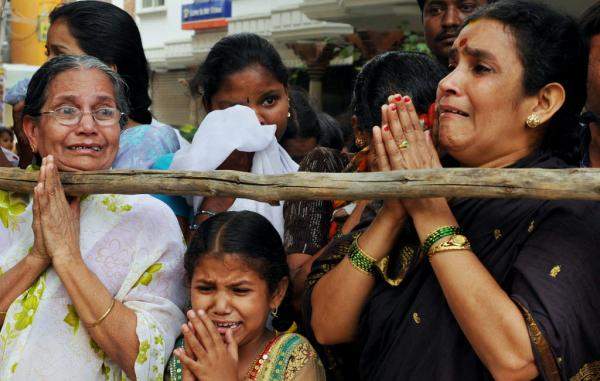
Women selling marigold garlands broke down in tears outside the ashram when the news was announced, and followers began trickling into the temple complex where the guru’s body would lie in state from Sunday night through Tuesday before a planned funeral Wednesday morning.
"We appeal to all not to rush to the hospital, but to remain calm," a hospital statement said.
The Sathya Sai Baba Organization, a charity, operates in more than 130 countries, and has centres across Canada.
His devotees include high-placed politicians, movie stars, world-class athletes and industrialists.
Sai Baba was said to perform miracles, conjuring rings and watches and "vibhuti," a sacred ash that his followers applied on their foreheads, from his overgrown and unkempt Afro-style hair.
But rationalist critics led campaigns against him, calling him a charlatan and his miracles fake. Several news reports also alleged he committed sexual abuse against devotees – allegations he denied as vilification campaigns.
Officials and celebrities expressed regret at the guru’s passing, remembering him as a "great pious personality" who worked selflessly to help others.
"Sri Sathya Sai Baba was a spiritual leader who inspired millions to lead a moral and meaningful life, even as they followed the religion of their choice," Prime Minister Manmohan Singh said in a statement. His death is "an irreparable loss to all, and the nation deeply mourns his passing away."
A heavy police deployment, in place for weeks as Sai Baba’s condition worsened, was using barricades to restrict road traffic Sunday, while shopkeepers were told to close to limit the number of people in town.
Andhra Pradesh state declared four days of mourning, with its top official calling Sai Baba "a symbol of love, affection and passion."
"Sri Sathya Sai Baba has given his great self to the service of humanity," Chief Minister Kiran Kumar Reddy said. "He will be remembered for ages to come by all sections of people all over the world."
Born Nov. 23, 1926, as Sathyanarayana Raju, he was said as a child to display a tendency toward spirituality and unusual intelligence, which he expressed through music, dance and writing poetry and plays.
In 1940, at the age of 14, he declared himself an "avatar," or reincarnation, of another Hindu holy man called the Sai Baba of Shirdi, a town in western Maharashtra state, who died in 1918.
As the young guru attracted followers, his home of Puttaparti grew from a sleepy village into a vibrant town with the sprawling "Prasanthi Nilayam" ashram built in 1950, as well as a hospital, university and schools run by his Satya Sai Central Trust, set up in 1972 with donations from devotees.
The trust – estimated to be worth at least $8.9 billion and possibly much more – also established spiritual centres in Mumbai, Hyderabad and Chennai. It built a hospital in Bangalore, where Sai Baba had a summer home, and funded water supply projects in several southern states.
Though no successor has been named to run the trust, it has assured "there is or will be no vacuum," according to a recent statement released after the guru was hospitalized.
Health woes over recent years had forced Sai Baba to cut down on public appearances. He survived a stroke and a series of heart attacks in 1963. In 2005, he began using a wheelchair, and a year later he fractured his hip when a student fell from a stool onto the guru.
Sai Baba was also mired in controversies, with several news reports about allegations of sexual abuse and fake miracles.
A 2004 television program by the British Broadcasting Corp. called the "Secret Swami" featured interviews with at least two American male devotees claiming the guru had fondled their genitals and exposed himself to them while claiming it was part of a healing ritual.
Though he denied the allegations and was never charged with any crime, the reports led some to break with the guru.
The ashram also said Sai Baba had survived an attempt against his life, with six devotees including the guru’s personal assistant killed in his bedroom in June 1993 after allegedly trying to attack him. Facts of the case still remain a mystery.
Sai Baba was never married and had no children.
With files from The Canadian Press



Comments
Want to discuss? Please read our Commenting Policy first.