



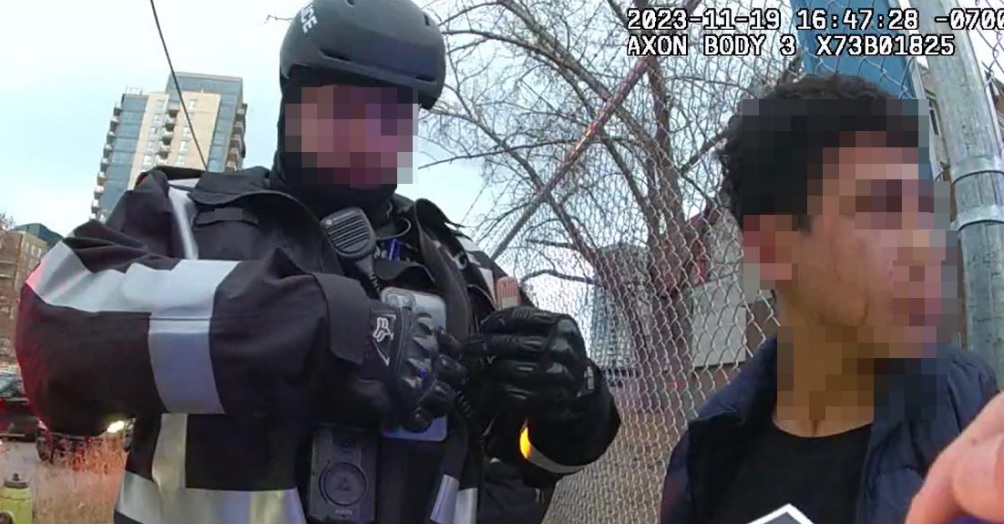
Four officers involved with the arrest of a young protester during rallies in downtown Calgary nearly two years ago have been cleared of any wrongdoing by Alberta’s police watchdog.

The Alberta Serious Incident Response Team (ASIRT) looked at the circumstances surrounding the arrest of a 13-year-old boy on Nov. 19, 2023.
On that day, Calgary police said more than 1,000 people attended a Justice for Palestinians rally in front of City Hall, while roughly 200 people were in attendance of a pro-Israel rally in Olympic Plaza across the street at Macleod Trail.
As a large number of protesters broke off and began marching, police said an estimated 100 protesters began to block traffic just a few blocks to the south of the protest site — at the corner of McLeod Trail and Fourth Avenue southeast.
Police took five people into custody, including Ahmed Ahalis who was 13 years old at the time.
According to ASIRT’s report, Ahalis stood at the front of the group of protesters, facing officers who were forming a barrier between the group and the traffic on Fourth Avenue. During an interaction with police, Ahalis spat on an officer.
ASIRT says the spit landed on the officer’s leg and the boy was then pulled behind the police line, coming into contact with three other officers as well as another protester who was being arrested at the time.
Two officers took Ahalis to the ground, with his face resting against a pile of icy snow, and he was subsequently handcuffed.

Get daily National news
In ASIRT’s interview with Ahalis, he said that police were applying pressure to him, and that he went straight into the ground face-first and then moved his head, so only the right side of his face remained on the ground. He added that he told police that he couldn’t breathe, but that the officers wouldn’t do anything.
Once Ahmed’s father, Mohammad Ahalis, became aware of what was happening he rushed from City Hall to the scene and spoke to officers. They released Ahmed into his parents’ custody and did not end up laying charges.
Medical records confirm Ahmed was taken to hospital the following morning, and after being assessed, he was diagnosed with a concussion, along with scratches on his face.
Looking back on that day, Ahmed says he still remembers it vividly.
“Those years have been going really hard, and every single time I remember it, I get flashbacks,” said Ahmed. “I have to be careful when I’m around kids, so I cannot hit my head.”
During the investigation, ASIRT says it interviewed Ahmed, his father Mohammad and two police officers, one of which was directly involved in the incident. Three other officers involved directly in the incident declined to speak to ASIRT, claiming their right to silence as subjects of a criminal investigation.


Investigators say they also reviewed footage from seven officers’ body-worn cameras.
Doug King, a criminal justice professor at Mount Royal University, says the cameras would have played a clear role in the investigation.
“In this situation in particular, you could actually see in the image — the young man pulling his head back and spitting at the officer. That kind of evidence is irrefutable.”
Ultimately, ASIRT says, “Each of the subject officers were required or authorized by law to control the AP (affected person) and acted reasonably in doing so.”
“After careful review, it was determined that (one officer) did not use any force against the AP. The uses of force by (the other three subject officers) were proportionate, necessary, and reasonable.”
King says officers are trained to use the least amount of force possible to safely apprehend a suspect.
“An officer’s use of force is an escalating kind of situation, King said. “They start out with enough force that is reasonable in the situation.”
“I wouldn’t be in favour of saying, ‘This person was a little bit younger, not as big as someone else, so we’re going to use a different level of force.’ You use as much force (as necessary) to end the interaction.”



Comments
Comments closed.
Due to the sensitive and/or legal subject matter of some of the content on globalnews.ca, we reserve the ability to disable comments from time to time.
Please see our Commenting Policy for more.