

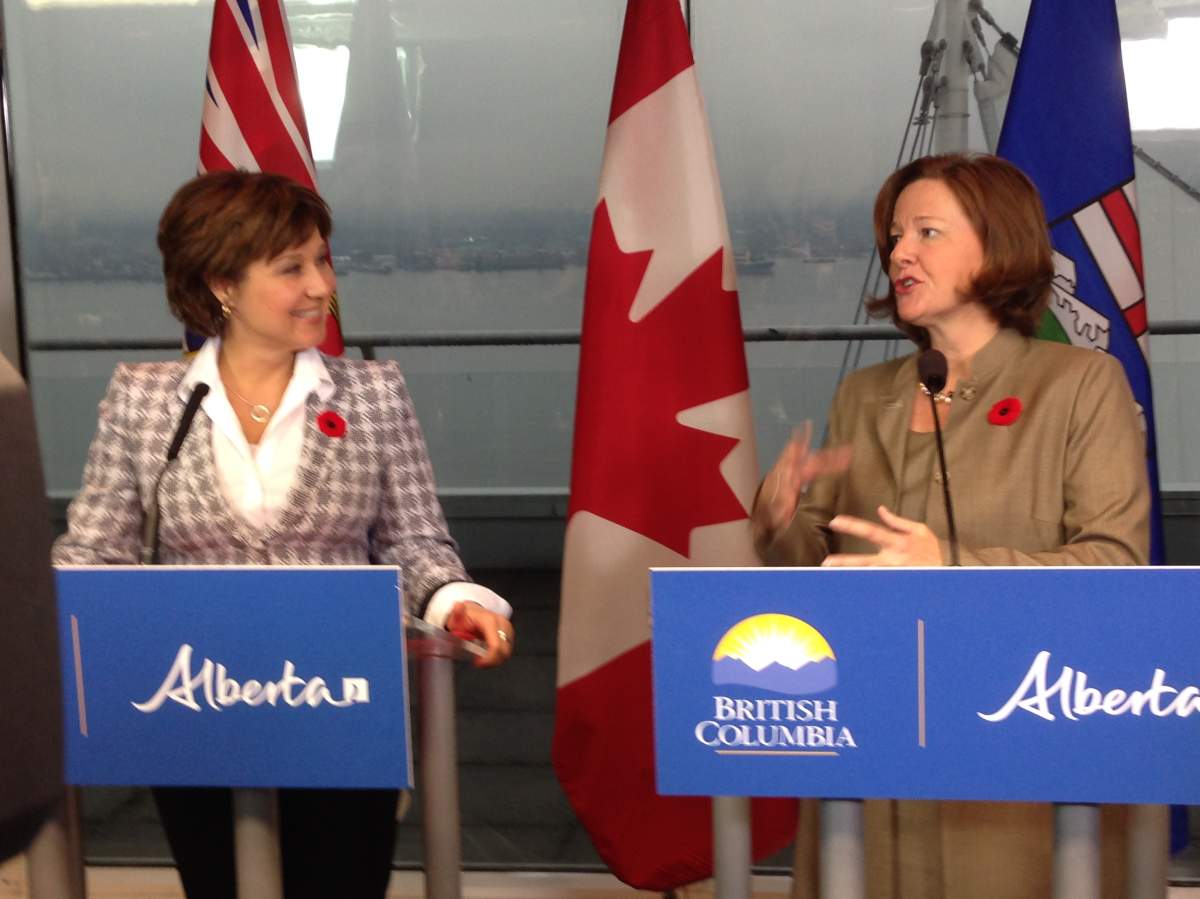
It’s not particularly surprising that the B.C. and Alberta governments have reached an agreement on the five conditions B.C. has put on the table when it comes to approval of oil pipelines being built in this province.

After all, the premiers of both provinces were elected largely with mandates to grow their respective economies, particularly through the natural resource sector. B.C. Premier Christy Clark has been saying since the beginning of last spring’s provincial election campaign that the province had to find ways to “say yes” to natural resource development projects.
The hang-up between the two provinces, however, has been Clark’s insistence that B.C. be given its “fair share” of economic benefits from a pipeline crossing its land. Alberta has long viewed that particular condition through a somewhat dark lens, suspicious that it meant somehow it would have to fork over barrels of cash from the royalties it will reap from shipping bitumen from its tar sands development.
That last stumbling block was resolved in talks between officials late last night and early this morning (Tuesday). Reassured once again that its royalties were not on the table, Alberta agreed that B.C. had the right to extract whatever economic benefits it could from the oil industry seeking to build those pipelines.

Get breaking National news
Those benefits could take the shape of guaranteed job levels or even some kind of “toll” on the pipeline flow. Those details have yet to be worked out, but an obstacle has been overcome.
However, significant other obstacles remain before B.C. nods its head that these pipelines should go ahead (it’s unclear whether the province has the ultimate power to stop them anyways, but that’s for another day).
The province’s five conditions for approving the pipelines have still not been met, even though Alberta now agrees with them. They start with the need for any project to successfully get through the environmental approval process and include the requirement of “world-leading” marine and land spill response capabilities, as well as “addressing” the legal rights of First Nations (whose members must be given opportunities to enjoy the economic benefits of the projects).
A recent report concluded B.C. is woefully unprepared to deal with a major oil spill on the coast, so that condition is very much not in sight for approval (although the report may provide a “road map” on how to get to that point).
And so far there remains considerable opposition among First Nations to both the Enbridge pipeline and the Kinder Morgan pipeline proposals. In fact, this may be THE biggest obstacle of all.
A number of senior court cases have sided with First Nations when it comes to land use decisions, although it’s far from certain a court would automatically grant a First Nations an injunction or some kind of mechanism to halt a pipeline’s construction should it get through the environmental approval process (particularly if the federal government says it is in the “national economic interest” for it to proceed).
Nevertheless, navigating the shoals of First Nations involvement may prove to the trickiest manoeuvre either of the major pipeline projects to pull off.
B.C. and Alberta are now singing from the same page when it comes to heavy oil pipelines. There is still a ways to go before those pipelines begin construction in the B.C. wilderness, although the odds of them ultimately getting the green light have improved slightly




Comments
Want to discuss? Please read our Commenting Policy first.