

A Catholic Church in Toronto is hoping for a miracle – that the thief who stole a saint’s relic will have a change of heart and return the holy object.
The relic of St. Therese of Lisieux, patron saint of missions, is a small piece of her body – about the size of a quarter – which could have easily fit in the pocket of the thief.
Jane Fleming, spokeswoman for St. Michael’s Catholic Church, said the thief may have pretended to be praying at the saint’s shrine while he or she removed the relic’s Plexiglas cover and stole it between services on Sunday.
"Because the church is open every day, all day, we have lots of people who come in and they kneel at the statue and say prayers," she said Wednesday. "Some will put their hand up to touch the statue at the same time, so you can’t really see what they’re doing."
"If someone took on that posture, we would never go over and ask them to move along," she added.
While the thief got away with the relic – estimated to be worth between $3,000 and $5,000 – he or she left behind the small, silver broach-like piece that had contained it.
The thief also didn’t get the relic’s Vatican-issued certificate of authenticity, which is kept in an office in the church, so Fleming doesn’t know how the thief will be able to prove the relic’s worth to prospective buyers.
"I don’t think a pawnshop would understand what it is and want to buy it," she said. "It’s not like taking a solid gold chalice."
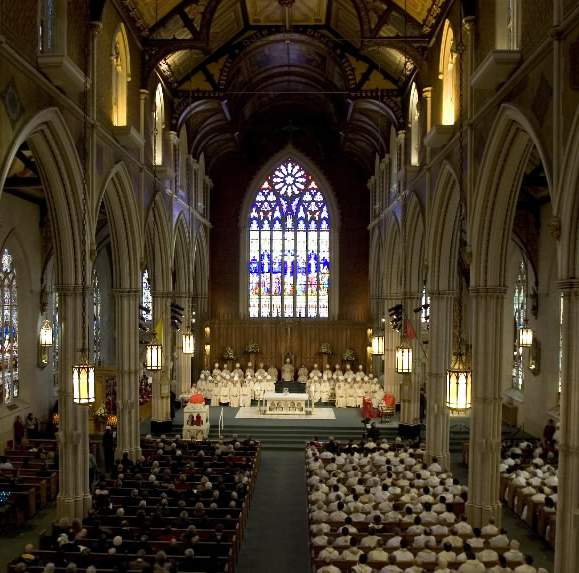
St. Michael’s is the mother church of the diocese of Toronto and an active historical building, so at noon mass on Sundays there can be more than 1,000 people present, said Fleming.
Since the theft was discovered, a valuable relic of St. Anthony has been removed from the public section of the church and is now stowed in a locked showcase in a private area of the rectory.
St. Therese of Lisieux, known as the Little Flower, was a nun who died in 1897 at the age of 24 and was canonized in 1924.
She spoke candidly in her journals about difficulties in choosing her vocation, struggles in her relationships and her family life, and Fleming says these everyday troubles make her easy to relate to.
"And when there’s also a relic, it enhances the worship experience," said Fleming.
The theft is not the first loss of a relic at St. Michael’s.
In 2000, a relic of the True Cross, which Catholics believe Jesus Christ was crucified upon, was stolen from the church. It was never returned.
Fleming hopes that whoever took the relic of St. Therese of Lisieux will realize that it has significance for Catholics and return it to the church.
According to the website Saints and Relics, relics come in three classes: first-class relics, such as that of St. Therese of Lisieux, are parts of a saint’s body or a fragment of the True Cross; second-class relics are objects owned by a saint; third-class relics are made by touching an object against either a first- or second-class relic.
Catholics have for hundreds of years, venerated relics for inspiration and guidance, the website says.



Comments
Want to discuss? Please read our Commenting Policy first.