


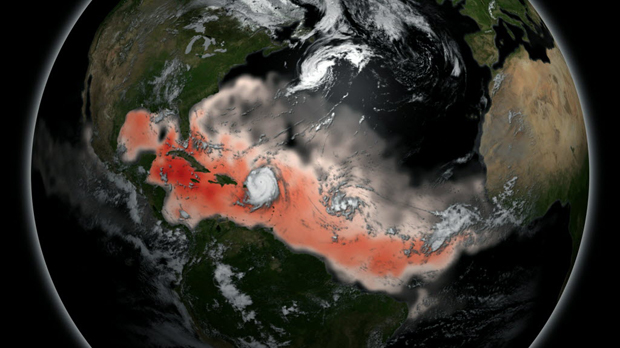
Hurricane Earl is currently a Category 4 storm as it moves over the water toward North America with 193 km/h winds.
What does Category 4 mean? How do hurricanes form? Global News takes a closer look at hurricanes.
BASICS
Hurricanes are large swirling storms that form over ocean water, but can travel over land. They bring heavy winds and a large wall of water, called a storm surge, when they hit land.
Hurricanes are categorized according to wind speed using the Saffir-Simpson Hurricane scale:
Category 1: Winds 119-153 km/hr (faster than a cheetah).
Category 2: Winds 154-177 km/hr (as fast or faster than a baseball pitcher’s fastball).
Category 3: Winds 178-209 km/hr (similar to the serving speed of many professional tennis players).
Category 4: Winds 210-249 km/hr (faster than the world’s fastest rollercoaster). Expect devastating damage by dangerous winds.
Category 5: Winds more than 259 km/hr (similar to the speed of some high-speed trains). Expect winds to cause catastrophic damage.
SECTIONS
Hurricanes are comprised of different parts. At the centre is the “eye,” which looks like a hole. In the eye of the storm, winds are calm and skies are even clear at times.
Just along the eye of the storm is a band of thunderstorms called the “eye wall,” the most violent section of the hurricane.
Extending from the eye wall are “rain bands,” spiral arms of precipitation and cloud which can spread over hundreds of kilometres and sometimes contain tornadoes.
HOW THEY FORM
Scientists still have a lot to learn about how hurricanes form, but there are certain ingredients that are necessary: warm water (typically 26 degrees Celsius or higher) mixed with rising winds that move in one direction.
Hurricanes start as tropical disturbances where rain clouds build over warm water. This can become a tropical depression, consisting of rotating thunderstorms and winds of less than 62 km/h. Heavier winds will elevate the storm to a tropical storm, or a hurricane if the winds top 119 km/hr.
Hurricanes can last anywhere from three to 14 days, and longer-lasting storms have been known to travel over 6,000 kilometres.
Most Pacific storms do not make landfall, at least in North America, making Canada’s west coast relatively safe from hurricanes. But Canada’s east coast lies along the track followed by many Atlantic storms.
NAMES
Storms are named if they become tropical storms or hurricanes. They are named in alphabetical order as they occur in the season, meaning Bill is the second storm to be named in 2009 (Ana was the first).
Names are chosen by the World Meteorological Organization and are re-used every six years. If a storm is particularly damaging that name is removed and replaced.
HOW TO PREPARE
Peter Bowyer is a weather expert and program supervisor for the Nova Scotia-based Canadian Hurricane Centre. He’s written two books on marine weather and two scientific journal papers on extreme waves with hurricanes.
Bowyer was awarded the 2004 Canadian Meteorological and Oceanographic Society’s Andrew Thompson Prize in applied meteorology. He spoke to Global News about how to prepare for a hurricane.
Q: What should we do to prepare for a hurricane?
A: Keep an eye on all the forecasts that Environment Canada is issuing. We’re updating our bulletins every six hours. People should be getting ready for the visit of a significant weather event. Prepare to keep your property secured.
Pretend you’re going to get the high winds now, gather all the loose things on your property like lawn furniture, and make sure you bring them in before Sunday.
This is the kind of thing you do now. It’s a good time to do it while the weather is still good.
Make sure you know your own vulnerability, and your property’s, to severe weather.
If you’ve got a basement make sure you have a sump pump and it’s working properly to pump the water out of your basement.
The big thing that we’re telling everybody is to make sure that you’re able to withstand 72 hours without basic necessities. Do you have enough water in the house? You should have 1-2 litres of water per person per day. You want to have all this stuff ahead of time.
Make sure you have cash on hand. During power outages the ATMs don’t give you cash. Cash is king during an emergency.
Do you have an emergency kit? You know you should have one, but now is the time to do it and stop putting it off.
Make sure you know your insurance coverage for both your car and house.


-
![]() Armed robbers steal $100K in merchandise from Pokémon card store as terrified witnesses look on
Armed robbers steal $100K in merchandise from Pokémon card store as terrified witnesses look on -
![]() People line up in Edmonton to sign Alberta separation petition
People line up in Edmonton to sign Alberta separation petition -
![]() City officials working on next steps for replacing Bearspaw feeder main
City officials working on next steps for replacing Bearspaw feeder main -
![]() Coordination and compassion: A look at how the Surrey Food Bank operates
Coordination and compassion: A look at how the Surrey Food Bank operates


Comments