


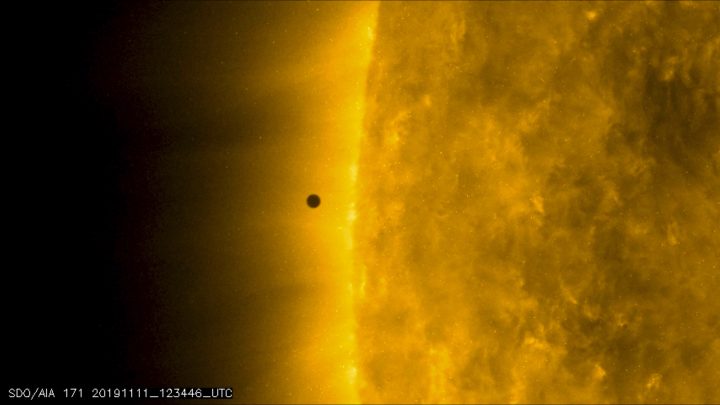
Mini Mercury skipped across the vast, glaring face of the sun Monday in a rare celestial transit.

Stargazers used solar-filtered binoculars and telescopes to spot Mercury — a tiny black dot — as it passed directly between Earth and the sun on Monday.
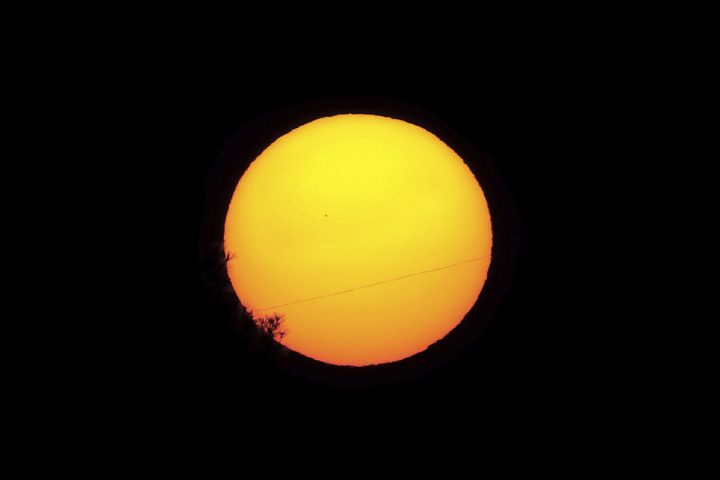
The eastern U.S. and Canada got the whole 5 1/2-hour show, weather permitting, along with Central and South America. The rest of the world, except for Asia and Australia, got just a sampling.
Mercury is the solar system’s smallest, innermost planet. The next transit isn’t until 2032, and North America won’t get another shot until 2049.
-
![]() ‘I’ve never heard of the person’: Trump slams Norway for not picking him as Nobel Peace Prize winner
‘I’ve never heard of the person’: Trump slams Norway for not picking him as Nobel Peace Prize winner -
![]() Russell Brand trial: Jury selection begins for rape, sexual assault case
Russell Brand trial: Jury selection begins for rape, sexual assault case -
![]() Saudi energy minister vows ‘serious’ response to deadly Houthi attack
Saudi energy minister vows ‘serious’ response to deadly Houthi attack -
![]() Montrealers stand in solidarity with ‘Cockroach’ movement in India
Montrealers stand in solidarity with ‘Cockroach’ movement in India


In Maryland, clouds prevented NASA solar astrophysicist Alex Young from getting a clear peek. Live coverage was provided by observatories including NASA’s orbiting Solar Dynamics Observatory.

“It’s a bummer, but the whole event was still great,” Young wrote in an email. “Both getting to see it from space and sharing it with people all over the country and world.”
At Cape Canaveral, space buffs got a two-for-one. As Mercury’s silhouette graced the morning sun, SpaceX launched 60 small satellites for global internet service, part of the company’s growing Starlink constellation in orbit.


Comments
Want to discuss? Please read our Commenting Policy first.