


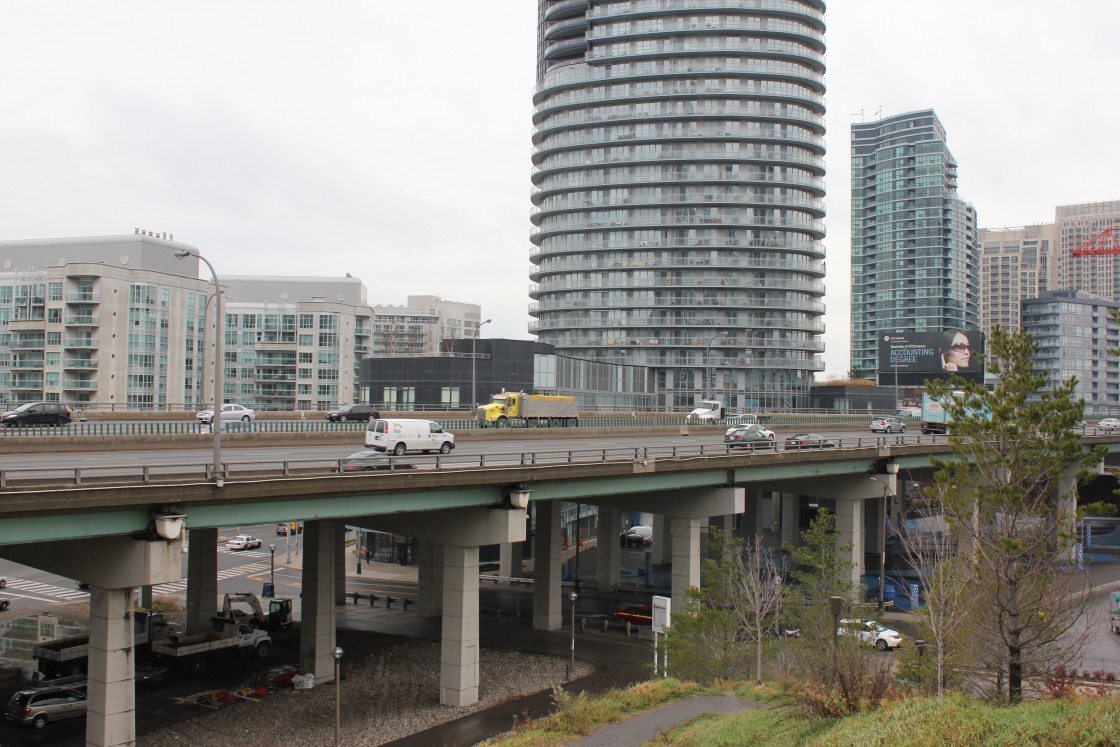
As the main artery to the downtown core, the waterfront, and most of Toronto’s big tourist attractions, the Gardiner Expressway is also a source of headaches for many Torontonians. Along with near-constant congestion, safety concerns surrounding its structural integrity have officials searching for solutions to repair the elevated highway. Do we add tolls in hopes it will get more people taking public transit? Tear it down and build an underground highway? Turn it into a park? Or start rebuilding it with hopes it will last another 50 years?

Here’s a look at what some other cities are doing to deal with problematic waterfront roadways.
Boston
Like Toronto’s Gardiner Expressway, Boston’s John F. Fitzgerald Expressway was a partially elevated freeway constructed in the 1950s to “alleviate traffic congestion and provide a direct route for moving goods in and out of Boston.” It became known as the ‘Distressway’ as other highway projects were cancelled and traffic congestion grew over time.
After 10 years of planning, it was decided to put the entire freeway underground and in 1991 the ‘Big Dig’ began.
Scheduled to be completed in 1998, the ‘Big Dig’ became the most expensive highway project in the U.S. after numerous delays and other issues, such as multiple leaks and the death of a woman when a slab of concrete fell on her.

Get breaking National news
It was finally completed in December 2007. The Associated Press reported in July 2012 that the final budget for the project was US$24.3 billion and it wouldn’t be paid in full until 2038.
After the above-ground portion was put underground, the Rose Fitzgerald Kennedy Greenway — a 15-acre urban park — was put in place. The park is currently operated by the non-profit Rose Fitzgerald Kennedy Greenway Conservancy and is funded with a 50/50 private-public model.
While the federal government forked over US$7 billion at the beginning of the project, most of the initial cost was covered by the state of Massachusetts, which has taken away from other highway and bridge upgrades in regions outside of Boston due to the lingering debt. The current system is maintained in part by federal funding and tolls.
Along with moving the expressway underground, there is a US$1.3-billion extension of their transit system planned that is still not completed.
Chicago
Chicago’s Lake Shore Drive, the main expressway that runs along the shoreline of Lake Michigan, is divided into an “inner drive” for local traffic and an “outer drive” for express traffic. Chicago plans to extend it as part of a 30-year, US$4-billion development of the U.S. Steel Site on the south lakefront, which will house 50,000 new residents and bring new retail and commercial space to the area. The city recently restored part of their waterfront as well.
A study conducted from 2010 to 2012 found they will need to upgrade their transit system in order to cope with the influx of people these projects will bring to the waterfront area.
Seattle
Seattle’s Alaskan Way Viaduct is a two-storey, elevated highway that runs along Elliott Bay. After it was damaged by an earthquake in 2001, a proposal was introduced to replace it with a four-lane tunnel running under the downtown core.
Demolition of the highway began in October 2011. The tunnel has a cost of US$4.25 billion with the city, state and county funding the project. It is expected to be completed in 2015.
San Francisco
Following in the footsteps of London, England and Stockholm, San Francisco has proposed a congestion tax for vehicles traveling into certain areas of the city during set times. If approved, the tolls would be tested out on a trial basis beginning in 2015 with a fee of US$1.50 to enter the city and US$3.00 to enter the downtown core.
In July 2010, a congestion toll of US$6 was implemented on the Bay Bridge Monday to Friday between 5 a.m. and 10 a.m and 3 p.m. to 7 p.m. On weekends the fee is US$5. Carpools pay US$2.50. At all other times, the toll remains at US$4.
SOUND OFF: What do you feel is the best model Toronto should be looking at to fix the problem with the Gardiner? Let us know in the comments below or on our Facebook page.




Comments
Want to discuss? Please read our Commenting Policy first.