

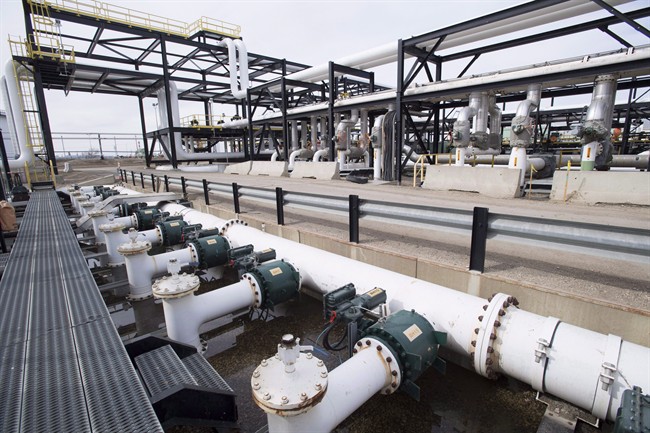
Kinder Morgan Canada has asked the National Energy Board to waive an approval condition of the Trans Mountain pipeline expansion because it might delay completion of the project.

Shawn Denstedt, a lawyer at Osler, Hoskin & Harcourt representing Kinder Morgan Canada subsidiary Trans Mountain, said in a letter to the NEB that it needs to be allowed to install mats to deter fish spawning as soon as possible to have them in place before spawning season.

Get breaking National news
The NEB told the company last week that it had to stop installing the deterrent mats because they’re considered construction activity, and the company does not yet have all conditions approved for pipeline construction.
Denstedt said if the NEB doesn’t grant Trans Mountain’s request “expeditiously,” then installations of the mats and corresponding crossing construction could be delayed by a year, potentially impacting when the project is complete.
- Parts of Nova Scotia national park closed temporarily after coyote bite: Parks Canada
- Canadians more united despite separatist sentiment in Alberta, Quebec: Ipsos
- Lions climb standings with win over Roughriders
- RCMP remind drivers to stop for school buses after two Kelowna students are struck by a vehicle
-
![]() ‘We’re still getting what we need’: Greer says U.S. has no ‘urgency’ amid trade tensions with Canada
‘We’re still getting what we need’: Greer says U.S. has no ‘urgency’ amid trade tensions with Canada -
![]() Canada reports first annual population decline on record
Canada reports first annual population decline on record -
![]() Toronto Tempo wraps inaugural WNBA season with loss in Connecticut
Toronto Tempo wraps inaugural WNBA season with loss in Connecticut -
![]() Ipsos poll on Alberta referendum initiatives shows the majority plan to vote to remain
Ipsos poll on Alberta referendum initiatives shows the majority plan to vote to remain


The NEB said Thursday that it’s continuing with its assessment, but that Trans Mountain has halted plans to install five more deterrent mats after having already installed eight.
The controversial $7.4-billion Trans Mountain expansion project, which would nearly triple the capacity of the pipeline system running from Alberta to B.C.’s southern coast, is facing significant scrutiny from the many environmentalists, Indigenous groups, and B.C. governments that oppose it.


Comments
Want to discuss? Please read our Commenting Policy first.