

In its account of the deadly fire at CFB Wainwright, the Canadian Armed Forces (CAF) describes an extraordinary chain of events on Oct. 17.
The base, it says, was monitoring a common grass fire that erupted in “uncommonly strong winds,” with flames soon devouring a kilometre in just 30 to 60 seconds.
The military called the event “entirely anomalous.”
A Global News analysis of satellite imagery and weather records, reviewed by seven Canadian wildfire experts, paints a different picture.
As soldiers continued their training on that day, satellites showed the fire had already spread. But the day before, Environment Canada forecast a cold front bringing powerful winds and later issued wind warnings for the area.
And experts say the flames were unlikely to travel at the speed the military suggests, although estimates made during a traumatic event may understandably be imprecise.
More importantly, however, experts say base leadership should have known the dangers posed by the incoming weather, even if they couldn’t predict the precise timing or consequences.
“This was not unexpected given the forecast cold front, the actively spreading fire and the wind warnings that were issued earlier in the day,” says Jen Beverly, an associate professor of wildland fire at the University of Alberta.
According to the military, four soldiers were killed and 39 injured, including 19 critically, when the fire swept through the military training grounds.
It said the fire rapidly intensified and overran soldiers around 4 p.m.
But satellite imagery and weather records show a two-kilometre stretch of fire at noon was likely spreading as winds picked up and a violent cold front approached.

Nearly two weeks after the disaster, crucial questions remain unanswered: What did commanders know about the growing fire and approaching weather? What warnings were passed on? And why were soldiers still training nearby?
The military says its Board of Inquiry, which will answer those questions, could take more than a year.
But weather records, satellite observations and decades of wildfire research already offer important clues about how the tragedy unfolded.
Global examined the evidence and had seven leading wildfire experts review its findings, reconstructing the hours before the disaster to better understand what happened — and whether the fire behaved as unexpectedly as the military has suggested.
The reconstruction traces how the fire may have spread throughout the day, what warnings were issued, and how a forecast wind shift changed the danger. It also raises questions about how quickly the flames advanced — and why soldiers remained in their path.
A sudden shift in ‘uncommonly strong winds’
Long before it became a military training ground, CFB Wainwright was known as Buffalo National Park, established in 1909 to help save plains bison from extinction. Dozens of the once-overhunted beasts still graze on the base today as a commemorative herd.
Those vast, open grasslands face powerful winds, with few natural barriers to interrupt them as they sweep across the prairie.
While the precise combination of weather and fire conditions on Oct. 17 may have been exceptional, the area has seen destructive winds before.
Exactly nine years earlier, on Oct. 17, 2017, gusts exceeding 100 kilometres per hour derailed 13 railway cars at a trestle bridge west of town.
Local Wainwright residents told Global News the area is known for being windy, but the day’s gusts were extraordinary.
However, forecasts predicted those winds.

Since the previous morning, Environment Canada had forecast strong winds, with gusts expected to rise from 60 to 80 kilometres per hour by Oct. 17. The forecast also predicted a shift in wind direction, from southwest to west, that afternoon.
Two hours before the soldiers were reportedly overrun, at 2:14 p.m., Environment Canada extended a yellow wind warning to Wainwright, indicating “hazardous” winds, and forecast gusts up to 100 kilometres per hour.
The base has its own weather station to monitor conditions, while CFB Wainwright’s standing orders, which set out safety rules, require Range Control to receive forecasts twice daily, at 6 a.m. and 6 p.m.
But it remains unclear who was monitoring the weather on Oct. 17.
In a tense exchange with a reporter days after the disaster, Maj.-Gen. Wade Rutland, speaking on behalf of the military, repeatedly declined to say whether Wainwright had a meteorologist or wildfire-behaviour expert, citing the ongoing investigation. Environment Canada provides meteorologists at some military bases, but confirmed none was stationed at Wainwright that day, adding that the base instead received remote forecasting support from CFB Gagetown in New Brunswick.

“Uncommonly strong winds caused the fire to spread rapidly and shift direction,” Rutland said on Oct. 18, speaking on behalf of the military.
While much remains unknown about that day, wildfire experts consulted by Global News said the forecasts and warnings should have raised serious concerns, particularly with an established grass fire already burning on the base. The approaching front threatened to intensify the blaze and abruptly change its direction.
“It was a classic setup,” said Mike Flannigan, a wildfire researcher at Thompson Rivers University.
“You don’t want to be out in the field on a day like Saturday.”
A fire already burning
A grass fire ignited on the automatic grenade launcher range that Saturday, although the military has declined to say precisely when it began. At the time, the Canadian Wildland Fire Information System categorized the wildfire danger in Wainwright as “extreme.”
The military’s account of the blaze’s timing has changed. The morning after the tragedy, officials put the ignition time at around 4 p.m. Later that day, Rutland told a briefing that the fire started “several hours earlier,” adding that officials believed it was “contained.”
Asked how big the fire had grown, he declined to say: “I wouldn’t say it was small nor large.”
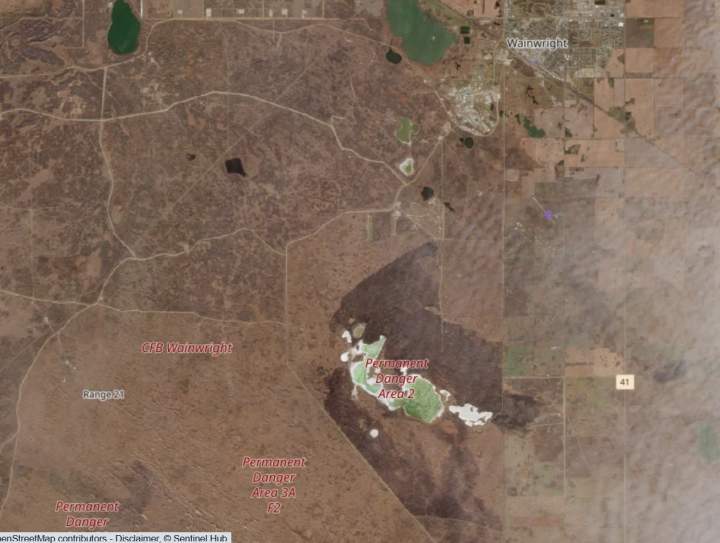
Four days later, military officials provided more detail, saying the fire was burning inside an area known as Permanent Danger Area 2, a restricted section of the base where live ammunition is fired, and unexploded munitions pose a hazard.

This “restricted the firefighters’ ability to conduct direct suppressive operations,” they said.
However, the base’s standing orders explicitly exempt firefighting and emergency vehicles from certain restrictions on entering the area, including the grenade range impact zone, although the danger posed by unexploded munitions could still prevent firefighters from entering.
They also give Range Control authority to halt dangerous training and coordinate emergency responses. Units must also report changes in a fire’s intensity, direction and speed.
The military has declined to say whether those procedures were followed on Oct. 17, citing the ongoing investigation.
Military officials said Range Control and the base’s fire department monitored the blaze while soldiers continued training nearby.
But high above the Alberta prairie, satellites captured images of a fire far larger than a small patch of burning grass as early as noon.

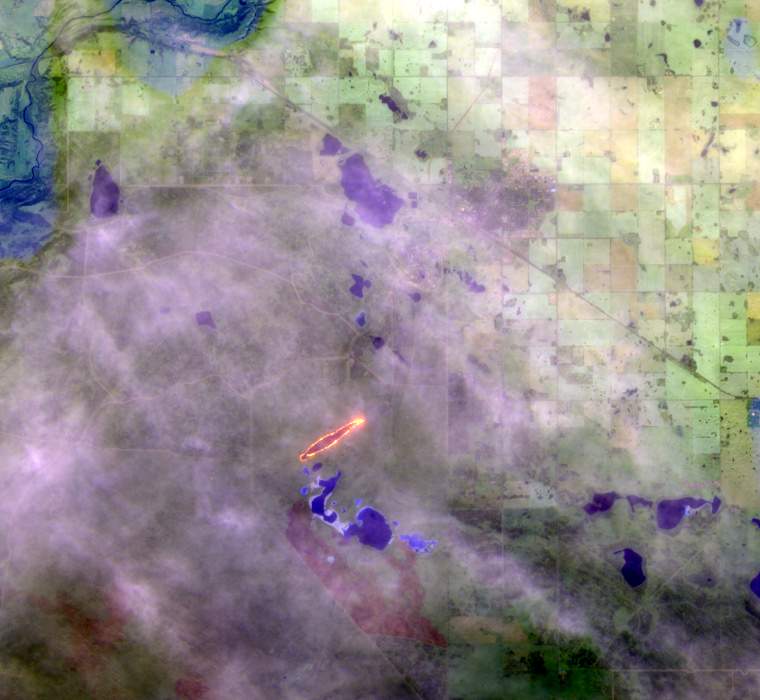
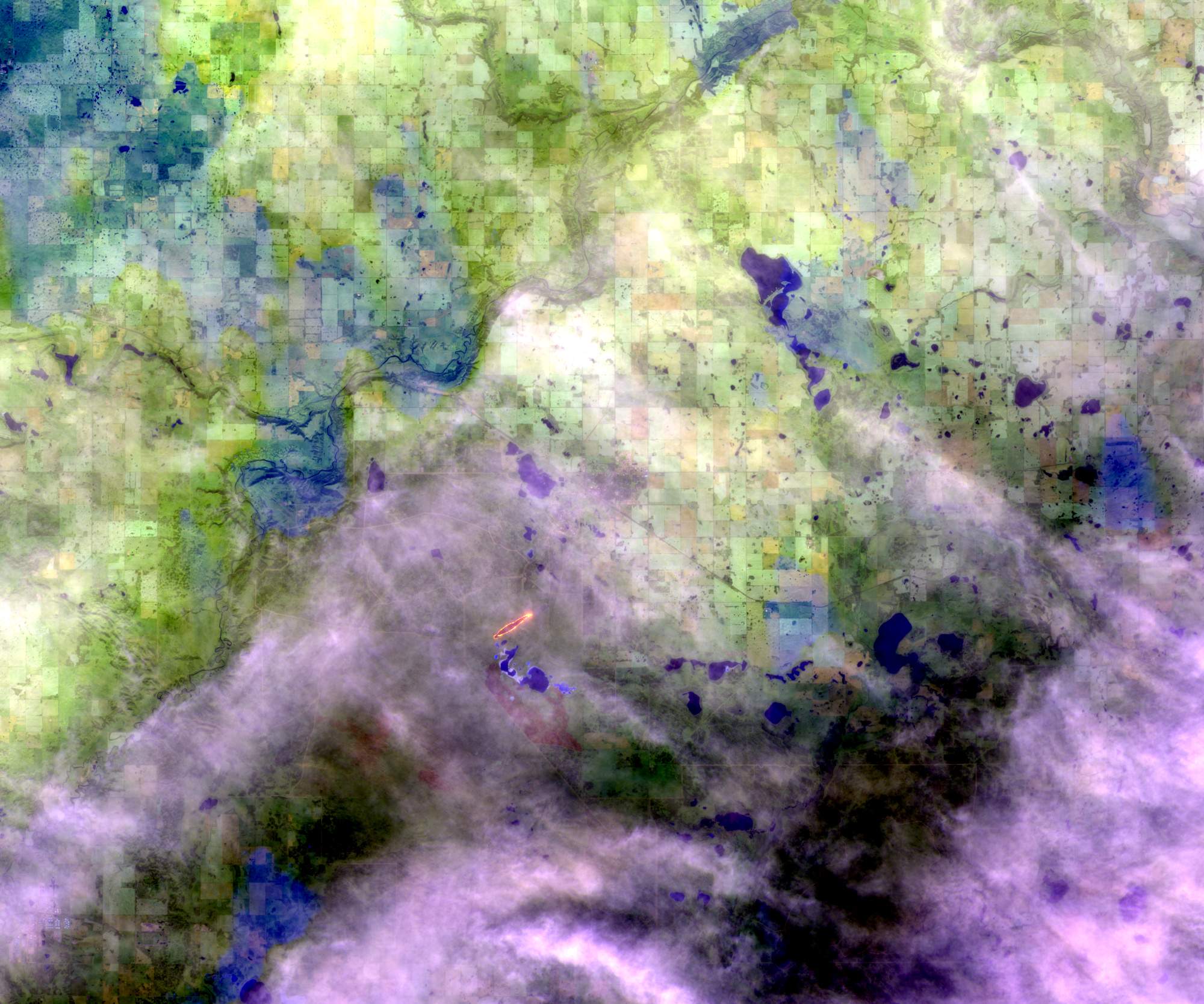
U.S. Earth-observation satellite Landsat 8 showed active fire at 12:17 p.m., stretching roughly two kilometres in length across the grasslands, with scorched ground already visible behind the flames.
Using the co-ordinates of satellite-detected hotspots recorded in NASA’s Fire Information for Resource Management System (FIRMS), Beverly estimates the blaze covered roughly 48 hectares — equivalent to about 50 football stadiums, including their surrounding grounds.
The military did not respond to questions about whether it agreed with that estimate.
“A one hectare fire is getting to be problematic… so imagine 50 of those,” Beverly said.
“I was quite surprised that anybody would have been working within several kilometres of an active fire knowing that a cold front was coming and there were wind warnings.”
And those winds were already gathering strength.
An 'unexpected and sudden wind change'
The military has described a fire that suddenly intensified as powerful winds swept through the base, overtaking soldiers around 4 p.m. An internal memo obtained by Global News later attributed the rapid spread to an “unexpected and sudden wind change.”
But satellite and weather records suggest the conditions were deteriorating well before then.
At the base airfield, about 15 kilometres from the fire, sustained winds doubled from 15 to 30 kilometres per hour between 1 p.m. and 2 p.m., according to Environment Canada records.

At 2:49 p.m., the U.S. weather satellite NOAA-20 passed overhead and detected heat beyond the earlier fire locations, suggesting the blaze may have been spreading outward.
Based on satellite hotspot data, Beverly estimates the fire had nearly tripled in size, to about 140 hectares, describing it as a “problem fire growing in size.”
Flannigan agrees, noting low humidity and dry grass: “I’d say it was quite active. By two o’clock that fire was running.”
By 3 p.m., temperatures had climbed above 23 C and humidity had fallen below the temperature – a term in fire science known as “crossover” fire conditions. Within an hour, temperatures plunged more than 10 degrees, according to Environment Canada records.
Then the weather began to turn.

At 3:10 p.m., another U.S. weather satellite, GOES-18, which monitors western North America at 10-minute intervals, recorded about 76 megawatts of fire radiative power — a measure of the energy emitted by the blaze. Twenty minutes later, satellite readings showed the fire’s radiative power had surged almost sixteenfold to 1,215 megawatts — before falling sharply over the next 10 minutes.
The readings indicate a major escalation in fire activity as a cold front reached the training grounds, Flannigan said, about 30 minutes before the military said the fire reached soldiers.

As the cold front swept through, Environment Canada recorded an 82-kilometre-per-hour wind gust at the CFB Wainwright airfield at 3:16 p.m. Temperatures plunged more than 10 degrees within the hour.
Beverly described the sudden change in fire behaviour as a textbook example of what happens when a cold front moves across an established blaze.
“This is a well-known pattern,” she said, adding that she teaches it to the students in her undergraduate course.
For soldiers caught in its path, the speed and intensity of the flames could have left little time to escape.
The fire travelled a kilometre 'in 30 to 60 seconds'
Both the military and Prime Minister Mark Carney have described the fire travelling roughly a kilometre in under a minute, from where it had been burning on the training grounds to soldiers conducting exercises.
Rutland put the time at 30 to 60 seconds, citing a commander on the ground — equivalent to 60 to 120 kilometres per hour if the flames travelled the full distance. However, he acknowledged the fire may have already spread unseen through the terrain, something the investigation would seek to establish.
Three wildfire experts cautioned that estimates made in the chaos of a rapidly advancing fire, particularly one involving serious injuries and loss of life, may understandably be imprecise.
But they also said the reported speed would be extraordinary.
Marty Alexander, one of Canada’s most experienced wildfire researchers, developed a widely used rule of thumb suggesting spread rates of roughly 20 per cent of sustained wind speed under critical burning conditions. His research documented a fire in Wangary, Australia, that spread at 17 kilometres per hour — the fastest he was aware of.
“A grass fire rate of spread of more than 60 kilometres per hour is very highly improbable,” he told Global.

Researcher Cordy Tymstra said the fastest documented Canadian grass fire he knew of, a fire in Granum, southern Alberta in 1997, averaged 14.7 to 16.8 kilometres per hour — far below the military’s Wainwright estimate.
However, three experts Global spoke to said spotting could have driven the rapid spread, as wind-blown embers ignite new fires ahead of the main blaze.
But they also said whether the fire travelled a kilometre in one minute or several, soldiers caught in its path would have had little chance of escape.
The greater danger, they said, was the forecast wind shift, which could turn the long flank of an established fire into a rapidly advancing front, sending flames racing in a different direction.
All the experts whom Global consulted said it was well understood that a wind shift can intensify an established fire.
“If a two-kilometre fire turns into a two-kilometre fire front, you can’t go sideways,” says Flannigan.
“You can only go directly away from it. But given the speed it was travelling and the terrain, most people couldn’t outrun it.”
The incident was 'entirely anomalous'
The base’s standing orders identify August through October as a high-risk fire period and advise units to plan live-fire exercises in the early morning, when fire danger is generally lower.
The orders also prohibit tracer ammunition, pyrotechnics and white phosphorus during extreme fire danger, but do not specifically list automatic grenade launchers or high-explosive grenades in those fire-hazard restrictions.
Asked about the orders, Rutland described them as a “guideline,” saying commanders must assess multiple factors before deciding whether to proceed with shooting and that soldiers train in all conditions.
It’s commonly known that fires are a recurring hazard at CFB Wainwright, as they are at military bases where live ammunition can ignite dry vegetation. The military also conducts controlled fires in spring to reduce the grass and other material that could fuel future outbreaks. But these too can escape in strong winds.

A 2026 scientific study, in collaboration with the Department of National Defence (DND) and CFB Wainwright, examined an April 2024 prescribed burn at Wainwright that escaped its intended boundaries under strong winds and eventually burned approximately 600 hectares.
In 2017, another military grass fire at CFB Suffield burned approximately 36,000 hectares during strong winds, prompting the military to pledge improvements to its fire-prevention procedures.
It found that half of hazardous incidents at the sites examined had not been investigated and warned that safety risks could be accepted without appropriate authorization or senior management awareness.
The audit did not establish whether those failures occurred specifically at Wainwright.
But two weeks after the disaster, lingering questions remain.
DND did confirm, however, that it has made no changes to safety measures since the tragedy and that its Board of Inquiry has yet to be formally convened, although it expects that to happen “in the near future.”
Other agencies have also been reluctant to release information. Environment Canada initially declined to confirm the timing of weather warnings and recorded wind gusts in response to media questions, but later answered after repeated questions.
Wildfire researchers say the tragedy should prompt a closer examination of how the military assesses fire risks, communicates warnings and trains personnel to respond to changing conditions.
“From a fire science perspective it was predictable, and there should have been information flows and procedures in place to ensure that the fire behaviour was understood by those interacting with fire or working near fire on the base,” said Beverly.
Rutland has said the military’s investigation will be made public, with changes to follow where necessary.
“Where they find our procedures, our training, our equipment, or our policies must change, they will change,” he said.



The army is desperately trying to cover it’s collective derrieres . Probably some officers will face court Marshall’s. 🙄
Folks, face it, we will never know the truth to this. Or many other things about this Liberal regime.
The regime has become very very adept at covering its ass. It walks a fine line. Most folks are not fooled. We can see the forest for the flames and trees all too well. The cover up was far too swift and complete and went right up to Heir Carney right away. His face was plastered all over within hours, verifying the story of the commanders.
The injuries sustained are consistent with a blast of some sort.
Fires covering miles in freak times, wind or not, does not cut it. I was a firefighter in my young years, it just does not compute.
This is brass ass covering brass ass. Nothing more and its disgusting.
They have turned the injured and dead into nothings, fodder, mere casualties of war.
And where is Heir carney? Once again winging trough the air safe and sound in luxury as he heads to the Caribbean, from Turkey and elsewhere. Once again thumbing his fascist nose at Canada and Canadians as we endure the highest cost of living in Canadian history. Poverty flourishes, starvation and diction. GDP growth non existent, industry being ham strung and attacked by incompetent, lying ministers.
Yeah this country is in great shape.
Carney army cover up
Too bad that the soldiers suffered the consequences of their leaders’ lack of intelligence. Also not surprising that those responsible are trying to dodge the blame. A firing squad is appropriate for the idiot who decided that the fire wasn’t a problem.
The main problem is that after years of pi$$ poor forecasting, few people believe what comes from Environment Canada. Started when they stopped using real live metrologists and only use their models to predict and forecast.
I am not sure WHY the media keeps upsetting people by continuing something that will NOT change what happened and only make it all worse for all those affected by this incident. Leave it alone and let those individuals that are now fighting for their lives and others who are healing let them do it in peace. Geeze, media….do you all EVER think of who you are harming by what you say and do?
Now we get to watch the institution protect itself.
I, for one, am thankful people are asking questions. Good work, Global.
When procedures override common sense…
When bureaucrats are promoted instead of leaders…
…you get institutional failure.
Nothing about this makes any sense.
Where was the Base Fire Chief and the Deputy. They would have told the Army not to conduct training in the area. That the Army would listen. How do I know this,as a Deputy fire chief another Army base, it’s it is always a fight not to use live fire when conditions are not favorable.
I am not in Wainright and was aware of the gusty wind forecasts despite that fact. The injuries and deaths are very regrettable, but the explanations given primarily by the military have made it difficult to understand how events led up to this. Thank you to Global for publishing a far more detailed and believable account of this, and it didn’t “take them a year”. Given the information available, it is difficult to believe that this event was not preventable.
J – Everyone in central Alberta who had a weather app on their phone that day knew there was a high risk for strong, damaging winds. We had them in the Edmonton area a while before they reached Wainwright.
It’s okay to question the military’s account when it is inconsistent with known facts and data.
Something has been not adding up from the details being given of this incident right from the beginning. Smells like something is not being disclosed.
Mel – nobody is discounting that. The question is, given Enviornment Canada’s repeated warnings of strong winds and the extreme fire conditions on the ground – why did nobody think to move the soldiers next to an active grass fire that was already well over 100 hectares in size.
This is typical of all government mouth pieces, lies and misinformation. Zero accountability as usual.
I disagree with this story greatly. Trying to place blame and make it seem like everyone should’ve known. Tell me how many other wildfires have happened at military base training in recent years? Anyone?
I luve in Wainwright, I walked by dog shortly before 3 and it was barely breezy and within 20 to 25 minutes of us returning home stuff was flying around our yard because the wind had come up hard and fast, so I definitely believe that the wind caused that fire to act in an unexpected wat.
To everyone saying “you can’t predict these wind changes and speeds” what are you talking about? They were literally predicted by Enviornment Canada 24 hours before the incident occurred. Two hours before the soldiers were overrun Environment Canada issues a wind warning – explicitly stating that wind speeds up to 100 km/hr gusts were imminent.
How much more warning would one need to think having the soldiers nearby an active grass fire might be a bad idea?
It’s okay to question the military’s account. You’re not harming the fallen. In fact, it would be dishonourable to the fallen to accept everything verbatim while ignoring the obvious inconsistencies in the military’s account.
There’s a reason that the military is no longer allowed to investigate certain crimes. Rank carries more weight than truth, this type of situation happens every day. WSO’s and BSO’s are routinely ignored without consequences.
Jim Smith – it’s been two weeks and the investigation hasn’t even begun. When is it okay to start asking questions, especially when the military’s account doesn’t match both the data we already have and the wildfire experts description of how wildfires behave.
The fire had been burning for hours nearby the soldiers and the wind forecasts existed for hours before hand. EC issues a wind warning hours before the incident. The soldiers should have been moved immediately.
The official story sounded fishy from the beginning. It definitely seems like those with authority weren’t properly monitoring the situation. Hopefully the truth comes out at some point and changes are made so this sort of thing doesn’t happen in the future.
@David Best
Not looking to blame anybody. I’m looking for ACCOUNTABILITY!
Someone was derelict in their duty and people died and where injured severely.
Yes, blame needs to be levied and those guilty need to be charged.
So sensational. I trust the accuracy and accounts given by those on the ground not the mathematical predictions of the “weather forecast”. As for size fire data, that has only just come to light, so why would an infantry unit on the ground have access to that data in real time? Common sense here it’s clear they are not fire experts, a fire started, it’s risk was clearly miscalculated and the winds picked up. It was an accident, we cannot stop training an Army because it’s “dangerous” it’s an Army. They need the best training possible so that when they are asked to run towards gun fire and people and robots that want to kill them they do it with the best training.
A tragic accident. You can’t predict the weather changing so drastically and blowing back towards foot soldiers. For those looking for blame give ot a rest. The investigation will show everything with time.
Why is it folks dont want the truth to come out? Why is it folks dont want the military to come clean? Are we picking on them? Poor babies. If they are lying and covering brass ass, it needs to be rooted out, the truth come forward or the people who died and were injured are nothing.
This country has become so jaded and pussified.
Why does this article seemingly purposefully imply that the military is hiding something by declining to comment on unknowns until an official investigation is completed?
Trust me, I have plenty of critiques of our military (as is all of our rights within a healthy democracy). I have some serious questions about why our soldiers were out with live ammunition for a run-of-the-mill training exercise during such a risky situation. But the focus of our attention right now should be on the victims and their families, not on sowing conspiracies about some grand military cover-up.
It’s being investigated. As it should be. I expect there will be some fallout, including changes to protocol (as there should be). But a news organization calling in a bunch of experts ad-hoc to make declarations about what happened is very different than an official investigation into the conditions, factors, and decisions made in the wake of a tragedy. It strikes me as dishonest and conspiratorial for a news agency to repeatedly drill home that the military “declined to comment” as if that is proof that they are clearly hiding something mere days after dozens of people were killed and injured.
I urge fellow readers to have a bit of media literacy here. In the online environment, news organizations thrive by inflaming public dissent to get more clicks.
My heart goes out to all those affected ❤️
Perhaps the person responsible for monitoring this was a DEI recruit and was busy in the men’s room changing their tampon when all of this happened
What does the Commanding Officer of CFB Wainwright have to say about this tragedy? Why were fire hazard protocols not followed?
With some of them suffering 70% burns I have to wonder what they were wearing