


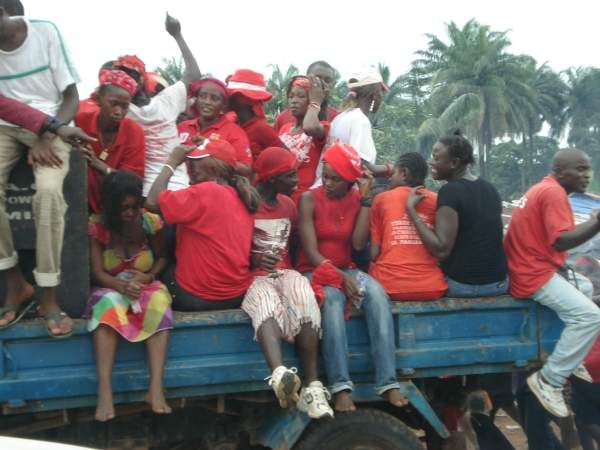
The sound is ear piercing. You can hear them coming before you see them. They are blowing as hard as they can into whistles and yelling at the top of their lungs.

Finally, around the corner comes a group of perhaps two dozen motorbikes. The riders and passengers are wearing red, some head to toe. A red cape, like Superman, streams out behind one young man. They screech to a halt and join what can only be described as a party in the street.
A car has been parked across the road, its windows and doors opened and its stereo blasting. All of this is part of a political rally in Sierra Leone. The ruling party’s leader has been officially nominated, so for these supporters, it is major cause for celebration. Celebrations like these are going on all across the city and some parts of the country.
In Freetown, thousands are converging on the APC’s (All People’s Congress, led by Ernest Bai Koroma) headquarters. It is a sea of red. They are dancing. They are yelling. They are nothing if not passionate about their cause.
Traffic grinds to a halt in the city, as does much of business. Politics has taken over. A similar scene was played out a few days earlier, but that time, everyone involved was wearing green, the colour of the main opposition party, SLPP (Sierra Leone People’s Party, led by Julius Maada Bio). There have also been several, smaller such rallies for the various parties vying for leadership (there are 10 in all).

Get breaking National news
Election “season” has taken hold of the country. You see articles about little else in the newspapers. Almost every radio show is talking politics, and the TV station SLBC (Sierra Leone Broadcasting Corporation) has added new shows dedicated to election coverage.
When Sierra Leoneans take to the polls November 17th, it will be their third democratic election since the end of the devastating civil war in 2002. There is a sense of excitement in Sierra Leone for these elections, but there is also concern that there could be corruption or even violence.
There are all kinds of public service announcements calling for calm during the campaign. Many people saying much of the responsibility lies with the politicians and the kind of message they give to their supporters.
There’s also a certain amount of cynicism. The term “watermelon politics” comes up time and again, though with two slightly different interpretations. A watermelon is green on the outside and red on the inside, and the two main parties’ colours are green and red.
So some are using the term to talk about those supporters who come out to the rallies, saying one day they will rally for one of the parties, then the next day vote for the other one. Some also use it to mean it’s all the same in the end, whether it’s green or red.



A group of young people though Artists United for Children and Youth Development is hoping to have an impact on the success of the elections through a music video encouraging Sierra Leoneans to participate and have peaceful elections, which has been played over and over on television.
It follows a young girl through all different areas, carrying a box which says simply “vote.” The video’s singer/songwriter Mohamed Samba Kamara (known in Sierra Leone as “Luxonjay”) says they feel it is really making a difference, that more and more people have registered to vote.
It really targets young adults in particular, he explains, “This video is there to make them understand that politics not about fighting. It’s about dialogue. It is about putting issues on the floor making sure that people vote on issues, not on tribes, not on region, not on religion, not on political colours – but political ideologies you believe in. It’s not about fighting, it’s not about bloodshed – it’s about issues that affect the ordinary lives of Sierra Leoneans.”
He speaks to the concern here that much of the voting is done based on tribe, religion, and loyalty rather than issues, so that is a major challenge and one the media can take part in. It is part of their job to push the agenda and focus on issues. The difficulty is fair and balanced coverage.
Many, but not all, of the newspapers do nothing to hide their political bias, and are pretty much outright in who they support. In such papers’ “news” articles – which should be neutral and are not labelled as commentary or opinion pieces – are extremely slanted.
However, among some media, there is an obvious effort to provide unbiased reporting and the sheer quantity of coverage the election is getting is heartening.
Christina is a Global National correspondent based in Toronto, and recently spent a few weeks reporting from Freetown. Follow her on Twitter: @StevensGlobal.


Comments
Want to discuss? Please read our Commenting Policy first.