


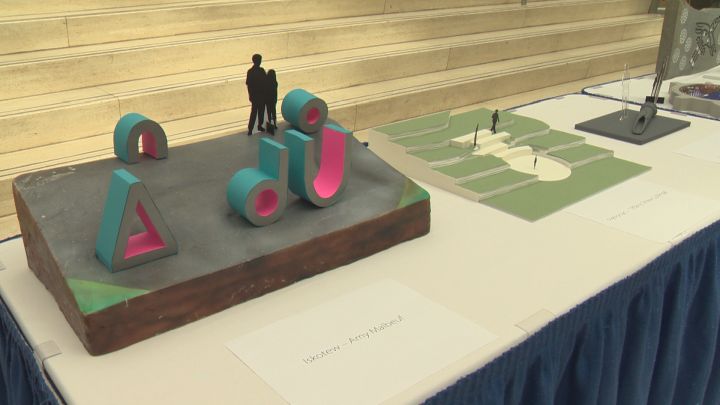
EDMONTON – Artwork symbolizing Edmonton’s Indigenous history was unveiled Tuesday.

Mayor Don Iveson, Confederacy of Treaty Six First Nations Grand Chief Tony Alexis and Metis Nation of Alberta president Audrey Poitras were on hand to reveal the six artworks, which will be displayed in the Indigenous Art Park at the Queen Elizabeth Park.
“For centuries, the banks of the North Saskatchewan River have been a place of gathering and commerce,” Iveson said.
“The Indigenous Art Park is an extension of that gathering place by enabling new relationships and renewing existing ties built around reconciliation and the recognition of our Indigenous community.”
READ MORE: City of Edmonton releases phase 2 design of Queen Elizabeth Park

Get daily National news
The artists are Mary Anne Barkhouse, Marianne Nicholson, Jerry Whitehead, Duance Linklater, Amy Malbeauf and Tiffany Shaw-Collinge.
They were picked after a workshop in 2015 with Elders, Indigenous knowledge holders, Confederacy of Treaty Six First Nations, the Metis Nation of Alberta and other Indigenous residents.
_848x480_1397405763961.jpg?h=article-hero-560-keepratio&w=article-hero-small-keepratio&crop=1&quality=70&strip=all)

“We want the Indigenous Art Park to not only showcase a diversity of exciting art and serve as a community gathering place, but also to ensure the works within are relevant and meaningful to the landscape and to Edmonton,” Edmonton Arts Council Public Art Director Katherine Kerr said.
READ MORE: Queen Elizabeth Park Road re-opens ahead of schedule
Queen Elizabeth Park is located in Edmonton’s North Saskatchewan River Valley, which was approved as part of the Queen Elizabeth Park Master Plan in August 2013.
The site is considered to have spiritual power by elders. First Nations people and traders met in the area for generations to rest, share stories and trade goods.
“The profound legacy left by our Kohkominawak (our grandmothers) and Kimosominawak (our grandfathers) is one of the sacred areas used to cross Kisiskacewansipi (Saskatchewan River), where many ceremonies and rituals took place before crossing this majestic sanctuary,” Elder Jerry Saddleback said.
The Indigenous Art Park is scheduled to open in fall 2018.


Comments
Want to discuss? Please read our Commenting Policy first.