



How comfortable would you be with a stranger touching your neck?

A new study involving 1,368 men and women from five different countries concluded that the closer someone is in a social relationship, the larger body area the person was allowed to touch. The closer you are to someone, the more of your body you allow them to touch.
Though this may not seem like a surprise, the findings lead the study’s authors to conclude that social touching has evolved as a way of forming social relationships and are closely linked with emotional bonds.
“Our findings indicate that touching is an important means of maintaining social relationships,” said researcher Juulia Suvilehto from Aalto University. “The bodily maps of touch were closely associated with the pleasure caused by touching. The greater the pleasure caused by touching a specific area of the body, the more selectively we allow others to touch it.”
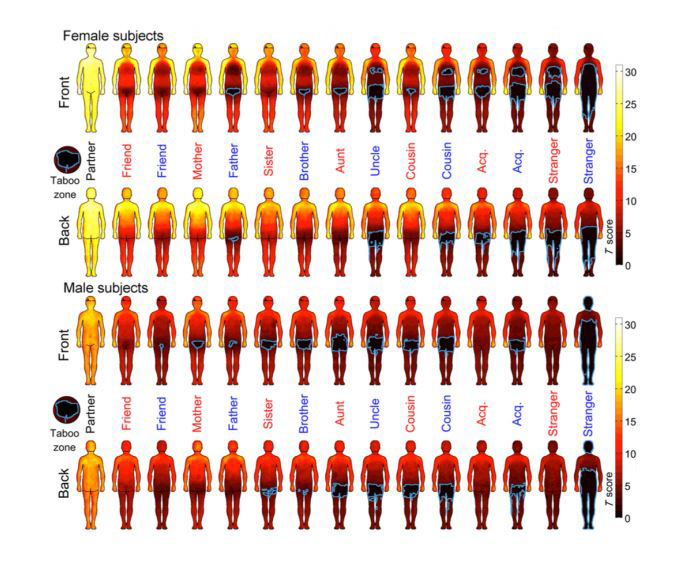
The online questionnaire asked participants to colour the areas of a human body where different members of their social network could touch them. The closer they were socially, the more they were allowed to touch.



Get breaking National news
“The results emphasise the importance of non-verbal communication in social relationships,” said Professor Lauri Nummenmaa. “Social relationships are important for well-being throughout peoples’ life, and their lack poses a significant psychological and somatic health risk. Our results help to understand the mechanisms related to maintaining social relationships and the associated disorders.”
Some of the findings concluded that British people are less comfortable with touching than people from other countries (Russia, Italy, France and Finland); Italians are less comfortable with touching than the Russians; overall the Finns were the most comfortable with being touched.
However, regardless of the nationality and the differences between them, the results indicated that the closer the social relationship, the more at ease a person was with touching.
The study was published in the Proceedings of the National Academy of Sciences.


Comments