

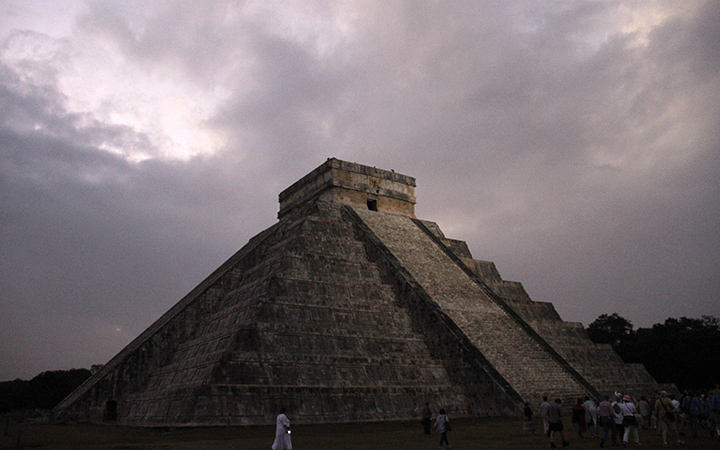
MEXICO CITY – Mexican experts have discovered that the main pyramid at Mexico’s Mayan ruins of Chichen Itza was at least partially built atop a subterranean river.

Experts from Mexico’s National Autonomous University say they found a subterranean cavity about 20 metres (yards) deep below the pyramid of Kukulkan, also known as El Castillo.
Geophysics expert Rene Chavez said Thursday the underground river chamber is naturally covered by rock.
Such underground rivers often connect the open “cenotes,” or sinkhole lakes, that dot Mexico’s Yucatan peninsula.

Get breaking National news
READ MORE: Tired of blood-dripping deities, Mexico museum exhibits nicer, ‘artistic’ Aztec god
The discovery was made using a kind electrical resistance survey, not by excavating. Chavez said one corner of the pyramid rested on the underground chamber, so it was in danger of collapsing.
Archaeologist Guillermo de Anda said the discovery was important.
De Anda, who did not participate in the study, said it may confirm that the Mayas included symbolic maps of their cosmology in their temples and sacred sites. The cenotes that surround the pyramid could represent the four points of the compass. The river at the centre might represent the centre of the Maya’s universe, which they thought of as a tree with roots reaching below ground.
- Iran pushes for war’s end but Trump says it hasn’t ‘paid a big enough price’
- Carney to take part in European summit on security, trade
- Video of NYC police killing machete-wielding man at Grand Central station released
- Carney’s trip to Armenia happening as Ottawa’s foreign policy aims shift, expert says


Also Thursday, the National Institute of Anthropology and History said research at another Mayan site, Uxmal, found an usually high number of medicinal plants growing nearing the structure known as the governor’s palace.
Uxmal site director Jose Huchim Herrera said the concentration of such plants was so much higher in the sacred area than in surrounding fields, that it indicates the Mayas planted them there intentionally as a sort of medicinal garden. The site has about 150 species used to treat snake bites, stomach infections and fevers.


Comments
Want to discuss? Please read our Commenting Policy first.