

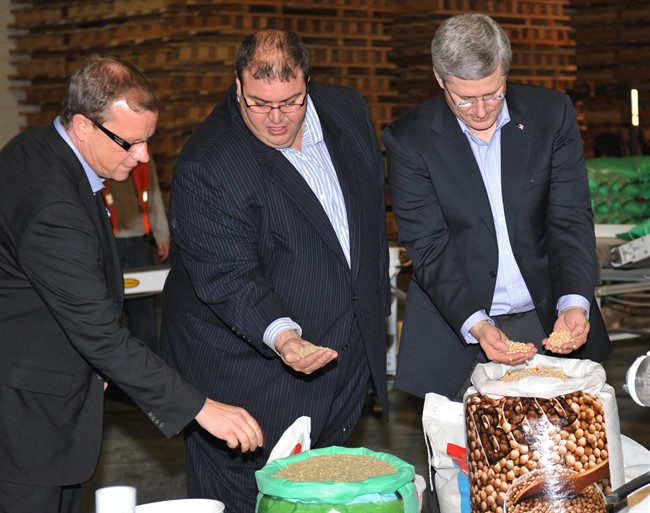
REGINA – Prime Minister Stephen Harper stood in a pulse processing plant in Regina and warned that it’s time for the Canadian Wheat Board to realize the end is near for its marketing monopoly.

Harper said legislation will be introduced “very shortly,” likely when Parliament returns from its break week, that will allow farmers to sell grain to whomever they choose.
“And let me be very clear, not only will the legislation come forward, it will be passed very soon,” said Harper.
“We will have dual-marketing in August for the next crop year and the reason I emphasize these points is this is a historic change that has been long overdue.
“It’s time for the wheat board and others who have been standing in the way to realize that this train is barrelling down a Prairie track. You’re much better to get on it than to lie on the tracks because this is going ahead.
“It’s time for the wheat board to go out in a dual-marketing environment, to cultivate its customers and to provide a competitive service because those customers are going to have choice in the future.”
Prairies farmers have had to sell their wheat and barley to the board since the 1940s, when producers banded together to get better prices. The board, in turn, exports the grain to foreign markets.

Get weekly money news
Board supporters contend the monopoly gives farmers stability and keeps them from competing against one another at lower prices. But opponents argue the monopoly is unfair and restricts farmers from marketing their grain to the highest bidder.


The Conservative government has long promised to end the board’s monopoly.
Friday’s announcement of a new $50 million pasta processing facility for Regina was eyeing that promise.
Murad Al-Katib, CEO of Alliance Grain Traders Inc. (TSX:AGT), announced plans to build the new durum wheat and pulse milling facility. The move is based on “the new economic opportunities created by the government’s commitment to end the single-desk wheat marketing system.”
The new plant is expected to generate 150 construction jobs and 60 full-time jobs when completed by mid-2012.
The Western Barley Growers Association and the Grain Growers of Canada welcomed the news.
“Ending the Canadian Wheat Board’s monopoly is clearly sending a signal that Canada is open for business,” Stephen Vandervalk, president of the Grain Growers of Canada, said in a news release.


But board supporters objected to the suggestion that the plant could only be built if the marketing change is made. The National Farmers Union and Canadian Wheat Board Alliance held a small protest outside the announcement Friday.
“It’s perfectly possible to have a pasta plant whether the CWB is there or not,” said union president Terry Boehm.
“Unless, of course, you’re building a plant with the assumption that when the CWB is gone that you’ll be able to access durum cheaper than you could have through the Canadian Wheat Board, which means less money for farmers.”
The Canadian Wheat Board Alliance also noted that several years ago another group developed a business plan for more pasta plants on the Prairies. But they couldn’t get financing because the economics of processing durum wheat into pasta favours plants closer to major population areas.
Harper said there are advantages and disadvantages to doing this kind of business in the region.
“But one big disadvantage has been the single desk … and that’s why we’ve not had, one of the reasons we’ve not had, this kind of secondary processing,” said Harper.
“I think the fact that Murad and the business community is making this investment tells you that the change we’re making is a significant change to the business environment for secondary food processing in this part of the country and I think it’s a great development.”
Comments