

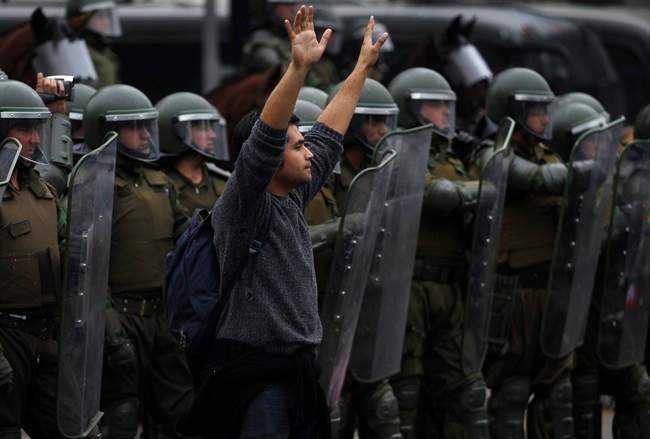
SANTIAGO, Chile – After three months of mass protests that provoked a sharp drop in his popularity, Chilean President Sebastian Pinera agreed Friday to negotiate with students and teachers demanding more state funding for education and profound changes in government.

Pinera, who leads Chile’s centre-right political coalition, made the call for dialogue as people recovered from a two-day nationwide strike called by the country’s largest union organization. As students, teachers and pot-banging families around the country joined in, the strike turned into a huge protest against his 18-month old government.
Most marchers were peaceful but scattered violence marred the protests, and a 16-year-old boy was shot to death early Friday, allegedly by a police bullet, as officers responded to looting and riots. Nearly 1,400 people were arrested nationwide, and more than 200 police and civilians were injured.
“After more than three months in which we’ve seen violence and conflict flourish, now is the time for peace, the time for unity, the time for dialogue, the time for agreements,” Pinera said.
He took care to invite representatives of all the sectors involved – students, teachers, parents, professors and those who run the nation’s schools and universities – and say that education reform talks should take place in the presidential palace as well as Congress.

Get daily National news
That represents an about-face for Pinera, who had avoided talking directly with protesting students or openly considering their demands before sending his 21-point package of education proposals to Congress.
The students had their own list when they began taking over high schools and universities three months ago, from more state funding to better teacher training, and a guarantee of free quality education to all Chileans. But their demands grew to include a new constitution to replace the top-down political system dictated by Gen. Augusto Pinochet’s regime, and popular referendums to give Chileans a direct voice in their democracy.


Union organizers of the nationwide strike added their own list, including major changes to pensions, health care and the labour code.
Camilo Ballesteros, student president at the University of Santiago, praised Pinera’s overture.
The student leader at the University of Concepcion, Guillermo Petersen, credited the movement’s pressure for changing the president’s mind, but said it remains to be seen how willing Pinera will be to make real concessions.
Students planned to decide this weekend how to respond. The presidents of Chile’s House and Senate, representing leftist and rightist parties, had offered to sponsor negotiations, but Pinera and the students were both leery of participating.
Neighbors blamed the death of Manuel Gutierrez on police gunfire. Deputy Interior Minister Rodrigo Ubilla suggested the boy may have died while confronting police, and said the case should be clarified quickly.
Union members estimated that 600,000 people participated in Thursday’s marches nationwide. Police offered no nationwide numbers, but estimated far lower crowds in Santiago. What is clear is that some isolated student boycotts have grown to become Chile’s largest mass movement since democracy was reestablished in 1991.


Comments
Want to discuss? Please read our Commenting Policy first.