


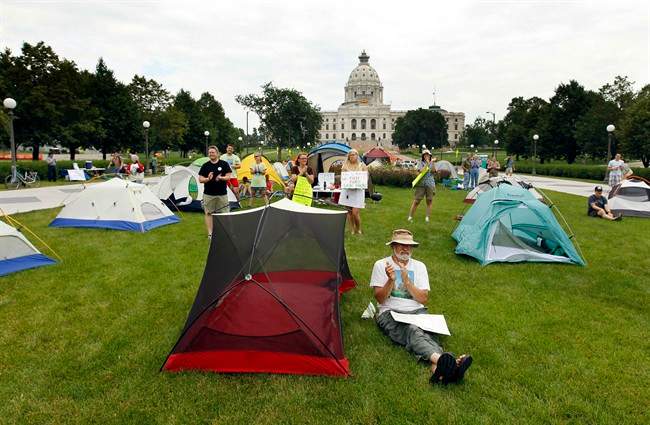
ST. PAUL, Minn. – Instead of sending Minnesota’s elected leaders into a frenzy of activity, the nation’s only state government shutdown has deepened the political paralysis that led them to their budget standoff. Top Democrats and Republicans have given no sign when they will talk again about how to resolve the stalemate.

After blowing May and June deadlines to agree on a budget, Democratic Gov. Mark Dayton and Republican legislative leaders have met only twice – once for less than 30 minutes – and have made no apparent progress since most of state government closed July 1. There’s little sense of urgency, even with 22,000 state employees idled, 100 road projects stopped, 66 state parks barricaded, an assortment of services discontinued and the state’s top credit rating tarnished.
The lack of action contrasts with what’s been happening in Washington, where an Aug. 2 deadline to raise the nation’s debt ceiling has lawmakers scrambling for a deal that would keep the U.S. from a potential default on its debt. President Barack Obama has summoned leaders for a rare weekend negotiating session at the White House and aides are trading proposals behind the scenes.
While the consequences of the state’s inaction hardly reach that scale, that’s little consolation for public workers who won’t be getting paychecks or people with disabilities who have lost social services.
“My thoughts would just be to encourage them to continue to meet and talk and try to work on a compromise that will benefit the entire state of Minnesota,” said Mary Nienow, who directs a child care advocacy organization, Child Care Works. She said her group is getting dozens of emails a day from families worried that they will lose their child care assistance.

Get breaking National news
The key players had one brief session at midweek that ended with the two sides accusing each other of taking a step backward. Speaking to reporters after each session, they have said nothing that suggests progress.
“Sometimes no news is good news, but in this case I’m not sure,” said former Minnesota House Minority Leader Marty Seifert, who represented Republicans in budget talks from 2007 until 2009. “In this case, no news is no news because it means there probably is nothing to report and it means nothing is going on.”
He added: “Really, I’m not sure that it’s any different than where they were on Jan. 8. It must be an incredible sense of frustration on both sides, and the general public is rather frustrated, too.”
The courts have taken some of the worst sting out of the shutdown. Decisions by a judge and a special master have restored services like special education payments to schools, state aid for training for the blind, and emergency crisis aid for the poor. More such rulings are likely on the way.
But some groups’ requests have been rejected, so the shutdown means continuing pain for them. Arc Minnesota, a St. Paul non-profit that helps people with disabilities, has suspended 90 per cent of a housing service since losing its state funding. The program helped more than 200 people, including some who were homeless and others who were institutionalized, find their own housing in the past 18 months.
“We really worry about what those people will do,” CEO Pat Mellenthin said.
The shutdown’s effects are wide-ranging. It has closed historical sites and rest stops, shut down the state lottery, made it tougher to get a driver’s license and halted the issuance of hunting and fishing licenses.


Much of the political dispute comes down to differences over how much to spend on health programs and social services and how to pay for it.
Republicans want to eliminate a $5 billion deficit by cutting projected spending and holding the two-year state budget to $34 billion, the amount projected to come in without new revenue.
But the state’s budget is being squeezed as enrolment and costs for public schools and health care programs grow and as the state, like others, copes with the loss of federal stimulus dollars. Dayton wants to soften cuts by raising another $1.4 billion; his latest offer relies on either a temporary income tax increase on top earners or higher cigarette taxes. House Speaker Kurt Zellers and Senate Majority Leader Amy Koch have rejected both options.
Both sides are dug in. Each says it’s up to the other to move.
In 2005, a more limited partial government shutdown ended after eight days when lawmakers and then-Gov. Tim Pawlenty, now a presidential candidate, agreed on a 75-cents-a-pack cigarette charge they called a “health impact fee.” During that shutdown, leaders of a divided Legislature met frequently and traded substantive offers. Back then, the leaders and Pawlenty’s chief of staff spent part of a Fourth of July weekend in talks; this year, the weekend was a long cooling-off period.
It appears that a solution this year will require some form of new revenue, just as 2005 did.
Dayton has more room to operate than Koch and Zellers, who have to line up votes from a caucus that includes a new, powerful faction of lawmakers dead-set against spending increases and others who hope for a quick way out of the shutdown.
“If they make a deal and they don’t have the votes to pass it, that’s a difficult position to be in, obviously,” said Rep. Kurt Daudt, a first-term Republican who opposes tax increases and gambling.


Comments
Want to discuss? Please read our Commenting Policy first.