


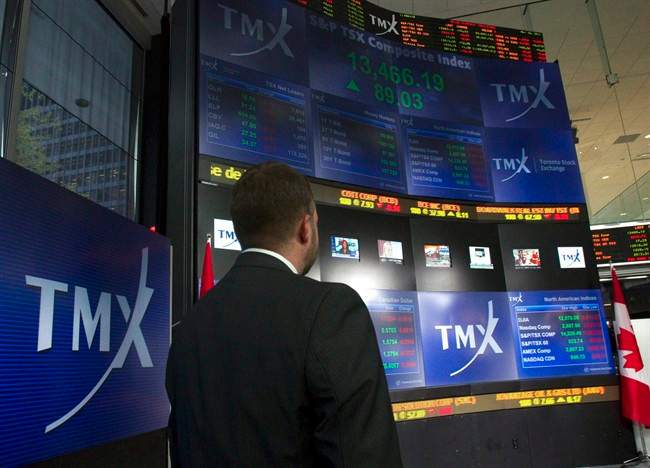
TORONTO – The group that operates the Toronto Stock Exchange has killed a $3.7-billion proposed merger with the London Stock Exchange Group, saying the controversial deal could not garner enough shareholder support to go ahead.

TMX Group (TSX:X) said Wednesday that a majority of proxy votes sent in ahead of its Thursday annual meeting supported the merger but it was “clear” the proposal could not achieve the required two-thirds support from all shareholders.
TMX Group CEO Tom Kloet said the company will now review a rival bid by Maple Group Acquisition Corp, a group of 13 Canadian banks and pension funds.
“The TMX Group management and board believe that the TMX-LSE Group merger would accelerate our business strategy and create shareholder value, while enhancing the performance of Canada’s capital markets,” Kloet said in a statement Thursday.
“Although we will not join forces with LSE Group, our business is strong and I have enormous confidence in the continued success of our company.”
TMX will pay a $10 million termination fee to the LSE (LSE:LSE), and a further $29 million if the acquisition with Maple goes through within 12 months. The company planned a conference call for media later in the day.
Get weekly money news
Proponents of both bids have been waging a media and speaking blitz to win support for their positions in recent weeks, the campaign pitting prominent Bay Street players against each other on either side.
The LSE merger had received the stamp of approval Monday from a group of 11 top Bay Street players, including former TSX chief executive Rowland Fleming, Caldwell Securities chairman and CEO Tom Caldwell, CI Financial (TSX:CIX) executive chairman Bill Holland and Raymond James chairman and chief executive Paul Allison.
The support of Holland was especially significant because independent mutual fund company CI Financial is one of TMX Group’s largest shareholders.
Meanwhile, investment guru Stephen Jarislowsky, who was one of the key forces in organizing support against the BHP Billiton hostile takeover offer for Potash Corp., had thrown his support behind Maple, saying Toronto does not need the help of London to build a global player in the stock trading business.
- Alberta tweaks carbon capture incentive program to allow grants during construction
- ‘Cash is king’: Why money is a popular holiday present for many Canadians
- Rancher says Alberta well cleanup fund a positive step — but litany of concerns remain
- What makes the Anthropic IPO so significant, and what is the ‘god share’?


Earlier Wednesday, NDP Industry critic Peter Julian said the deal as was, wasn’t good for Canada, saying there was a need for vigilant oversight to remain in Canada, and noting that London would have had a majority on the board of directors of the combined exchanges.
“There is no other way to put it, it is a takeover of our capital markets,” which he said should be regarded as a national strategic asset.
Under the proposed deal, LSE shareholders would have owned 55 per cent of the combined exchange, while TMX Group shareholders would have owned 45.
The LSE had sweetened its bid in an attempt to lure investors to the all-shares deal, by offering a special dividend of $4 per share. The TMX also promised to continue to pay other dividends – replacing an earlier plan that would have seen TMX shareholders take a hit.
The Maple Group then increased its offer to $50 per share up from $48 – on the condition that shareholders of TMX Group reject the merger with the LSE.
Shares in TMX Group were up 89 cents or two per cent to $44.45 in midday trading on the Toronto Stock Exchange.


Comments
Want to discuss? Please read our Commenting Policy first.