

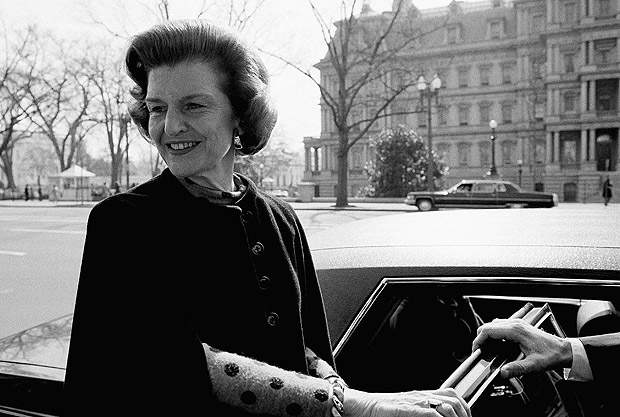
Betty Ford, the wife of the late President Gerald Ford, who overcame alcohol and prescription drug addictions and helped found a rehabilitation clinic that bears her name, died Friday at the age of 93. "She was a wonderful wife and mother; a great friend; and a courageous First Lady," former President George H.W. Bush said in a statement on Friday. "No one confronted life’s struggles with more fortitude or honesty, and as a result, we all learned from the challenges she faced." While her husband served as president, Betty Ford’s comments weren’t the kind of genteel, innocuous talk expected from a first lady, and a Republican one no less. Her unscripted comments sparked tempests in the press and dismayed President Ford’s advisers, who were trying to soothe the national psyche after Watergate. But to the scandal-scarred, Vietnam-wearied, hippie-rattled nation, Mrs. Ford’s openness was refreshing. According to Mrs. Ford, her young adult children probably had smoked marijuana – and if she were their age, she’d try it, too. She told the CBS television news magazine "60 Minutes" she wouldn’t be surprised to learn that her youngest, 18-year-old Susan, was in a sexual relationship (an embarrassed Susan issued a denial). She mused that living together before marriage might be wise; thought women should be drafted into the military if men were, and spoke up unapologetically for abortion rights, taking a position contrary to the president’s. "Having babies is a blessing, not a duty," Mrs. Ford said. Memorable quotes from Betty Ford, displayed in a word cloud In an era when cancer was discussed in hushed tones and mastectomy was still a taboo subject, the first lady shared the specifics of her breast cancer surgery. The publicity helped bring the disease into the open and inspired countless women to seek breast examinations. Her most painful revelation came 15 months after leaving the White House, when Mrs. Ford announced that she was entering treatment for a longtime addiction to painkillers and alcohol. It turned out the famously forthcoming first lady had been keeping a secret, even from herself. She used the unvarnished story of her own descent and recovery to crusade for better addiction treatment, especially for women. She co-founded the non-profit Betty Ford Center near the Fords’ home in Rancho Mirage, California, in 1982. Mrs. Ford raised millions of dollars for the centre, kept close watch over its operations, and regularly welcomed groups of new patients with a speech that started, "Hello, my name’s Betty Ford, and I’m an alcoholic and drug addict." Although most famous for a string of celebrity patients over the years – from Elizabeth Taylor and Johnny Cash to Lindsay Lohan – the centre keeps its rates relatively affordable and has served more than 90,000 people. Mrs. Ford was thrust into a role she found exhausting and unfulfilling: political housewife. While her husband campaigned for weeks at a time or worked late on Capitol Hill, she raised their four children: Michael, Jack, Steven and Susan. She arranged luncheons for congressional wives, helped with her husband’s campaigns, became a Cub Scout den mother, taught Sunday school. Mrs. Ford wrote of her sudden ascent to first lady: "It was like going to a party you’re terrified of, and finding out to your amazement that you’re having a good time." She was 56 when she moved into the White House, and looked more matronly than mod. Ever gracious, her chestnut hair carefully coifed into a soft bouffant, she tended to speak softly and slowly, even when taking a feminist stand. Her breast cancer diagnosis, coming less than two months after President Ford was whisked into office, may have helped disarm the clergymen, conservative activists and Southern politicians who were most inflamed by her loose comments. She was photographed recovering at Bethesda Naval Hospital, looking frail in her robe, and won praise for her grace and courage. "She seems to have just what it takes to make people feel at home in the world again," media critic Marshall McLuhan observed at the time. "Something about her makes us feel rooted and secure – a feeling we haven’t had in a while. And her cancer has been a catharsis for everybody." The public outpouring of support helped her embrace the power of her position. "I was somebody, the first lady," she wrote later. "When I spoke, people listened."



Comments
Want to discuss? Please read our Commenting Policy first.