

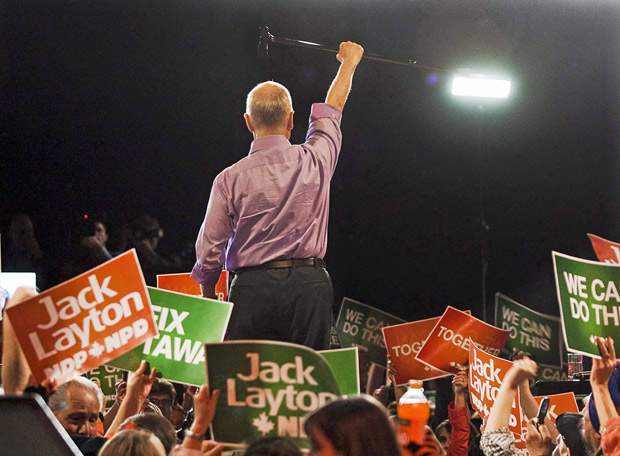
OTTAWA – Even now, doubts linger.
New Democrats have never been in this position before on the day of a federal election, almost certain to become the official opposition and – what’s the point of being a so-called N-Dipper if you can’t dream? – perhaps heading a minority government.
There was a moment in the past, when the popular Ed Broadbent led a popular crusade against free trade with the U.S. in the 1988 election, but that fizzled quickly.
And there’s an example of it happening at the provincial level, in Ontario, when Bob Rae’s New Democrats were also given no chance heading into the 1990 election against what seemed a popular premier, David Peterson.
Heading into the 2011 campaign, the prevailing wisdom was that the NDP would face their perennial problem in a hotly contested vote, squeezed in a contest between Stephen Harper and Michael Ignatieff.
What happened?
University of Toronto political scientist David Wiseman believes there were several turning points in the campaign.
The first was Layton’s strong and quick-witted performance in the televised debates, in English and French, and more to the point, Ignatieff’s relatively poor showing.
Layton followed the debates with a well-reviewed appearance on a popular Quebec television show, "Tout le monde en parle," that gave him a major bump in a province that had never really considered him before.
Suddenly, the NDP were at 30 per cent in a Quebec poll, and through the laws of averaging, a force in the national polls.
"The media gave this impression there was this NDP surge across the country when it was actually only happening in Quebec, but all of a sudden people in the rest of Canada started looking at them seriously," Wiseman said.
"It stiffened the spine of NDP supporters who were thinking of voting strategically for the Liberals, and weakened the resolve of those Liberals, who thought, ‘Our cause is lost, maybe I’ll be wasting my vote."’
The dynamic that had traditionally undercut the NDP, now was benefiting them at the expense of the Liberals.
The polls suggest that’s what happened. While Harper’s Conservatives continued polling in the mid-30s, the Liberals plunged from near 30 per cent to the low 20s and even lower. All those votes, along with a similar collapse for the Bloc Quebecois in Quebec, seemed to gravitate to the smiling man with the cane and unfashionable moustache.
At NDP headquarters, they had been planning for a mini-orange wave all along – but then party strategists are paid to see possibilities where others see only a wasteland.
In Quebec, the NDP had been building its organizational strength for several years, opening a new office in the province and hiring a separate ad agency to create a Quebec-specific marketing strategy.
Last fall, Layton’s inner circle invested in some intensive public opinion research to figure out how the party, having slowly but steadily gained back its base in the previous three elections after cratering in the 1990s, could expand its support.
The research suggested they should target women, especially single women in social sector professions like nursing and moms with managerial jobs struggling to care for their kids and their elderly parents. The male partners of those women were next in line.
Demographic and attitudinal profiles determined that the NDP’s existing base and the new voters it hoped to woo shared some common views: None of them trusted Harper or liked Ignatieff. But they did all like Layton. Hence, New Democrats concluded they must make the campaign about leadership, above all else.
"We want this campaign to be about leadership because our leader is our asset, their (Liberal) leader is their detriment, their albatross," said Brad Lavigne, the NDP’s national campaign director.
The NDP rebranded itself "Jack Layton’s NDP." It crafted television ads which revolved around Layton pitching his plan to ease the burden on working families. They were strategically aired during prime time shows like "American Idol", "Grey’s Anatomy" and "The Good Wife," whose viewers are primarily women – along with a good number of their husbands.
The NDP platform was similar to that of the Liberals but, says Lavigne, Layton was actually trusted to deliver on it, Ignatieff was not.
On voting day, the only question is whether Jack’s newfound friends will make the effort to vote.
New converts, especially the young, have proven themselves fickle before, or just not committed enough to put in the extra effort. But there have equally been examples of young voters staying true to the end, most notably in the 2010 election of U.S. President Barack Obama.
Political scientist Christian Rouillard at the University of Ottawa noted that fewer than four in 10 eligible voters under 25 cast ballots in 2008. The NDP will need that figure to rise to realize their most daring ambition.
That’s one reason there are still doubts out there mere hours before the votes are counted.
The federal NDP has never been in this position, nor have Canadians.
Voting in his Toronto Danforth riding on Monday, Layton said this time he is getting the sense Canadians "will break out of the old patterns and the old habits."
—
With files from Joan Bryden



Comments
Want to discuss? Please read our Commenting Policy first.