


The company behind a spaceport in Canso, N.S., is defending the project after images of the site sparked criticism shortly after Maritime Launch Services signed a multi-million dollar lease with the federal government.

Maritime Launch Services’ spaceport has been in development for years on the outskirts of the small rural fishing community.
The company leases the land from the province of Nova Scotia.
The Department of National Defence signed a $200 million, 10-year lease with Maritime Launch in March to secure the location as a sovereign launch site.
Soon after, images of the site, which currently consists of a long gravel road, a concrete pad and a storage container, sparked criticism.
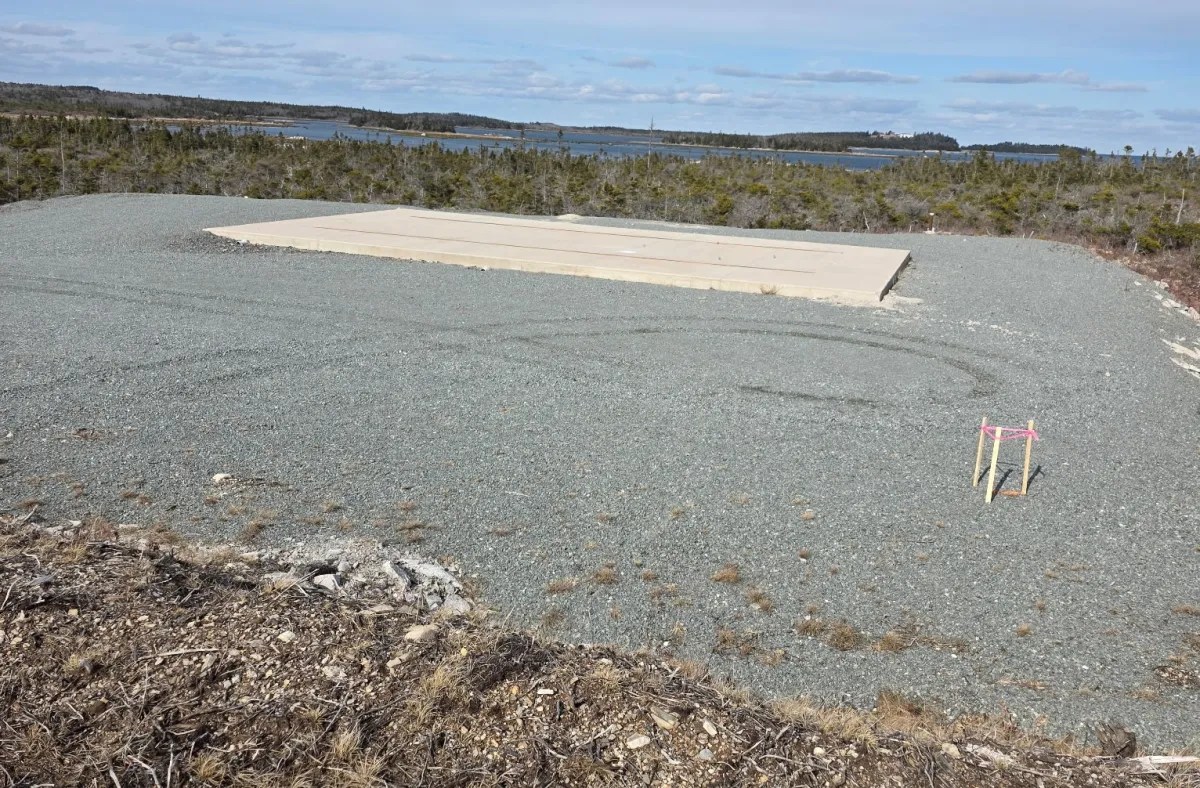
Conservative MP Vincent Ho called on the parliamentary Science and Research committee in May to study the deal, which he described as a “procurement disaster.”
The CEO of Maritime Launch Services, Steve Matier, defends the project.
“Frankly, it’s right where it should be,” he says. “As you’re building anything, you’ve got to start with roads, grounds, and then start working on the structures that come after that.”
Five years ago, the company released detailed architectural drawings of its plan for the site, which included a launch control facility and visitor centre.
Matier insists design work for the site is taking place behind the scenes.
“We’ve done initial construction, initial roads. We’ve got design teams that have been working all winter on the buildings and utility hubs,” he explains.
Canso residents have waited years for the spaceport to become a reality and bring promised jobs and economic spinoffs.
Resident John Cook, who owns two businesses in town, says he’d like to see more progress.
“If it doesn’t happen, you’re going to see we’re going to lose our hospital. The school will end up moving to Guysborough,” says Cook. “It’s just going to be a spinoff of losing. And that’s what this town has dealt with for the last 25 years.”
The warden of the District of the Municipality of Guysborough, which includes Canso, says the area needs an economic boost.
“Anytime there’s any perspective of project development, they’re going to need a big backing, big reason for doing it. And having the Department of National Defence on board certainly gets credibility to that project,” he says.

Get daily National news
Some residents raise doubts, concerns
But some residents would rather the spaceport never happen at all.
“This is going to be a testing ground for this company,” worries Bernie Steger, who, along with his wife Pat, moved to Canso from Ontario 10 years ago.
“We’re only three plus kilometres away from the launch pad,” says Pat. “I can’t see how we could possibly be here during a launch.”
Maritime Launch often calls itself “a fully licensed launch site,” but there is no such thing in Canada. Ottawa’s formal regulations for commercial space operations are still in the works.
Transport Canada imposes safety requirements on launches on a case-by-case basis and says it wouldn’t approve any rocket launch that could put lives at risk.
That means safety setbacks are determined based on an individual launch, depending on the type and size of rocket used.
Global News asked the department for the launch requirements for a suborbital rocket launch conducted by the company last fall, but Transport Canada would not provide the information, referring Global News back to the company itself.
Resident Marie Lumsden’s home is less than three kilometres from the launch site.
She questions how construction can happen without a formal regulatory system and argues for the need for greater transparency.

When asked by Global News about the distance of residents from the launch pad, Matier says the setback is now closer to four kilometres after he says the company “adjusted its layout.”
Lumsden is among a group of residents who have banded together to oppose the spaceport.
Documents obtained by the group and viewed by Global News indicate the provincial government is still waiting for Maritime Launch to complete all the conditions required under environmental assessment to operate as a spaceport. It has fulfilled the requirements necessary for construction.
“We have concerns about how consultation happened here, there’s a lot of people who don’t want this project, and it’s being forced, it feels like it’s been forced upon us,” says Lumsden.
“We are fully permitted for construction. The handover is once we go operational. And that’s where Transport Canada comes in,” says Matier.
He insists the company’s plans follow widely accepted industry safety standards and that Transport Canada has reviewed its safety calculations.
“Dealing with rocket fuels … and all the things that go into that, laying out the facilities. That’s in my resume and it’s being modelled after how they’ve been doing it in the U.S.”
“We have to demonstrate that they’re safe to a level of one times 10 to the minus six, meaning less than one million chance that anybody on the ground is going to have anything that’s going to affect them,” he adds.
Sovereign-built rocket lacking
Global News asked Dr. George Nield to review the focus report outlining safety setbacks and hazard mitigation prepared by Maritime Launch in 2019 for Nova Scotia’s environment department.
Nield is chair of the Global Spaceport Alliance, was a former associate administrator for Commercial Space Transportation at the Federal Aviation Administration and also worked as manager of the Flight Integration Office for the Space Shuttle Program at the NASA Johnson Space Centre.
The MLS focus report’s calculations are based on the Ukrainian-built Cyclone-4M rocket, which is no longer on the table.
Nield says the distance setbacks being discussed seem reasonable.
“Based on the reading that I’ve done, the rockets that have been proposed both in the past and going forward now look like they probably would be compatible with that kind of population density,” he says.
Nield says it’s common practice in the United States to give residents who live close to launch sites advance notice of a launch date so they can either leave home for the day or watch from a VIP site.
He agrees that transparency is important.
“Once a licence is granted, that information is posted on the FAA’s website in terms of, yes, there’s a launch licence to SpaceX or this kind of rocket in this location under these conditions,” he explains.
Long-time space industry journalist Eric Berger of Ars Technica adds the project does face challenges.
“I think Canada’s made a good-sized investment in this. But I have questions of whether Maritime Launch Services is capable of delivering on it,” he says.
Berger cautions achieving sovereign orbital launch in Canada is “going to take longer than anyone expects.”
No Canadian-built rocket capable of orbital launch exists yet, although several companies have rockets in development with hopes to launch in 2028.
Maritime Launch’s agreement with the Department of Defence stipulates the company must provide a dedicated launch pad and associated services by the end of 2026.
A spokesperson for the department told Global News those “associated services” include access to water, power, fibre connections, site security, and payload integration.
Matier promises the site will be ready.




Excellent piece, Heidi. “The Emperor’s New Clothes” comes to mind. Also, “The Carpetbaggers”. The word “sovereign” is a tell these days. It means there’s some political/opportunistic footsy is going on.
Finally something worth putting our taxes into. I’d 100% choose this over the 10s of billions that have been sent to Ukraine. Also most of us in Canso actually support this Spaceport, but for some odd reason the news is only listening to the 2 individuals that are protesting against it. I have family and friends currently working on the project and making money.
Of coarse they defend it. Lots of money for doing nothing.
What a waste of money