


The head of the World Health Organization said Friday that the Ebola outbreak in Congo is “spreading rapidly” and poses a “very high” risk at the national level.

WHO Director-General Tedros Adhanom Ghebreyesus said the UN health agency was revising its assessment to “very high” within the Democratic Republic of Congo (DRC), which had previously been deemed high.
The risk remains high for regional spread and low at global levels, he told reporters in Geneva.
Ghebreyesus, who referred to the Ebola outbreak as “deeply worrisome,” said 82 cases have now been confirmed in Congo, with seven confirmed deaths, “but we know the epidemic in DRC is much larger.”

He also noted that there are now almost 750 suspected cases and 177 suspected deaths, rising from Wednesday’s update of 600 suspected cases and 139 suspected deaths.
“The situation in Uganda is stable, with two cases confirmed in people who travelled from DRC, with one death,” he added. “The measures taken in Uganda, including intense contact tracing and cancelling the Martyrs’ Day commemoration, appear to have been effective in preventing the further spread of the virus.”
Ghebreyesus said the American national who was working in DRC has also been confirmed positive and transferred to Germany for care.
“We are also aware of reports today about another American national who is a high-risk contact who has been transferred to the Czech Republic,” he added.
The governments of DRC and Uganda are leading the response to the Ebola outbreak, with support from the WHO and partners.
“In addition to our national staff in DRC, so far we have deployed 22 international staff to the field, including some of our most experienced people,” he told reporters. “And we have released US$3.9 million from the Contingency Fund for Emergencies.”
The WHO head said the organization is also in touch with UN humanitarian chief Tom Fletcher, who allocated $60 million to the response.
“On the ground, we’re supporting national authorities with every pillar of the response, including contact tracing, establishing treatment centres, risk communication and community engagement and more,” he said.
The WHO is also establishing a continental incident management support team and in the coming days, it will publish a multi-agency strategic preparedness and response plan, aligned with the national plans of DRC, Uganda and other partners.
No approved vaccines or therapeutics
Unlike many previous Ebola outbreaks, which were caused by the Zaire virus, this outbreak is caused by the Bundibugyo virus, for which there are no approved vaccines or therapeutics, Ghebreyesus said.

Get weekly health news
The Bundibugyo virus was first detected in Uganda’s Bundibugyo district during a 2007-08 outbreak that infected 149 people and killed 37. The second time was in 2012, in an outbreak in Isiro, Congo, where 57 cases and 29 deaths were reported.
“Yesterday, WHO convened the leaders of several partner organizations under the interim Medical Countermeasures Network, to review the pipeline of vaccines, therapeutics and diagnostics,” Ghebreyesus added.
The WHO R&D Blueprint has convened its technical advisory group on therapeutics and recommended prioritizing two monoclonal antibodies to advance in clinical trials.

The advisory group recommended the evaluation of the antiviral obeldesivir in a clinical trial as post-exposure prophylaxis for people who are high-risk contacts, according to Ghebreyesus.
The clinical trial is now being developed jointly with Africa CDC and the Collaborative Open Research Consortium on filoviruses.
The WHO is also discussing with partners candidate vaccines in the development and manufacturing pipeline.
Sylvie Briand, the WHO’s chief scientist, said the organization is repurposing drugs previously used for different strains of Ebola viruses.
“We make an inventory of all the things that are potentially useful or in the pipeline and then the committee looks at prioritizing them using a number of criteria,” she said. “The main criteria is their safety. Then also we look at criteria for implementation. We are not yet at this phase of criteria for implementation because the committee only looked at the drugs that are available.”
Briand said the next steps require discussing with health authorities and other partners to see how they can implement them.
She called the antiviral obeldesivir a “promising treatment” but it will have to be implemented under a “very, very strict protocol.”
Vasee Moorthy, the WHO’s senior science and strategy advisor, said the WHO already has “something prioritized in the prevention of cases and that’s the oral obeldesivir that has already been mentioned.”


Earlier this week, Moorthy said one vaccine candidate was six to nine months away from being available for clinical trials.
Another is being developed by the University of Oxford and India’s Serum Institute and was having doses “manufactured as we speak,” he added.
But Moorthy said there was no data from animal testing to support the vaccine.
“It is possible that doses could be available for clinical trial in two to three months but there is a lot of uncertainty about whether that is a promising candidate,” he said.
“It will depend on the animal data on whether that’s considered a promising candidate research vaccine for Bundibugyo, so that’s what I would say about the pipeline now.”
Residents burn Ebola treatment centre in Congo
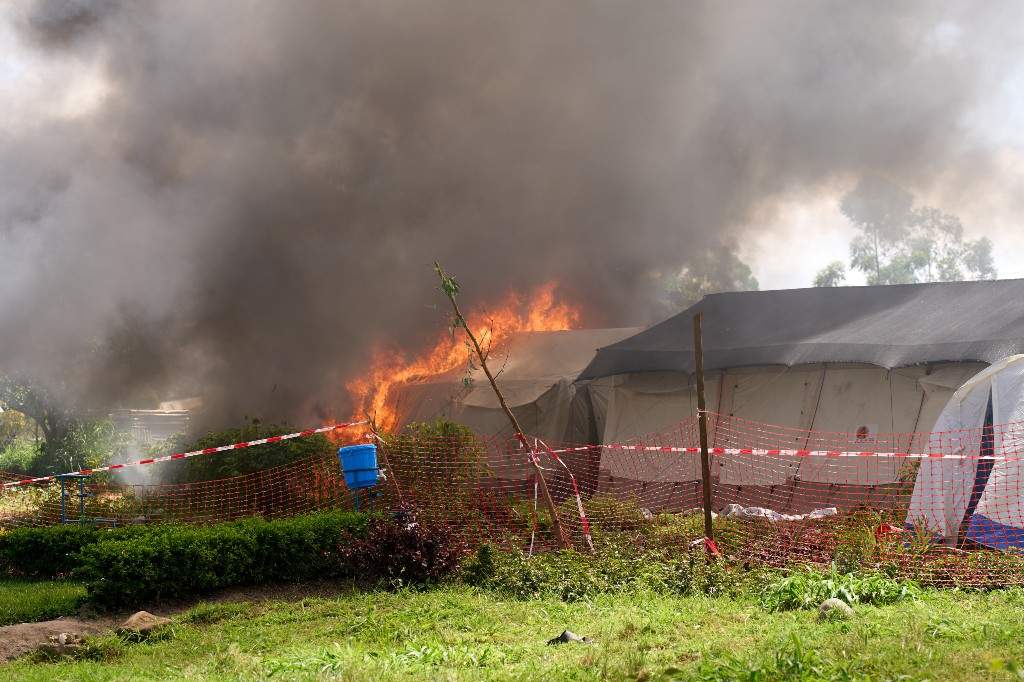
The WHO head spoke about the Ebola treatment centre in a town at the heart of the outbreak in eastern Congo that was set on fire Thursday.
The arson attack in Rwampara took place after people were stopped from retrieving the body of a local man, according to a senior police officer.
The bodies of those who die from Ebola can be highly contagious and lead to further spread when people prepare them for burial and gather for funerals. The dangerous work of burying suspected victims is being managed wherever possible by authorities.
Deputy Senior Commissioner Jean Claude Mukendi, head of the public security department in Ituri Province, said the youths accused of setting the fire had not understood the protocols for burying a suspected Ebola victim.
“His family, friends, and other young people wanted to take his body home for a funeral even though the instructions from the authorities during this Ebola virus outbreak are clear,” Mukendi told The Associated Press. “All bodies must be buried according to the regulations.”
On Friday, Ghebreyesus said there is “significant distrust of outside authorities among the local population.”
“As you know, the provinces of Ituri and North Kivu in which the outbreak is occurring are highly insecure, with intensified fighting in recent months, causing more than 100,000 people to be newly displaced,” Ghebreyesus said. “Across both provinces, around four million people need urgent humanitarian assistance, two million are displaced, and 10 million face acute hunger.”
“Just yesterday, there was a security incident at a hospital in Ituri, where tents and medical supplies were set on fire,” he continued. “Building trust in the affected communities is critical to a successful response, and is one of our highest priorities.”
Ghebreyesus said the WHO is committed to ensuring that essential health services for the affected communities are “maintained and strengthened, based on their needs.”
— with files from The Associated Press


since Canada is open arms to immigrants we might be screwed .nothing worse then bleeding from your eye balls then die
Mind control vaccines?
with this Ebola ,its dormant for 2 weeks , then you blled from the eye balls and a hole, a horrible death
liberal government has open arms to all immigrants no back ground checks no nothing!! , they even let united state redirect jets with any threat of Ebola to Canada , so i would very concerned, by time its spread its to late,
This outbreak is caused by the Bundibugyo variant of the virus which as struck in 2007/8 and again in 2012, and currently there are no approved vaccines or therapeutics. Pfizer is letting a good epidemic go to waste, so their shareholders should be livid.
Yeah right
Suck me
No more people from Africa should be allowed into Canada until this is over.
THIS DESERVES A LIFE SENTENCE ! THIS IS AN EXTREMELY DANGEROUS INDIVIDUAL
Bring them in …. we need another Pandemic!!
For heaven’s sake, WHY is the media NOT reporting on the vaccine the Winnipeg scientists developed YEARS AGO and WHY are they not using it or does the WHO want to keep this disease spreading, making news? “cientists at the Public Health Agency of Canada’s National Microbiology Laboratory in Winnipeg spearheaded the development of the rVSV-ZEBOV (Ervebo) vaccine, widely recognized as the world’s first highly effective Ebola vaccine.”
Covid-19 vaccine supposedly created in less than a year, they’ve known about this Ebola strain for 20yrs yet no vaccine 🤔
they burned down the distribution center so now the whom has ti send in more people ti keep this fear going. the locals know its a scam so they take action to save themselves. good for them resist thats the answer. goooo carney
Travel from these countries need to be halted now especially with people traveling for the World Cup games
Close the affected countries borders………NO in or out!!!
Keep them from travelling, Canada does not want them.
As usual, the WHO is allowing the infected onto international flights.