


The Alberta Electoral Boundaries Commission has submitted its final report to the Speaker of the Legislative Assembly.

Among the report’s recommendations are an additional two ridings for Calgary, one more riding in the city of Edmonton, and the modification or consolidation of several other ridings in Calgary, Edmonton and central and southern Alberta.
The net result is two new constituencies that would be added in the provincial legislature, should the recommendations be adopted by the government.
This would increased the total number of MLAs from 87 to 89.

The changes are meant to reflect population changes around the province and ensure effective representation for all Albertans.
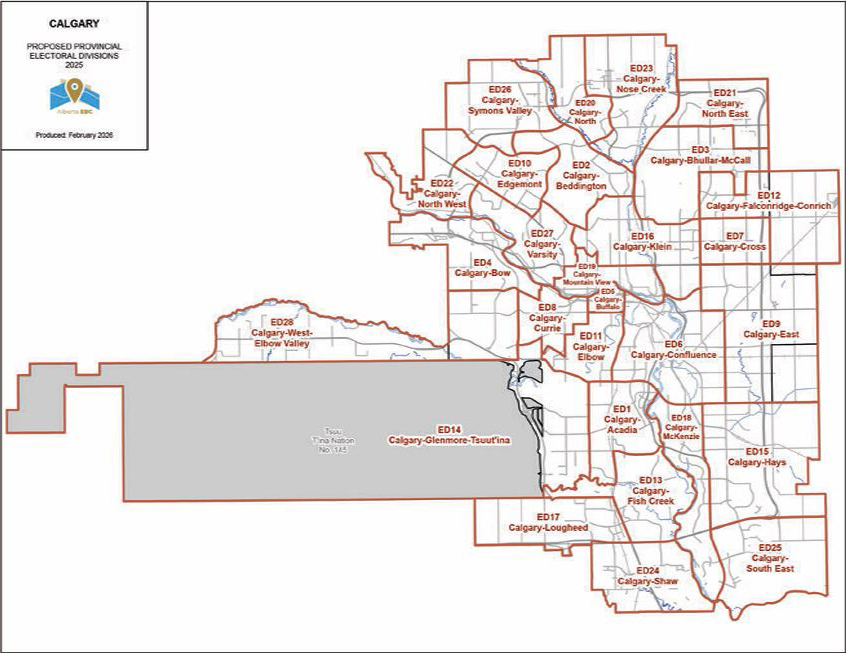
In Calgary, there would be three new ridings called Calgary-Nose Creek, Calgary-Confluence and Calgary-McKenzie.
However, the existing riding of Calgary-Peigan would be eliminated and the areas within it added to adjacent ridings.
North and west of Calgary, there would be three ridings called Aidrie-East, Airdrie-Cochrane and Cochrane-Springbank.

Get daily National news
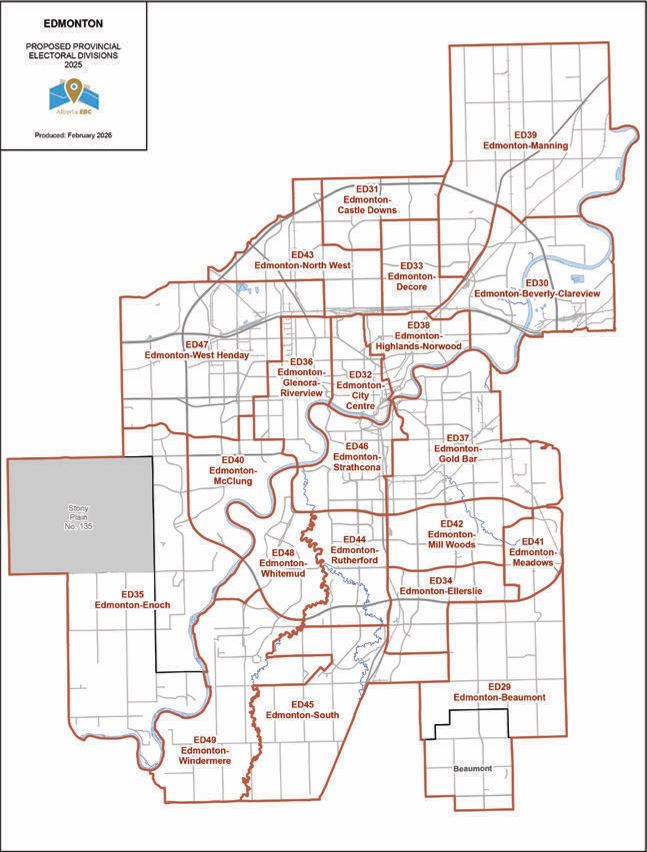
In central Alberta, the existing ridings of Rimbey-Rocky Mountain House-Sundre and Lac St. Anne-Parkland would be consolidated into the surrounding ridings of Lacombe-Ponoka, along with the new urban-rural ridings of Edmonton-Enoch and Edmonton-Beaumont.
The report recommends six ridings in Edmonton’s urban core be consolidated into five, with several of them also given new names.
No electoral boundaries are recommended to be removed or added in southern Alberta.
However, the boundaries of the ridings encompassing the city of Lethbridge, along with the ridings surrounding the city would be modified to reflect the greater population growth in Lethbridge-West compared to Lethbridge-East.
The report also recommends Northern Alberta retain all nine of its current electoral divisions.
If adopted as recommended, the riding with the largest population would be Calgary-McKenzie with an estimated population of 62,772 people, while the riding of Edmonton-West Henday would be the second most populous with 61,775 people.
The least populous ridings would be in the northern part of the province where the riding of Central-Peace Notley would have a population of 28,715 people and the riding of Lesser Slave Lake a population of 30,011 — variations from the average riding population that are allowed because the ridings are large in area and sparsely populated.

The Electoral Boundaries Commission was established on March 28, 2025, and it held more than 30 public hearings across Alberta, both in-person and online as well as receiving nearly 2,000 written submissions.
It presented an interim or “draft” report to the Speaker of the Legislative Assembly in Oct. 2025 and its final report on Thursday morning.
Not all five members of the commission are in complete agreement, though.
The final report also includes a “minority report” written by two of the commission’s members, who recommended a different set of electoral divisions, including greater use of “hybrid” ridings around Alberta cities to “improve regional representation, bridge artificial urban/rural divides and to manage population shifts.”
The conflicting recommendations are leading the Opposition NDP to warn that members of Premier Danielle Smith’s United Conservative Party are trying to gerrymander electoral districts to increase the power of rural votes.
The law dictating the boundary change process says the legislative assembly has the power to implement the commission’s majority report either in full or with amendments.
Chief government whip Justin Wright says the UCP caucus is reviewing the recommendations and will have more to say at a later date.
The complete report can be viewed online at assembly.ab.ca.
With files from The Canadian Press.




Comments
Want to discuss? Please read our Commenting Policy first.