


Some Maritime residents are voicing their frustrations with a lack of reliable cell coverage in rural areas, despite promises from the Nova Scotia and New Brunswick governments that more towers are coming online.

Among those joining the chorus of concerned citizens are three men who just received the Nova Scotia Medal of Bravery.
“There’s a lot of people who travel from away to snowmobile in our neck of the woods,” said Richard MacPhee of Bouladerie, N.S., in Cape Breton.
“They’re not familiar with what they’re getting into — the vastness of the highlands and the dangers. Yeah, it’s a different world up there.”
MacPhee was recognized with the medal Thursday at a ceremony at Province House alongside fellow snowmobilers Ryan O’Shea and Scott Rafuse.
On Feb. 14, 2025, the trio helped in the search for two missing snowmobilers in the Cape Breton Highlands during a blizzard.
“With conditions deteriorating and knowing the trails, they decided to search that evening. They found one of the men after a difficult search and assisted him until he was able to get to safety,” the province wrote in a release.
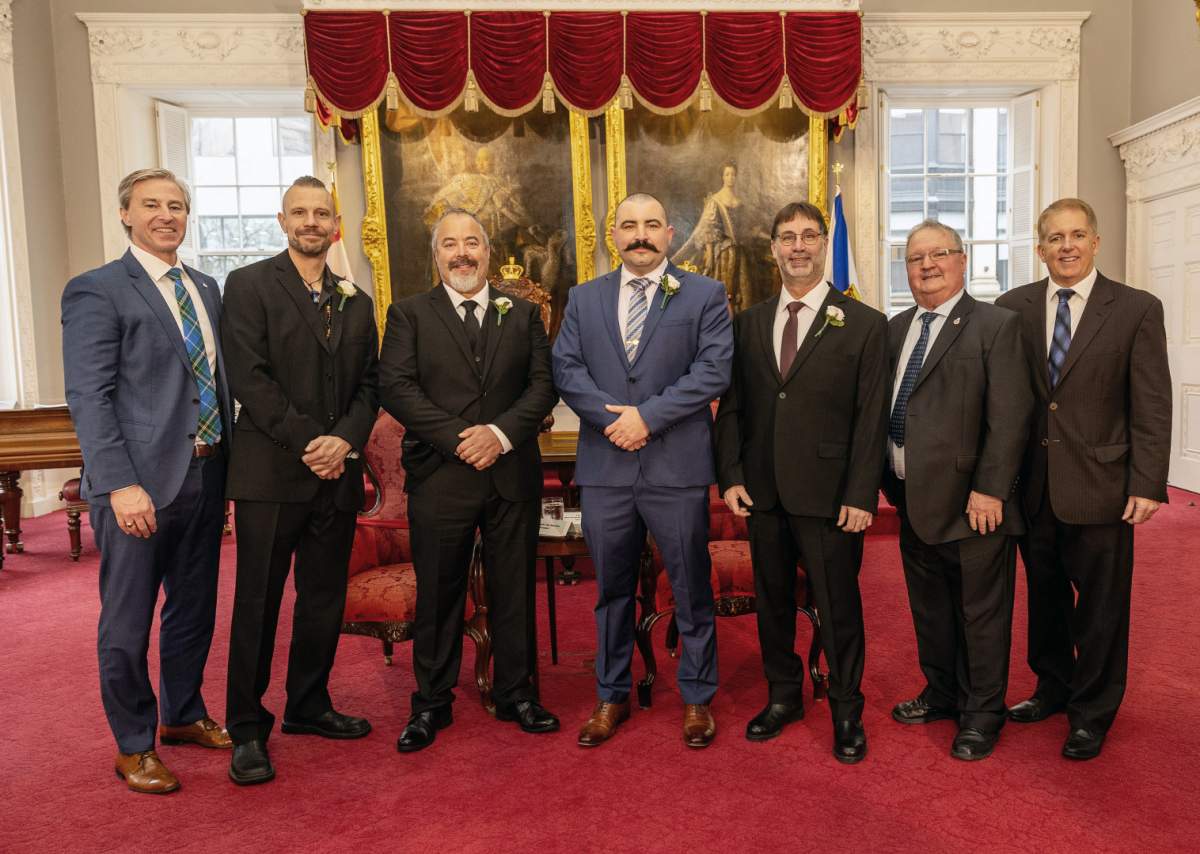
The three later joined the major search and rescue operation that was underway to help find the second missing man.

Get breaking National news
“It didn’t occur to us that we saved two lives that night by speeding up the recovery by 12, 13-plus hours, or if not more,” said MacPhee.
But the men pointed out that cell service in rural and remote areas in the Maritimes, including the highlands, desperately needs improvement and could be putting lives at risk.
“There’s a lot of good that came (out) of the whole incident. There’s been a lot of new protocols, lots of new safety equipment and emergency equipment. There needs to be much more,” said MacPhee.
“The ultimate goal would be to have cell service for all of the Cape Breton Islands. So when people are travelling from away, they’re not relying on having expensive satellite communication devices in order to reach emergency or reach home.”
‘Definitely out of luck’
On the other side of the province, Darren Hudson said cell coverage in his neck of the woods is only getting worse.
The Barrington, N.S. man owns an axe-throwing business in Dartmouth, N.S. and Moncton, N.B. — meaning his work revolves heavily around getting timber from the forest.
“If you rely on cell phone service in an emergency situation, nine times out of 10 you are definitely out of luck,” he said.
- Rutland’s ‘Blue Shirts’ return to support businesses, community
- Kelowna councilllor Ron Cannan launches mayoral campaign, promises focus on public safety
- Black Montreal police employees told management some are worried about going to work
- Weeknight concerts during Calgary Stampede must end at midnight, city memo says


He said it’s concerning because there’s no helpline if someone finds themselves in a dire situation.
“We have to watch out for each other. We know when we’re in the woods, we’re on our own,” he said.
In a statement to Global News, Build Nova Scotia — the Crown corporation tasked with improving cell service — said it “recognizes the seriousness of unreliable cellular connectivity and its impact on public safety, emergency response, economic activity, and everyday connections.”
It added that to date, 17 telecommunications towers have been upgraded and connected to the 5G network, with 10 more expected to be connected by the end of 2026.
“These upgraded sites now provide cellular network access to more than 2,100 previously unserved civic addresses and 127 kilometres of primary roadways,” wrote spokesperson Lauren Dunn, who added that physical factors and “national policy decisions” can also affect network coverage.
The statement said Canada’s decision to ban Huawei and ZTE equipment from Canadian telecommunications networks in 2022 over security concerns meant that companies using this equipment had to switch to other suppliers.
In New Brunswick, the province partnered with Bell to improve service reliability, saying work on 10 communication towers will begin early this year.
But for Hudson, he’s still waiting for a signal.
“People want to have a business and do business worldwide and it’s very frustrating when you’re limited to when you’re mobile and you can’t communicate,” he said.



Comments
Want to discuss? Please read our Commenting Policy first.