



Canadian-American architect Frank Gehry, known for his distinct, unique design style of buildings all over the world, died Friday at the age of 96.

Gehry died in his home in Santa Monica after a brief respiratory illness, said Meaghan Lloyd, chief of staff at Gehry Partners LLP.
Prime Minister Mark Carney said in a statement he was “saddened” to learn of Gehry’s passing, calling the architect’s work “groundbreaking,” “iconic,” “visionary” and “unmistakable.”

“I extend my deepest condolences to Mr. Gehry’s family and friends, and to the many admirers of his work,” he said.
Born Frank Owen Goldberg on Feb. 28, 1929 in Toronto, he showed interest in building things from a very young age. Starting with scraps of wood and eventually graduating to more complex materials from his grandfather’s hardware store, he had a penchant for stylish original design.
His mother instilled a knowledge of art in him, and the two areas meshed together perfectly, leading him to develop a well-rounded approach to architecture.
Gehry and his family moved to Los Angeles in 1947, where he attended City College and worked as a delivery truck driver. After some preliminary waywardness and questioning about what he wanted to do with his life, he consciously seized on what made him happy, and that was art and architecture.
He graduated from the University of Southern California in 1954 with a Bachelor of Architecture. Post-graduation, he served a stint in the U.S. Army before returning to academics. He enrolled at the Harvard Graduate School of Design, but didn’t complete the program. Disillusioned with the incongruity of his ideas and established architectural practice, Gehry worked at several architectural firms before establishing his own company, Frank O. Gehry & Associates, in 1962. It was renamed Gehry Partners in 2002.

Get breaking National news
His first commercial success was the launch of his “Easy Edges” cardboard furniture line, which sold for a period of a few years. With the money he made from the venture, Gehry remodelled a home for his family in Santa Monica.
Gehry’s style — characterized by the use of chain-link fencing and metal cladding and by forms that twist the traditional rectangular structure of buildings or flow and curve in non-linear shapes — was exemplified here.
His “avant-garde” design caught the attention of the architectural world, and after his remodel, his career took off. During the 1980s, he began designing homes throughout Southern California to critical acclaim.
His notoriety went into the stratosphere after he designed the Guggenheim Museum in Bilbao, Spain. Opening in 1997, it was considered a “masterpiece of the 20th century” and set the bar for architecture at the time. It also transformed Bilbao as a whole, pouring money into the city’s coffers.


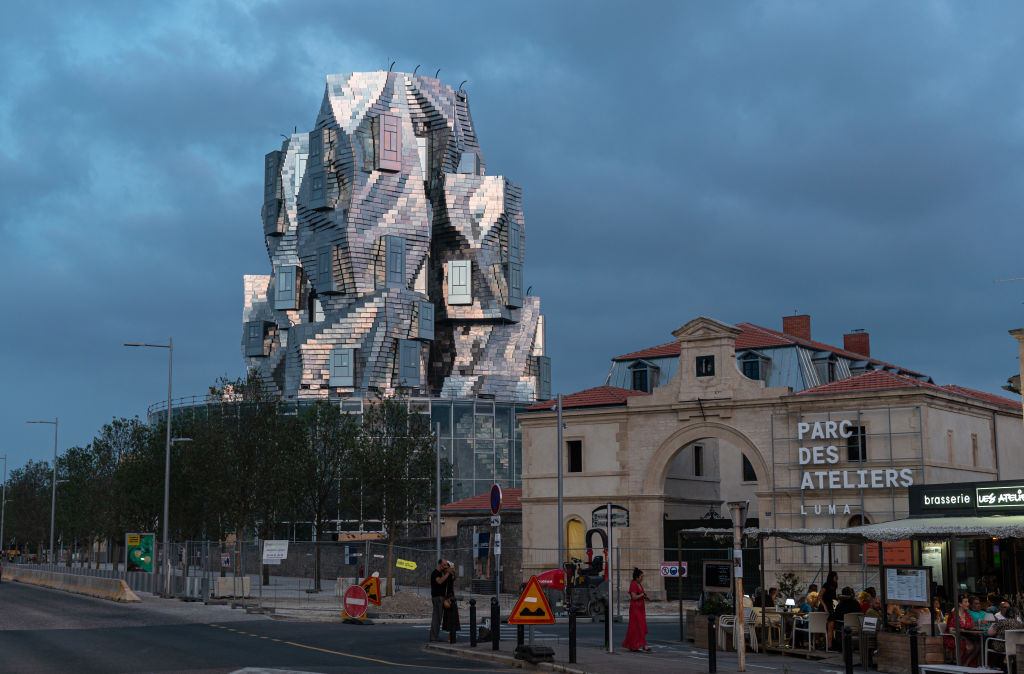

His other most famous works include the Louis Vuitton Foundation in Paris, the Walt Disney Concert Hall in downtown L.A., the Vitra Design Museum in Germany and his aforementioned home in Santa Monica.
In Canada, Gehry redesigned the Art Gallery of Ontario (AGO) from 2004 to 2008 in a $276 million redevelopment. He expanded and revitalized the museum to much fanfare, bringing together multiple motley segments of the building into one whole. Notably, it was the first of Gehry’s designs to not feature a contorted structural steel frame for the building support system.
In more recent years, Gehry returned to academia as a professor of architecture at Columbia University, the University of Southern California and Yale.
He leaves behind his wife of 50 years and four children.
— With files from The Associated Press and Global’s Sean Boynton


Comments
Want to discuss? Please read our Commenting Policy first.