



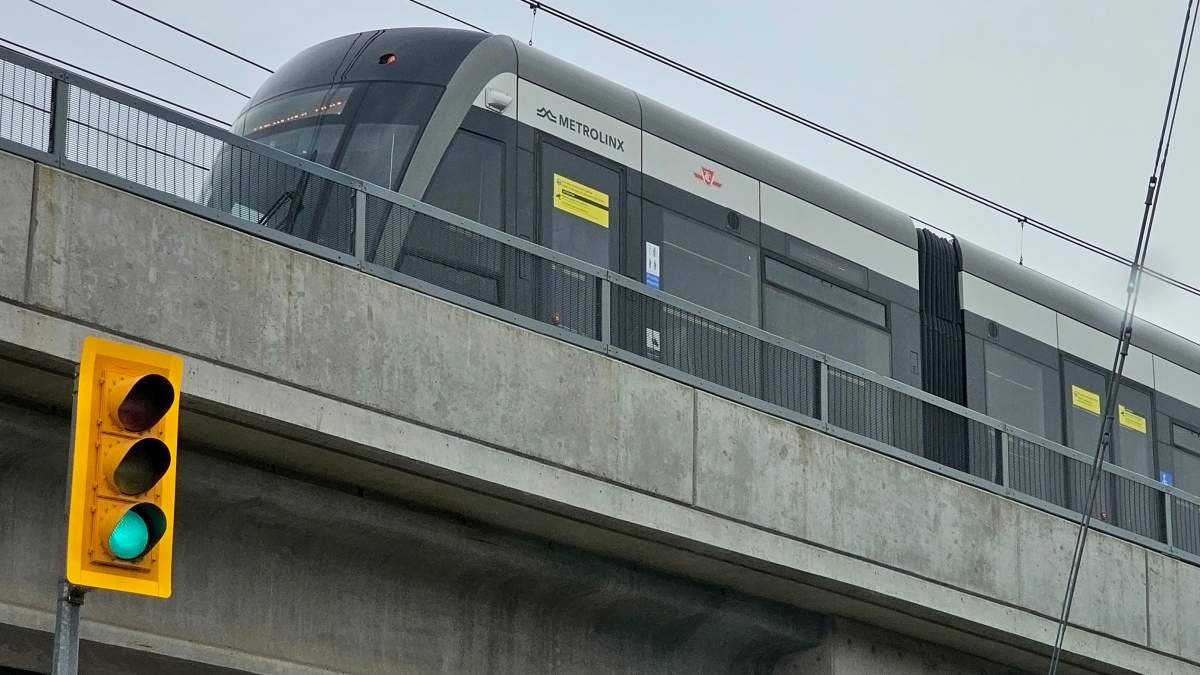
The years-delayed Eglinton Crosstown LRT has officially achieved substantial completion, the government of Ontario says, the final major hurdle on the way to opening the line.

On Friday, the province said the 25-stop light-rail line had successfully graduated from its final testing phase and was being handed over from Metrolinx to the Toronto Transit Commission.
“Under the leadership of Premier (Doug) Ford, our government is delivering the largest transit expansion in Canadian history,” Transportation Minister Prabmeet Sarkaria said in a statement.

Get daily National news
The substantial completion milestone, which means the line is “ready for service,” ends more than a decade of construction and testing and signals the route can be ridden as soon as Toronto’s transit agency gives the green light.
The province said the completion meant an official opening date would be set for early in 2026.
“With this rigorous testing complete and final preparatory works underway, it is expected the Eglinton Crosstown LRT will open to the public in the coming weeks,” the government said.


“To ensure a smooth launch, service levels on the line will gradually increase over the first six months, a standard approach for major LRT projects worldwide.”
On the day it opens, trains will run just under every five minutes, between 6 a.m. and 11 p.m. After six months, service will increase to every three minutes and 30 seconds between 5:30 a.m. and 2:30 a.m.
During testing, the line drove more than 11,000 kilometres per week in a variety of conditions, including in the snow.


Comments
Want to discuss? Please read our Commenting Policy first.