


A coalition of Ontario First Nations is taking legal action to try and throw out provincial and federal legislation designed to fast-track major projects, saying the two laws threaten their rights and “ways of life.”

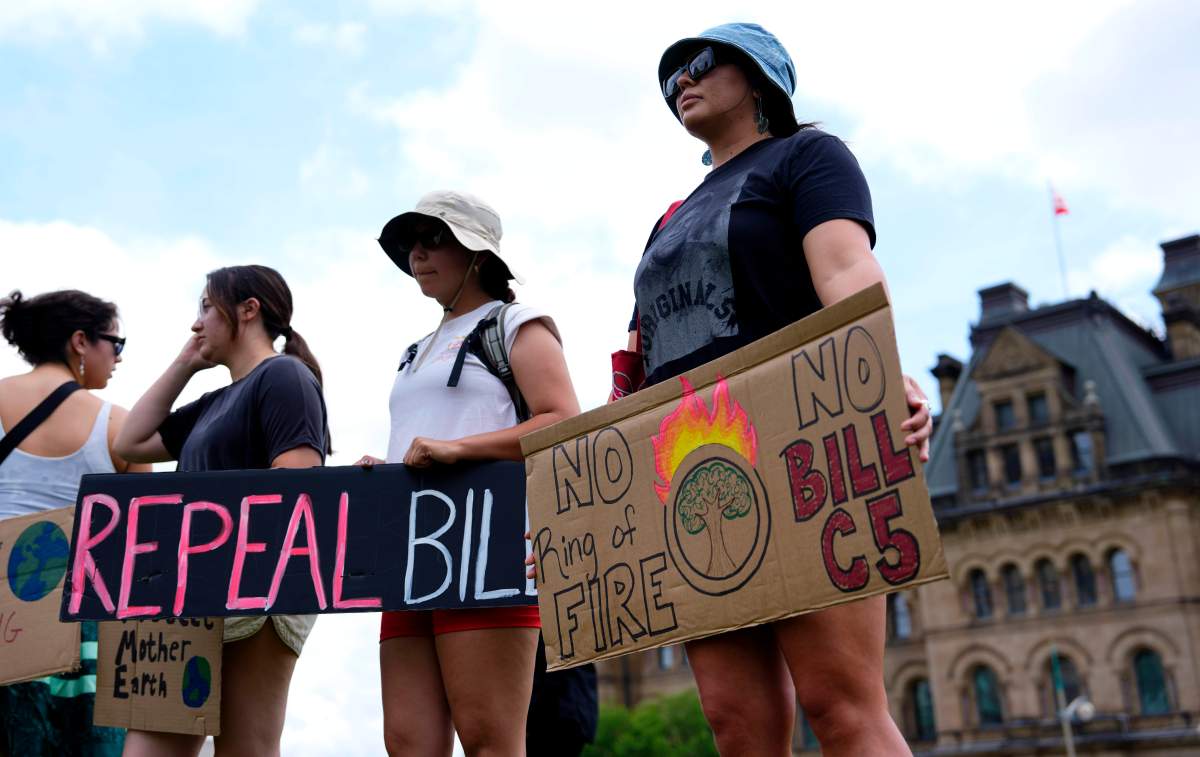
Nine First Nation groups announced in a statement on Tuesday that they are bringing urgent litigation to the Ontario Superior Court of Justice to try and kill Ontario’s Bill 5 and the federal government’s Bill C-5.
The Ford government passed Bill 5 in June, which allows it to create special economic zones where municipal and provincial laws can be suspended. The opposition has referred to the areas as “no-law zones.”
Similarly, the federal Bill C-5 allows cabinet to quickly grant federal approvals for big projects deemed to be in the national interest, such as mines, ports and pipelines, by sidestepping existing laws.
Kate Kempton, senior legal counsel for the group, confirmed to Global News that the litigation was filed Monday evening. It looks to have Bill 5 struck down in its entirety, and the parts of Bill C-5 that allow for major project designation also to be killed.
The court documents claim the two laws “violate the constitutional obligation of the Crown to advance and not set back or foreclose reconciliation” with First Nations.
Bill 5, the group writes in its court submission, “authorizes the Crown to unilaterally ram through projects” without any meaningful engagement.
The documents ask the court to strike out Bill 5 and Bill C-5 as violating the right of life, liberty and security of the person as well as equality clauses in the Charter of Rights and Freedoms.
It also asks the court for a declaration both governments “failed to act honourably” and an interim or permanent injunction stopping both Ontario and Canada from designating projects under their laws.

Get daily National news
A spokesperson for the premier’s office said the Ford government would “continue to build consensus with First Nations” on infrastructure, resource extraction and all-season roads.
“We have begun productive conversations with First Nations who share our vision of unlocking economic opportunity and critical infrastructure in their community and will continue these consultations throughout the summer,” they wrote in a statement.
“These consultations will shape the regulations and criteria for new special economic zones and Indigenous-led economic zones.”
Consultation questions
Ontario has promised engagement with First Nations on its controversial legislation, but said it would take place over the summer of 2025 — after the bill officially became law.
The notice of application claims the government’s promise to consult is “a smoke and mirrors trick, deflecting attention from all the other ways the laws necessarily diminish the ability of First Nations to engage on the regimes’ broader consequences.”
It added that the promise to conduct consultation after the bill was already passed into law was “hollow.”
While it remains opposed to Bill 5, the First Nations group said it was not against the development of northern Ontario in general.
“These laws authorize the Crown governments to approve on a fast track major projects like Ring of Fire mining and pipelines, by short circuiting the need to get critical information about human and environmental safety and impacts,” Alderville First Nation Chief Taynar Simpson said in a statement.
“Our case is not a fight against development, it is a fight against dangerous development pushed ahead by factless, thoughtless and reckless decision making from government Ministers behind closed doors with little accountability.”
As part of its attempts to convince First Nations groups, who have been vocal opponents of Bill 5 since its introduction, the Ford government has offered them special economic zones of their own.
The suggestion would allow First Nations to apply to bypass laws and regulations in order to advance projects they see as beneficial to their communities.
The legal claim said that the creation of those zones would “do nothing to offset the irreparable harm to reconciliation that these laws, if left as is, will cause by establishing regimes under which the self-determination of First Nations may only happen on terms unilaterally dictated by Crown governments.”
Attawapiskat First Nation Chief Sylvia Koostachin-Metatawabin pointed out the dangers of using the legislation in the remote, mineral-rich Ring of Fire, in particular.
“In the Ring of Fire area, this could be disastrous,” she said. “That region is peatlands, which is a globally critical carbon sink that must stay intact if it is to counter climate change. If parts of it are destroyed through mining and infrastructure, this could unravel the whole thing.”
The Ford government has confirmed it plans to designate the Ring of Fire as a special economic zone. In June, Premier Doug Ford said he wanted to do that as “quickly as possible.”
He also suggested he would make the James Bay deep-sea port, nuclear power projects, a tunnel under Highway 401 and parts of the GO network special economic zones.
Global News also contacted the federal government for comment.




Comments
Want to discuss? Please read our Commenting Policy first.