


Price growth in Canada’s most expensive housing markets has accelerated, while the average home price jumped more than 10 per cent in December, data released Wednesday shows.

But the emerging trend points toward the ‘soft landing’ scenario that policy makers and economists have been hoping for.
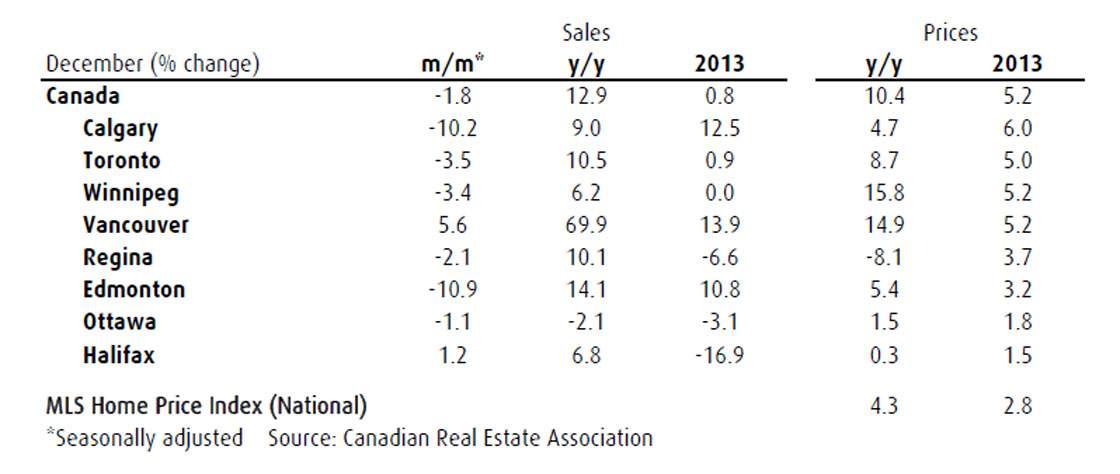
While the year-on-year numbers comparing last month to December 2012 show torrid sales and price appreciation across the country, a closer look reveals the market by and large is cooling.
Month to month, home sales were down 1.8 per cent compared to November.
Sure, December is always a slower time for home sales, and brutal weather across much of the country in the final weeks put an even deeper chill on activity – but it was the third month in a row of lower sales.
More so than the chilly weather, mortgage rate hikes over the summer that have stuck around are doing their part to deter some buyers, TD says.
“December’s decline may reflect weather conditions, as markets hit the hardest were experiencing Mars-like temperatures. However, higher mortgage interest rates appear to be taking some steam out of home demand, particularly for first time homebuyers,” TD economist Diana Petramala says.
Interest rates on a standard five-year mortgage have risen by 70 basis points (0.7 per cent) since May.
Prices still climbing

Get weekly money news
But prices edged back up to an all-time high in December, according to the Teranet-National Bank house price index. The average cost of home across the country now stands at $389,119, according to Canadian Real Estate Association.
The acceleration of prices, economists say, reflects a rebound from the slowdown that gripped the market a year earlier after tighter lending rules were imposed by Ottawa.
The price gains also stem in part from those very same rate hikes, which have served to pull ahead some demand from buyers worried about a further rise in interest costs.
With the pool of those buyers now drying up, a more muted 2014 is anticipated experts say; the market place kept in check or “balanced” by mortgage rates continuing to edge higher, experts believe.
“While price growth has accelerated in the past 6 months (particularly in Vancouver and Toronto), upward drifting interest rates and balanced conditions should contain the gains this year,” BMO economists said in a note.
READ MORE: As lending slowdown looms, some banks rush to lock in mortgages
Ample supply of new homes that will come up for sale this year will also serve to put the brakes on price gains in many markets, TD say, giving buyers “bargaining power.”
‘Too hot for comfort’
- Veterinary tranquilizer detected amid spike in Regina drug overdoses
- Kraft Dinner protest targets Montreal mayor over historic property tax hike
- Funding future for Calgary’s Foothills Fieldhouse questioned during budget talks
- Advisory council to issue antisemitism report as Jewish groups call out campus hate


Overall, TD expects sales to “stabilize” in 2014 while nationally prices will climb by a “more moderate” 2.0 per cent in 2014.
“It’s hard to find evidence to suggest anything but a soft landing for the Canadian housing market,” BMO’s Doug Porter said.
The sentiment may come as a relief to some market watchers rattled by comments earlier this week from the head of one of the country’s biggest lenders.
Ed Clark, chief executive of TD Bank publicly flagged on Tuesday the rapid run-up in real estate prices since the 2009 recession as a source of worry.
“It’s a big, macro concern,” Clark said of the prospect of a runaway market place.


Comments
Want to discuss? Please read our Commenting Policy first.