


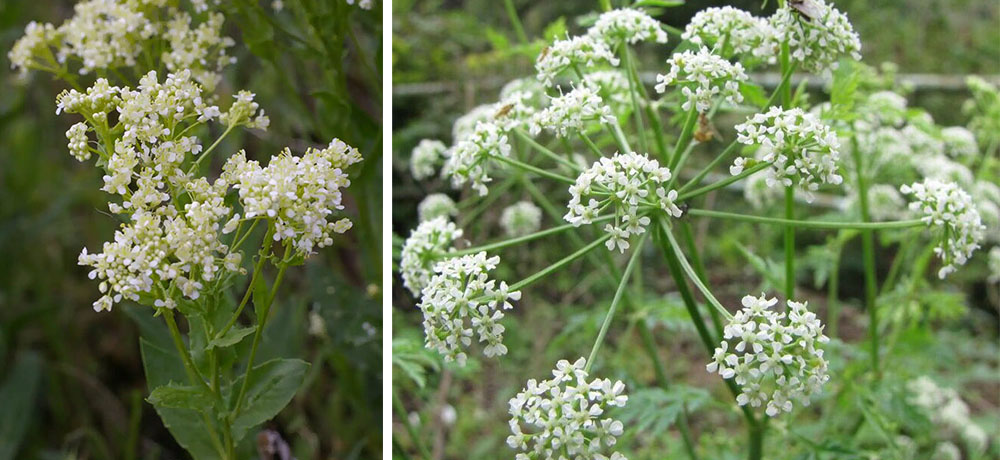
A non-profit organization is asking area residents to be on the lookout for two invasive species of plants.

Last month, the Columbia Shuswap Invasive Species Society added poison hemlock and hoary cress to its priority list of invasive plants.
The charitable organization says both don’t belong in B.C.’s Southern Interior and residents should be reporting sightings.
The society says its list contains six rankings based on how established a species is and their potential impact within the region.

Hoary cress is described as being one of B.C.’s top 25 invasive plants, and it can spread quickly through prolific seed production.
The society says it’s commonly spread through contaminated hay and seeds, and prefers open, sunny areas such as pastures and meadows.

Get breaking National news
“Hoary cress presents a threat to agriculture as it lowers crop yields and can ruin livestock products,” said the society.
The Invasive Species Council of BC says hoary cress is native to eastern Europe and western Asia and has been designated as a noxious weed.
And with the North Okanagan Rail Trail undergoing construction, society field manager Laura Gaster said “this plant has a higher potential to spread into our region.”
This plant is between 10-60 cm tall, has blue-green arrow-shaped leaves and many small white flowers in clusters at the top of the stem. It also has two heart-shaped seed pods per flower.

Regarding poison hemlock, it’s described as being highly toxic in that an ingested small amount can kill people and animals.


“All parts of the plant are poisonous, and can cause recurring skin reactions and respiratory ailments,” said the society.
Poison hemlock is said to be similar in appearance to other members of the Apiaceae family such as carrots, parsnips, wild celery and Queen Anne’s lace.
It’s described as having tiny, white, five-petaled flowers that form a broad umbrella shape. The leaves are bright green, triangular, and have a strong musty smell while the stems are hollow, hairless, and have distinctive purple blotches.
The society added that poison hemlock can produce up to 30,000 seeds per plant, which can remain viable and poisonous in the soil for three to five years.
The Fraser Valley Invasive Species Society says poison hemlock can be commonly found along ditches, sides of roads, fields and disturbed areas.

Information on how to report an invasive plant is available at the society’s website, as is how to dispose of an invasive plant.
May is also Invasive Species Action Month, and the Invasive Species Council of BC has more information available online.


Comments