

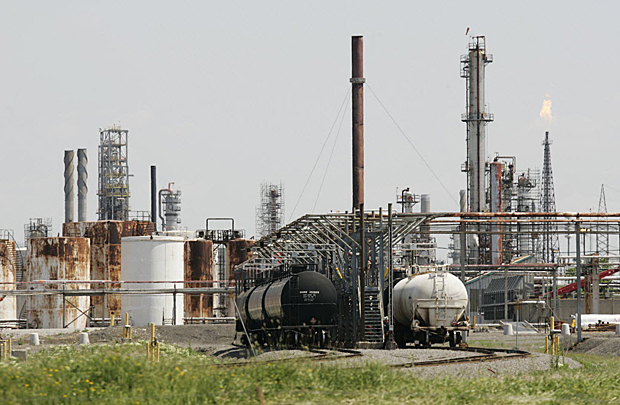
MONTREAL – Government regulators will come under intense union pressure to stall Shell Canada Products’s plans to convert its east-end Montreal refinery into a terminal, labour leaders say.
The plans for a terminal, which would result in the loss of almost 500 high-paying jobs, are inevitable after negotiations ended with potential buyer Delek US Holdings, Inc., Shell says.
Union leaders say they’re asking Quebec to use provincial laws governing environmental protection and oil products to make the conversion more difficult for Shell. For example, Shell cannot demolish its oil refining equipment when it converts to a terminal, which would receive refined oil from both domestic and international markets.
“It’s clear that we are going to use these tactics to stop the conversion,” said Jean-Claude Rocheleau, president of local 121 of the Communications, Energy and Paperworkers Union of Canada.
The conversion to a terminal will eliminate all but 25 to 30 jobs at the site, which is now staffed by about 500 unionized workers and an additional 250 temporary, full-time employees. The workers, including engineers, welders and technicians, earn about $80,000 a year, on average, Rocheleau said.
“This will make Quebec poorer,” he said.
Larry Lalonde, spokesman for Shell, which operates 280 company-owned retail outlets and a wholesale business in Quebec, said any delays to the permit-approval process could result in shortages.
While Shell doesn’t need to demolish parts of the plant, it is seeking government approval to modify certain pieces of equipment for the terminal.
“We need to get moving on the conversion,” Lalonde said. “Otherwise supply would be tight.”
Shell intends to cease production at the refinery in mid-September and would like to have the terminal running by November, he said.
“But this is all pending regulatory approval, of course.”
At a time when companies are operating modern, efficient refineries in oil producing regions like Qatar, Lalonde said, it would cost Shell more than $400 million in capital upgrades to properly run the 130,000 barrel-per-day crude processing facility in Montreal. The refinery now processes crude oil imported from Portland, Me.
“This refinery, in particular, is 77 years old,” he said. “It is an old facility. It is not commercially viable for Shell to keep running it as is.”
Lalonde said Shell had searched unsuccessfully for a buyer for more than a year. While Shell was asking for a sale price of around $150 million to $200 million for the refinery alone, the best offer from Delek would have included the refinery plus the sale of parts of Shell’s resale and wholesale businesses, he said.
But Rocheleau dismissed the sales process as a sham. The potential buyer, Delek, was found by a special committee of union and political representatives, not Shell, he said.
“It’s clear that what they always wanted to do was to convert the refinery into a terminal,” he said.



Comments
Want to discuss? Please read our Commenting Policy first.