

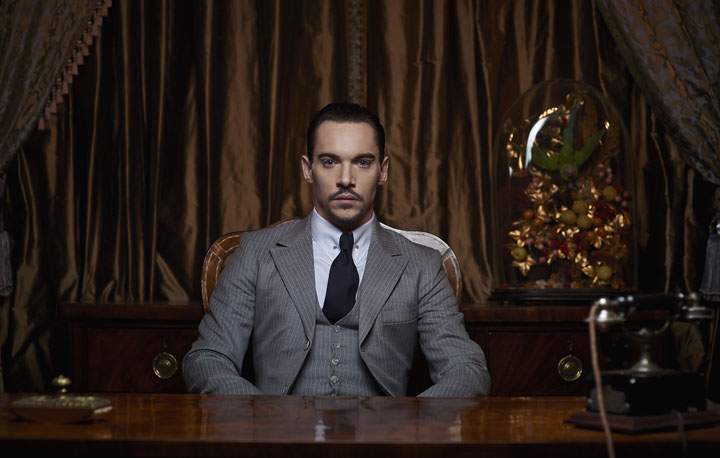
LONDON – Sexy monsters are a bit of a specialty for Jonathan Rhys Meyers.

In The Tudors, the Irish actor made King Henry VIII an attractive despot who dispatched wives and enemies while strutting, sulking and seducing his way through 16th-century England.
Rhys Meyers is back in the new series Dracula, playing the world’s most famous vampire as a sleekly alluring bloodsucker. Still, he says he hesitated when the part was offered to him, hoping for something a little more, well, normal.
“I was hoping I was going to get to play a generic cop or something, who’s got his lawyer fiancee who’s an uptown D.A.,” Rhys Meyers said.
It’s easy to see why Dracula producers cast the 36-year-old as a brooding vampire. Even dressed in jeans, leather jacket and Doc Marten boots, he’s a striking presence with chiseled cheekbones and piercing eyes.
Modern-day vampires, he acknowledges over a salt beef sandwich near his north London home, are an irresistible combination of the repulsive and the attractive.
“If all vampires in all films had been made to look like Klaus Kinski in Nosferatu, nobody would be interested in vampires,” he said. (Kinski’s bald, sepulchral predator in Werner Herzog’s film is the stuff of nightmares.)

Get breaking National news
“As soon as they made vampires kind of good looking — well, there you go,” he said.
In Dracula, which airs in Canada on Global, the undead Romanian count disguises himself as Alexander Grayson, a brash young American industrialist. He turns up in 1895 in London’s high society, seeking revenge on a secret vampire-hating cabal called the Order of the Dragon.
Dracula’s carefully prepared plan is threatened when he meets Mina, a medical student who bears an uncanny resemblance to the wife he lost centuries earlier.
Despite his early reservations, Rhys Meyers is enthusiastic about the show, on which he is a producer. He says he was determined that his Dracula would be free from bats, Gothic cobwebs and mock-Transylvanian accents.
“I wanted him to appear more like a Howard Hughes or a Citizen Kane than I wanted him to be ‘Drrac-ula,'” he said, rolling the “r” with Bela Lugosi-style menace. “I said to them, ‘There’s no way I’m going to do ‘Drrac-ula.’ I’ll sound like a really bad Bond villain.'”


Horror fans, never fear, there is still plenty of blood. Dracula feeds lustily — though he only bites women. Men are dispatched with a sword.
“I didn’t want too many scenes of him biting people’s necks,” Rhys Meyers said. “That gets very boring.”
“No bats, no garlic. I was even a bit (hesitant) about the crucifixes,” he added.
Instead of emphasizing the supernatural, the show conjures a highly material world of oil barons, social inequality and fast-changing technology. Its vision of late-Victorian London — filmed in Budapest — has an industrial, steam-punk edge.
“We wanted to do something different, something that brought into that time a little bit of the modern struggles that we struggle with now: politics, money, oil,” said Rhys Meyers. “I didn’t want to go and make a period drama that was stale. Because Victorian England at that time wasn’t stale. It was a very keen, very eager time. ”
Dracula’s enemies are the ruthless capitalist overlords of the British empire. Viewers could be forgiven for wondering whether Dracula, the outsider who comes to avenge ancient wrongs, is the true hero.
He’s not, Rhys Meyers says. He’s a monster — one with a “pinhole of humanity,” but doomed all the same.
“He must lose. That’s the thing I like about it,” the actor said. “He’s a monster in the worst possible place — in a world of humans. And we know what humans are capable of.”


Comments
Want to discuss? Please read our Commenting Policy first.