

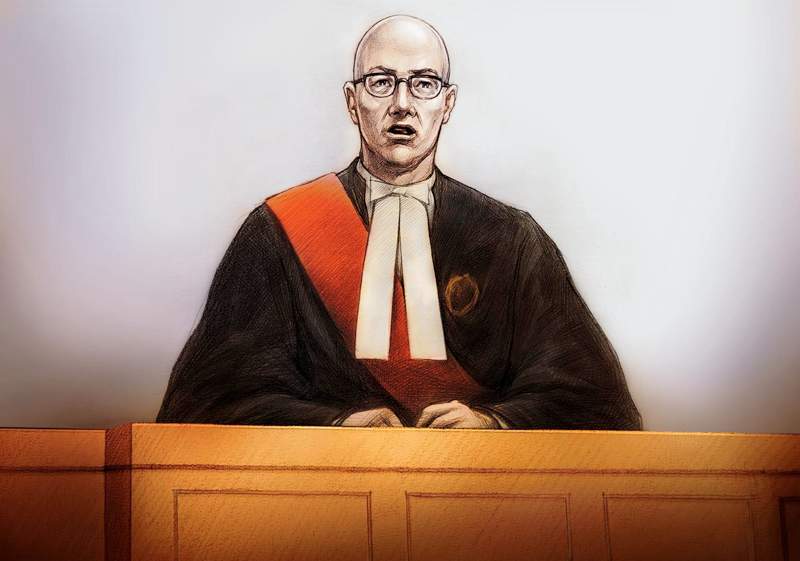
The jury in the Jordan Manners trial did not hear about a particle of gunshot residue found on one of the accused because of a “serious violation” of his rights by Toronto police.
The then-head of the homicide squad was criticized by Ontario Superior Court Justice Ian Nordheimer in a pre-trial ruling after she testified it was “not practical” for police to follow the law.
“It suggests that there may be a widespread or systemic problem within the Toronto Police Service, or at least the homicide squad, on this issue,” the judge wrote.
The pre-trial ruling and the excluded evidence can now be reported because the jury is sequestered and in its second day of deliberations in the first-degree murder trial.
J.W. and C.D. are accusing of shooting and then robbing their 15-year-old friend as he lay dying in the hallway of C.W. Jefferys Collegiate in northwest Toronto on May 23, 2007. The Grade 9 student was shot through the heart with a bullet from a .25 calibre handgun. It was Toronto’s first fatal school shooting.
J.W. was asked to attend a police station several hours later as a result of information that he and another youth were seen with Jordan shortly before he was shot.
J.W., who was 17 at the time, was driven to the police station by his basketball coach. He was not under arrest and considered to be a “person of interest,” the court heard.
Police conducted the gunshot residue test without the consent of J.W., did not inform him of the right to speak to a lawyer and did not try to obtain a search warrant (which could be done over the telephone).
Superintendent Kathryn Martin, who was then the acting head of homicide, testified at a pre-trial hearing that gunshot residue tests need to be done quickly. She stated it was “not practical” to try to get a search warrant, obtain someone’s consent or inform them of the right to speak to a lawyer.
The testimony was “particularly troubling,” wrote Judge Nordheimer, because it came from a senior and experienced officer.
The prosecution agreed that J.W.’s Charter rights were violated, but argued the jury should still be permitted to hear the gunshot residue evidence.
Judge Nordheimer noted it was only a single particle. As well, it could have been transferred by the basketball coach who came into contact with Jordan when trying to help him after he was shot.
Admitting this evidence “would tend to reinforce a view in young persons that the police can act towards them as they wish and there will not be any adverse consequences if they do,” he wrote.



Comments
Want to discuss? Please read our Commenting Policy first.