


Kelowna’s COVID-19 numbers are starting to even out at an uncomfortably high rate for health officials.

“We are seeing the same number of cases level off at a much-too-high level of around 100 to 150 cases a day in the Central Okanagan, specifically,” provincial health officer Dr. Bonnie Henry said during a Friday afternoon press conference announcing that social restrictions and masking mandates already applied to the Central Okanagan will now roll out across the entire Southern Interior.
Dr. Rob Parker, interim chief medical health officer in Interior Health (I.H.), said Central Okanagan COVID-19 numbers peaked over the weekend but they started to taper off during the week. That’s when transmission in the East Kootenay, Kootenay Boundary, the North and South Okanagan, and in the Thompson, Cariboo and Shuswap picked up the slack.
“We are seeing that rise across I.H. with almost a vast majority in unvaccinated people in the age group of 20 to 59,” Parker said.
“(COVID-19) is coming under control in the Central Okanagan but it’s starting to put pressure on acute care beds in other facilities in other areas of I.H.”
This regional shift was somewhat identified in the latest situation report from the BC Centre for Disease Control.

Get weekly health news
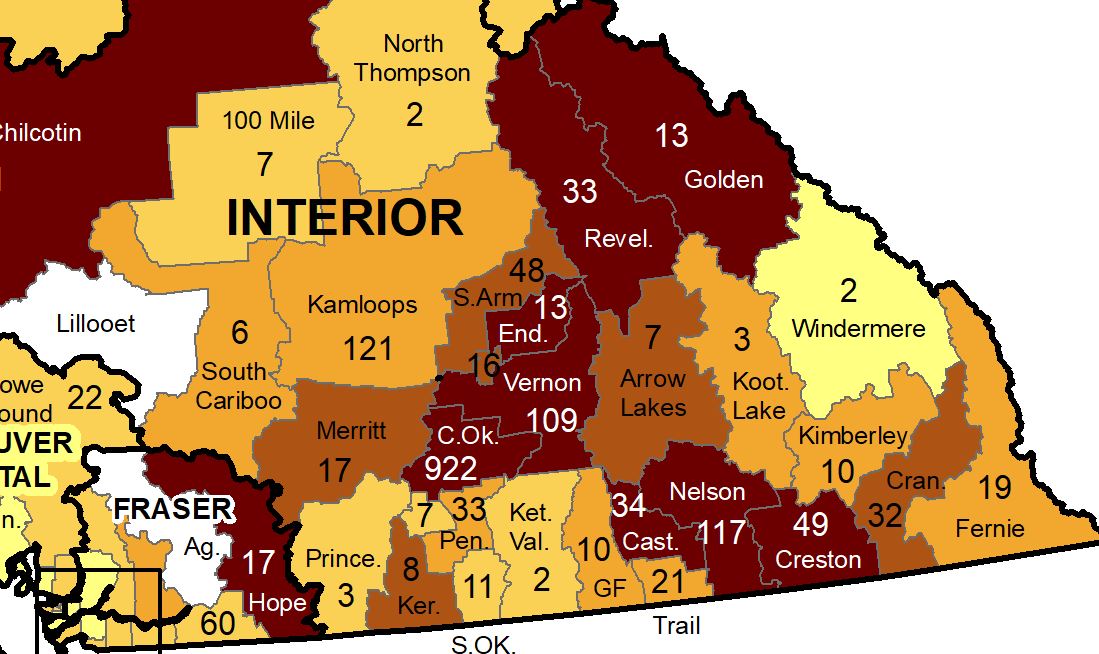
The Central Okanagan racked up an unprecedented 922 cases in the week running from Aug. 8 to 14, amounting to an average caseload of 131 a day. By comparison Surrey, which has a population more than double the Central Okanagan, had 155 new cases.

While the Central Okanagan was a stand out in B.C., the situation was starting to turn worse in other parts of the Interior at the same time.
Nearby, Vernon also showed up as a hotspot on the province-wide map and had 109 new cases in that week and Enderby had 13. All were marked hot zones, for the average daily rate exceeding 20 per 100,000 population.
Outside the Okanagan, in the Kootenays, Nelson had 117 cases, Creston had 49. The Cariboo also had 51 cases, while Golden had 13 and Revelstoke 33.


While cases are on the rise, Dr. Bonnie Henry said that contact tracing has been scaled back due to resources.

“We are doing contact tracing for people in high-risk environments,” she said, adding those include health care and child care facilities.
People working in those environments will see more stringent tracing measures and get additional follow-up.
Those in lower-risk environments will get contacted but they may not get the daily updates.



Comments
Want to discuss? Please read our Commenting Policy first.