

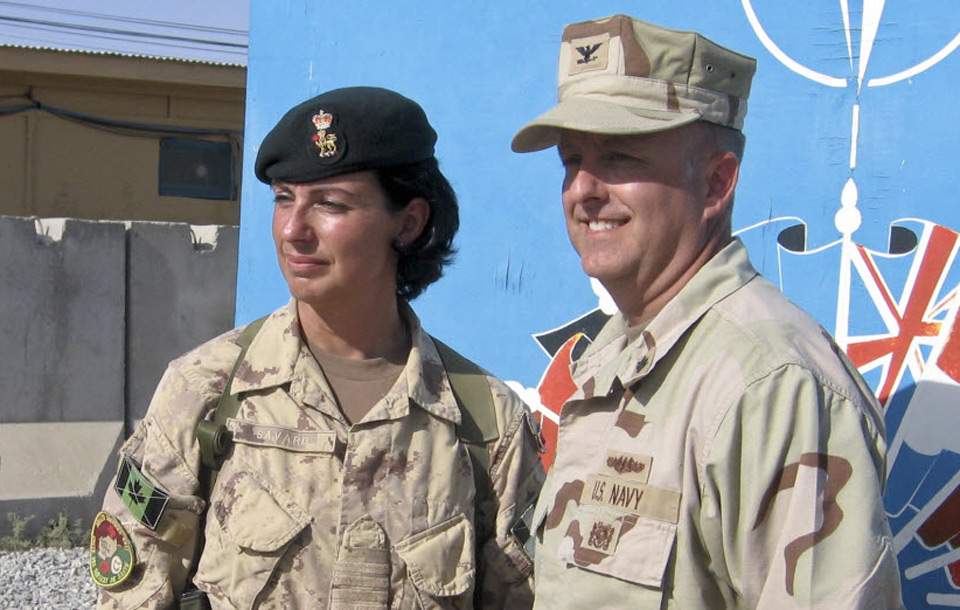
KANDAHAR AIRFIELD, Afghanistan – The multinational hospital here has "a hard-earned reputation" among coalition soldiers, Col. Danielle Savard, the hospital’s departing commanding officer, said Thursday at a change-of-command ceremony.
"They rightfully believe if they arrive with a heartbeat, they will probably survive," said Savard, who handed over command of the Role 3 hospital to U.S. Navy Capt. Darin Via.
The U.S. also takes on lead-nation status from the Canadian Forces.
Canada has been running Role 3 for the past three years.
"We have saved more lives than we possibly thought we would do," said Savard, who took command of the multinational medical unit in the spring of 2009. "We are a multinational unit when you look at the uniforms. However, we are working as one team, with one vision and one goal: saving lives and taking care of each other."
She described her hospital as "the best team I have ever led."
During the past six months, she said, the hospital has "broken all records for number of patients seen – close to 6,000. And we have admitted more than 880 trauma patients."
Maj. Gen. Mart de Kruif, the International Security Assistance Force’s RC South commander, noted in a speech that since he took command last November, coalition forces have lost "253 colleagues and saw more than 600 soldiers evacuated back to their country with life-changing wounds."
Although these figures "sometimes take your breath away, it could have been much, much worse," he said.
In 2009, more than 4,000 patients were taken from the battlefield by medevac helicopter, most of them coalition soldiers, he said.
"All of them needed urgent medical attention. Only a few of them did not survive. These figures show that we have a robust and courageous medical system in place. It also tells you something about our Role 3."
Speaking to reporters after the ceremony, Savard spoke with pride of the tremendous amount of hard work carried out by medical staff.
"Sometimes we worked 18 hours without a break, just to be sure that the patient comes first. We have saved so many lives, it’s hard for us if somebody dies."
Savard said it was an emotional day for her: "It’s my big family I’m leaving behind."
Via, who has Role 3 experience in Iraq, said he was "honoured and humbled by taking over from Col. Savard and the Canadians.
"They’ve done a phenomenal job and it’s going to be big shoes to fill but I think we have the right people to make it a successful mission."
A few hours before the ceremony, Maj. Brent Crawford of 1 Field Ambulance spoke of his job directing action in the trauma bay at the hospital. Crawford, who is based in Edmonton, had worked all night delegating medical staff and the use of equipment to save the life of a severely wounded American soldier.
"It’s exciting, it gets emotional, it’s challenging. We all thrive on that pressure," said Crawford, who has been at the hospital for three weeks.
"It seems every day I’m coming across a new situation I haven’t seen in a civilian hospital."
The wounded soldier who arrived Wednesday "received four times his blood volume" in transfusions, he said.
"There were two surgeons working on him simultaneously, an anesthetist, with nurses and paramedics as part of the team. It was such an amazing experience, such a challenging experience.
"He did make it through the night, and is now in ICU. If I was in Canada, maybe this patient might not have survived."
He said Canada’s leadership role at the hospital "has been a big deal and a source of pride for the Canadian military medical system as a whole."
Handing over that role "gives our medical staff a bit of a pause.
"But we’re still here. We’re still in the game and we’re still providing a valuable contribution to Role 3."
Canada’s mission in Afghanistan is "more than simply treating patients as we see them," he said. "We’re giving a lot back by mentoring Afghans in their medical systems. There’s an ultimate goal of bringing the local system to the level that they can take care of themselves.
Crawford also spoke movingly of his reason for being here – his son, who is 2 1/2 years old.
"The thing I miss most about being here in Afghanistan is being with my son. And, ironically, that’s the reason why I’m here today. I want to be able to say to myself that I made a very small but personal contribution to making the world a more stable and secure place for him to grow up."



Comments
Want to discuss? Please read our Commenting Policy first.