




Data released by the B.C. government shows just how many cases of COVID-19 spread in workplaces and the impact a workplace cluster can have on the surrounding community.

The data, released Thursday, looked at the two biggest health regions in the province: Vancouver Coastal Health and Fraser Health.

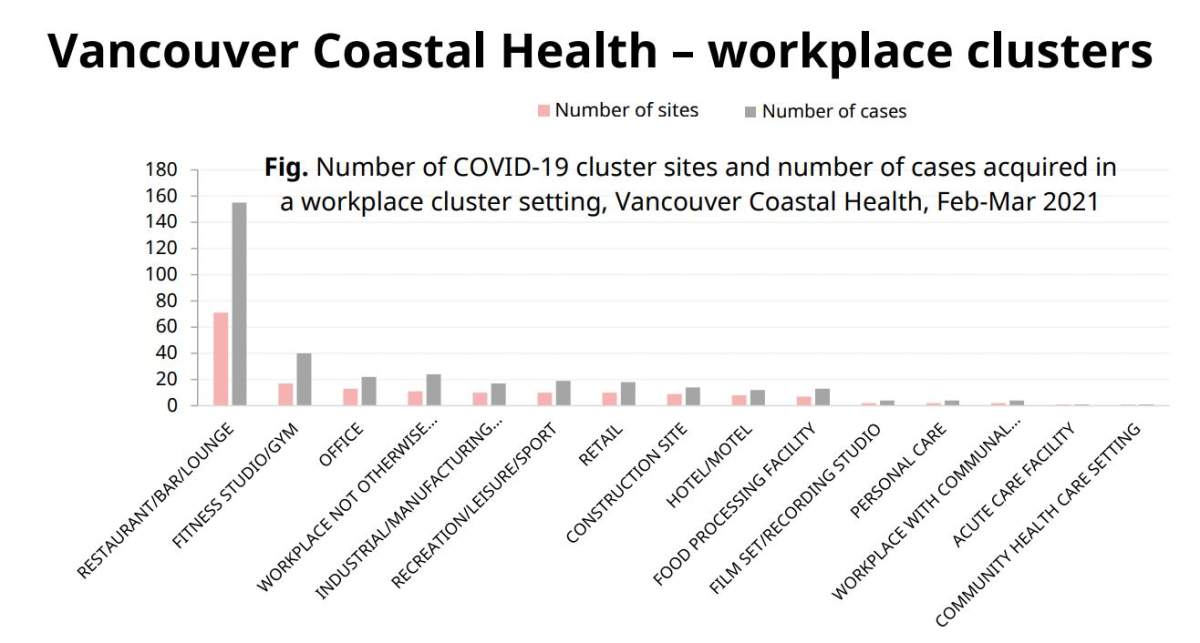
In Coastal Health, restaurants, bars and lounges were by far the sites of the biggest clusters in February and March, with clusters detected at 70 businesses that resulted in 155 cases.
Fitness studios and gyms came in a distant second with about 18 sites affected, resulting in 40 cases.
Offices, other workplaces and industrial and manufacturing businesses round out the top five.

In Fraser Health, however, industrial and manufacturing businesses easily had the biggest outbreaks.

Get weekly health news
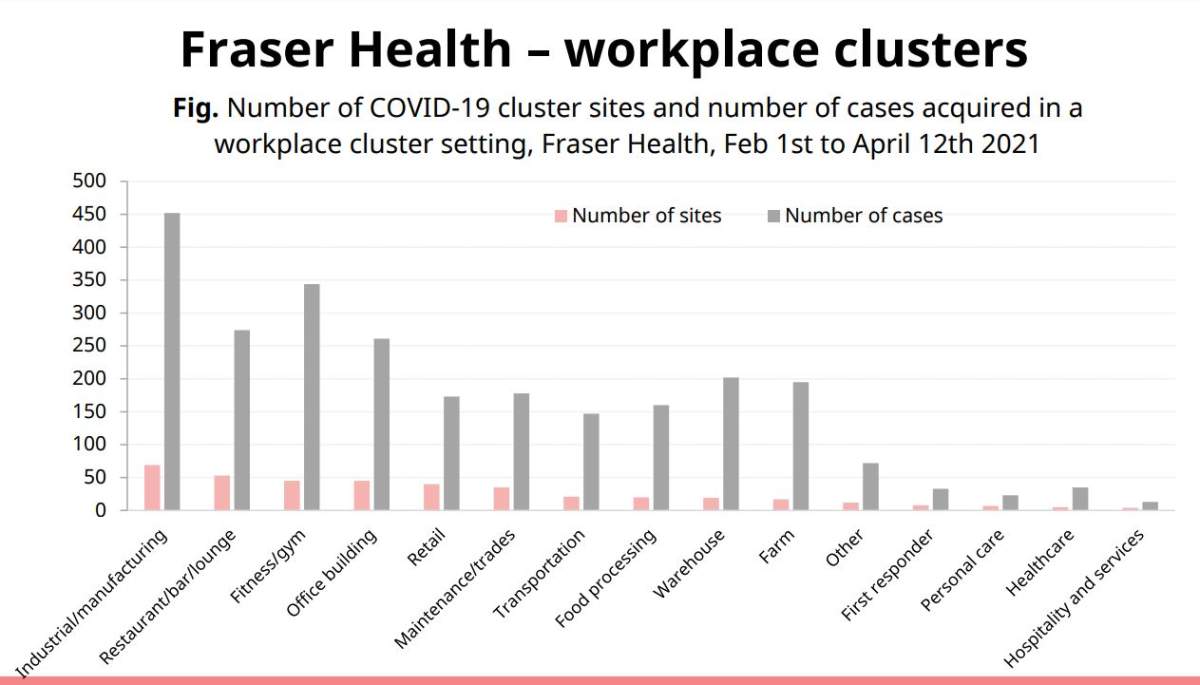
The province shared data from Feb. 1 to April 12 — a broader timeline than the Coastal Health data.
About 60 industrial and manufacturing companies had outbreaks that were responsible for about 450 cases.
Restaurants, bars and lounges came next with 50 sites responsible for about 275 cases.
About 45 fitness centres and gyms had outbreaks in that time period, but resulted in more cases at just under 350.
Office buildings and retail, maintenance and trades businesses made up the rest of the top five in the region.

Read more: B.C. could hit 3,000 new COVID-19 cases a day if contact trends don’t go down: health officials
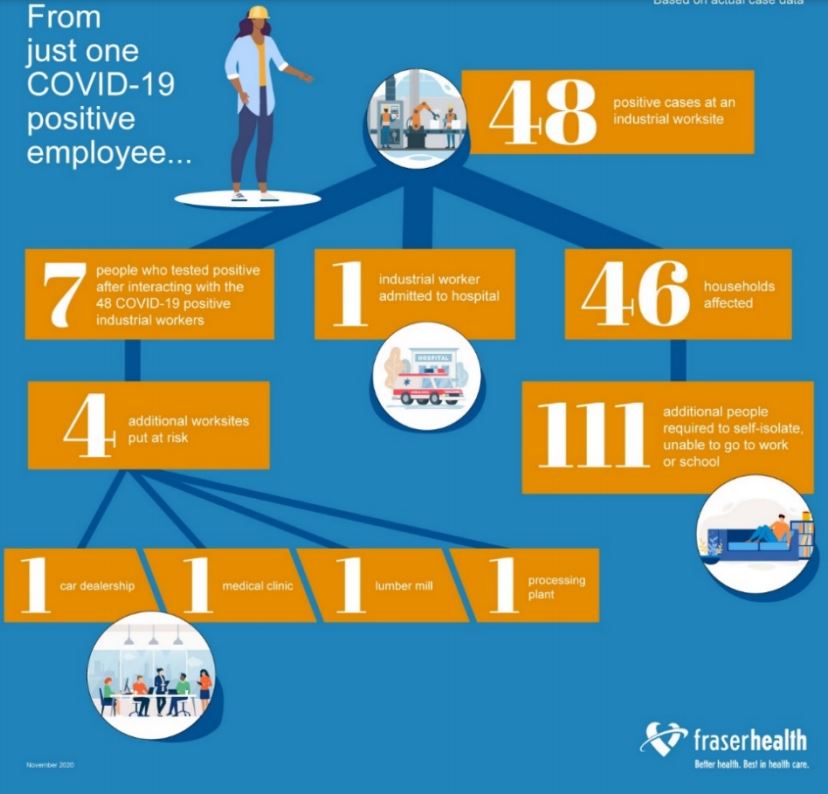
In an effort to decrease workplace transmission, Fraser Health showed how just one employee who tested positive for COVID-19 can affect their coworkers.
Based on an actual case, one person with the virus resulted in 48 positive cases at an industrial worksite.


Seven people then tested positive after interacting with those 48 people. One worker was admitted to the hospital.
Forty-six households in total were affected and 111 people had to self-isolate without going to school or work.
Finally, four additional worksites were put at risk, including a car dealership, a medical clinic, a lumber mill and a processing plant.
On Thursday, provincial health officer Dr. Bonnie Henry said data from other parts of the province has not been collected as “systematically” as in Fraser Health and Coastal Health, and that transmission is higher in those two areas.
Workplace transmission is still occurring around B.C., she added, but not at as rapid a rate as in the Lower Mainland.
“I think for a lot of people I think it’s that sense that this is never-ending,” Henry said.
“This concept that we’re in the end game and we can let things go and make exceptions for ourselves, we need to look at that again.”

Read more: B.C. sets new records for active COVID-19 cases, hospitalizations as new cases top 1,200 again
Meanwhile, British Columbia reported more than 1,200 new COVID-19 cases for the fourth time in eight days, along with three additional deaths on Thursday.
The workplace data was part of a larger modelling presentation from health officials showing that the virus on track to hit 3,000 cases per day, if trends do not change.
“Right now, the rate of infectious contacts we’re having — so the contacts where the virus can be transmitted to others — on average in the province is somewhere around 55-60 per cent. That is too high,” Henry said.
“We need to get down to 40 per cent or less, and we have done that consistently — we were able to do that last March, we did that in November when we put in restrictions again.”


Comments
Want to discuss? Please read our Commenting Policy first.