

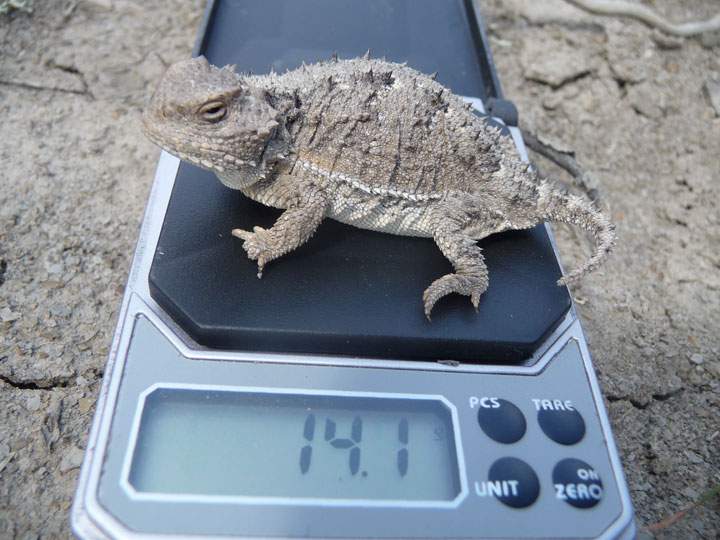
REGINA – Here’s something you don’t see every day — a lizard that shoots blood out of its eyes.

But if you’re travelling to Grasslands National Park in Saskatchewan and you’re very, very lucky, you might just catch a glimpse of the Greater Short-Horned Lizard, also known as Canada’s version of the iguana.
Biologists are conducting a study of the creature, which is also found in southeast Alberta, aiming to help move it off Canada’s list of “at-risk” species.

Get daily National news
Dr. Shelley Pruss is a species conservation specialist, part of a group of biologists with Parks Canada who are trying to learn more about the lizard.
She says they’ve only seen it once, partly because it is hard to spot due to its camouflaging armour.
As for the spurting-blood party trick, Pruss says the lizard isn’t likely to do it if approached by a human, though the one she saw did have a bit of blood dripping from its eyes.
“They don’t do it to people. People like us don’t really scare them enough. But they will do it if they’re picked up by a coyote or fox.”
She says scientists have theorized there are chemicals in the blood that “are maybe a little bit noxious when the predators taste it.”
Pruss says scientists are hoping to learn more about their environment in order to protect them and their habitat.
(CJME)


Comments
Want to discuss? Please read our Commenting Policy first.