


The Romans thought the gods caused earthquakes to show their displeasure.
Modern scientists have identified other causes – the buildup of stress in the Earth’s crust – and have developed technology that determines their magnitude and origin.
Scientists use the body-wave magnitude scale and the moment magnitude scale to measure earthquakes, but the Richter scale is still commonly cited when talking about quakes.
In this scale, the magnitude of a quake is calculated from the amplitude of its largest seismic wave.
The Richter magnitudes are based on a logarithmic scale. That means that the numbers of the scale measure factors of 10.
So, an earthquake measuring 4.0 on the Richter scale is 10 times larger than one measuring 3.0 – the amplitude of the ground motion recorded by a seismograph is ten times greater.
Earthquakes measuring less than four are minor, with those less than two being so small only seismometres can detect them. Those occur quite frequently.
Earthquakes measuring between four and 5.9 on the Richter scale are considered moderate, while strong quakes measure between 6 and 6.9.
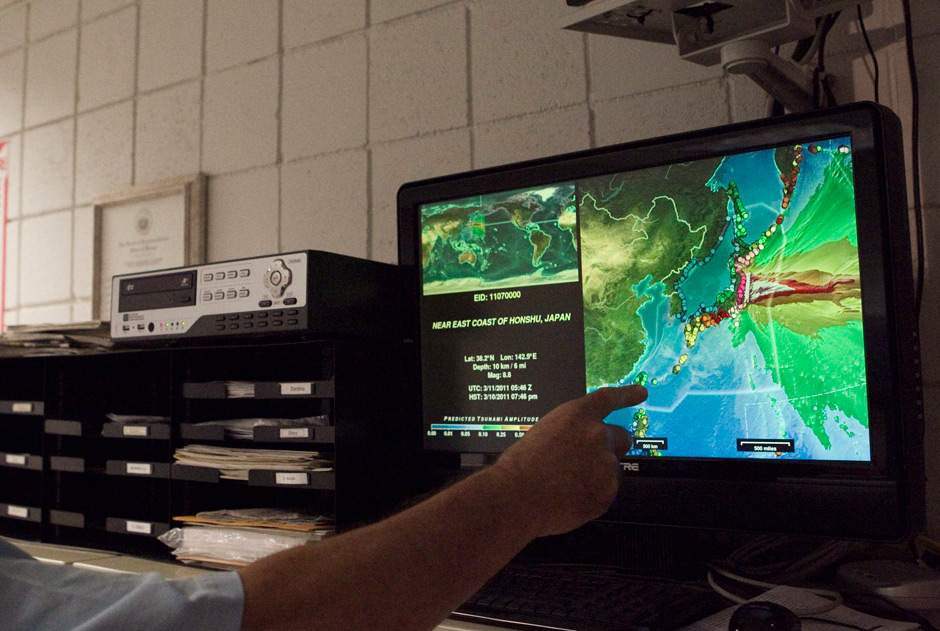
Earthquakes of magnitude 7 to 7.9 are considered major tremors while those, like the recent one in Japan, that measure eight and above are classified as great earthquakes.
Modern seismographs can detect seismic waves even smaller than those originally chosen for zero magnitude. As a result, the Richter scale now measures earthquakes having negative magnitudes.
Earthquakes of a large magnitude do not necessarily cause the most intense surface effects. The effect in a given region relates to the geological conditions. For example, an area of sand or clay would suffer a greater impact than an area of granite.
Richter scale developed in 1935
Charles Richter developed the scale in 1935 as a way to measure the magnitude of local earthquakes in southern California.
The Richter scale was the go-to method of measuring quakes for many years. However, Richter only used a certain type of seismograph and measured shallow earthquakes in the Golden State.
So, about 30 years ago, seismologists began to use the “moment-magnitude” scale. It relies on data recorded by instruments that are more sophisticated than those available during Richter’s time.
Moment magnitude and Richter magnitude are about the same for earthquakes up to a magnitude of seven, but the moment magnitude scale is considered more accurate for gauging major and great earthquakes.
The biggest quake in the world since 1900 scored a 9.5 on the Richter scale. It rocked Chile on May 22, 1960.
The massive earthquake that struck off the coast of Japan Friday ranks as the fifth largest in the world since 1900, and the largest to strike Japan in 140 years.



Comments
Want to discuss? Please read our Commenting Policy first.