


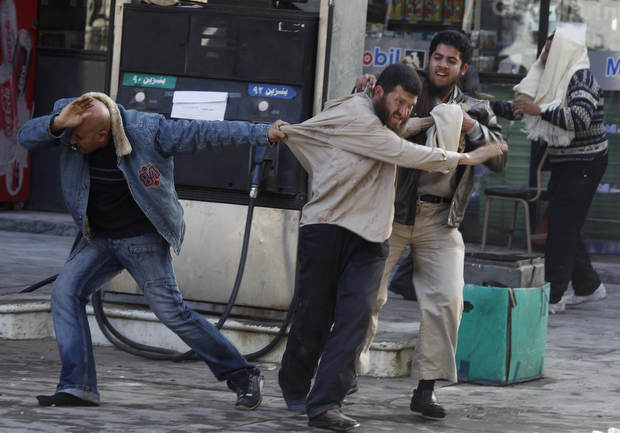
While protesters and government supporters clash in central Cairo, and lawlessness spreads round the city, there is increasing concern about the safety of journalists covering the unrest.
Two Canadian journalists were among the many members of the media who have been detained or beaten with sticks and fists by pro-government mobs.
Patrick Martin and Sonia Verma of The Globe and Mail were held for about three hours at an impromptu checkpoint while driving through Cairo. They were detained with some other foreigners, including a four-year-old girl.
CBC radio reporter Margaret Evans had her audio recording equipment confiscated by Egyptian authorities and CTV News had its television camera confiscated.
Camera equipment used by Richard Latendresse, a reporter for Quebec-based television network TVA, was seized by the security staff at his hotel.
CNN’s Anderson Cooper was one of dozens of journalists attacked during protests that turned violent in Cairo Wednesday. A crowd of angry supporters of President Hosni Mubarak hit Cooper in the head and threw bottles and water at him and his crew.
Crackdown denounced
Such incidents have prompted a global outcry.
“The regime has decided to target media personnel physically by unleashing its supporters in an unprecedented campaign of hatred and violence,” secretary-general of Reporters Without Borders, Jean-François Julliard, said in a statement. They are trying to rid Cairo of “all journalists working for foreign news media.”
On Thursday, the Canadian government called on Egypt to protect and immediately release Canadian journalists detained there.
"All detained journalists should be immediately released and their … equipment returned," said Canadian Foreign Affairs Minister Lawrence Cannon.
Cannon said he had contacted the Egyptian ambassador in Ottawa to express "grave concerns" about the targeting of foreign journalists and to request that the military provide them adequate protection.
In the United States, White House spokesman Robert Gibbs said the “systematic targeting of journalists in Egypt is unacceptable” and added that those who have been detained must be freed.
British Foreign Secretary William Hague called for Egyptian authorities to look into such reports of mistreatment.
"The abuse of Internet and mobile networks and, in particular, today’s increased intimidation and harassment of journalists are unacceptable and disturbing," he said.
Journalists killed
The journalists in Egypt are not the first to be targeted.
Just three weeks ago, a French journalist was killed while covering the unrest in Tunisia. Lucas Mebrouk Dolega, a 32-year-old photographer for the European Pressphoto Agency, was hit by a tear gas grenade launched by police in Tunis.
So far, Dolega is the only journalist who has been killed in the line of duty but dozens more met the same fate last year.
According to Reporters Without Borders, 57 journalists were killed while covering the news last year. The organization says 11 journalists were killed in Pakistan alone, and seven were killed in Iraq and Mexico each.
Meanwhile, Canadian Journalists for Free Expression says 87 journalists were killed in 2010. The CJFE said three countries were particularly perilous for media, stating that Pakistan, Mexico and Honduras accounted for 43 per cent of journalists murdered last year.
Media watchdog Press Emblem Campaign reported that 105 journalists were killed while working in 2010. The organization said Mexico and Pakistan were the two most dangerous countries for media, with 14 journalists killed in each country.
Though they disagree on the exact numbers, all the organizations agree with CJFE President Arnold Amber who said, “Quite obviously many journalists live with constant threat just for doing their jobs."



Comments
Want to discuss? Please read our Commenting Policy first.