


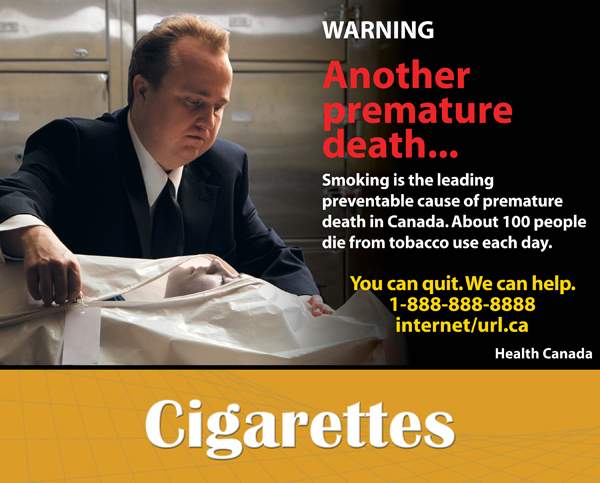
Countries around the world have introduced legislation requiring tobacco companies to place labels on cigarette packages warning consumers about the harmful effects of smoking.
Those nations took their cue from Canada, which became the first country to introduce such legislation more than two decades ago.
In 1988, parliament introduced legislation requiring cigarette packages to carry one of four health warnings: Smoking reduces life expectancy; smoking is the major cause of lung cancer; smoking is a major cause of heart disease; smoking during pregnancy can harm the baby
Legislation introduced six years later required cigarette packages to carry new warnings, and to display them more prominently than before.
In 1997, the Tobacco Act was enacted to regulate the manufacturing, sale, labeling and promotion of tobacco products in Canada.
Ten years ago, lawmakers introduced legislation requiring cigarette packages to carry one of 16 new health warnings covering half of the cigarette pack and including graphic images such as diseased mouths and cancer-laden lungs.
In September 2010, the Conservative government suspended plans to update the warning labels even though the health ministry had spent six years devising the new campaign and agreeing on details with the provinces.
Opposition politicians accused the government of bowing to the wishes of the tobacco industry, which has long opposed such regulations.
Then, in a dramatic turnaround three months later, Ottawa announced that tobacco companies would have to place larger and enhanced warning labels on cigarette packages.
The new warnings will cover three-quarters of the front and back of cigarette packs.
The new graphic messages will include warnings about tobacco-related diseases such as bladder cancer as well as testimonials from cancer victims.
One of them is Barb Tarbox, who died of lung cancer in 2003. Tarbox was a model who campaigned against smoking and was photographed on her deathbed. The image was used in anti-smoking campaigns along with the slogan, “This is what dying of cancer looks like.”
The graphic warnings will change from time to time so they remain fresh and noticeable.
"Canadian and international research has shown that to be effective, health warnings must be noticeable and memorable,” said Health Minister Leona Aglukkaq. “They must also be believable and relevant.”
The packages will also include the phone number for a quit-smoking hotline.
According to Aglukkaq, the government will be drafting regulations for the new warning labels in 2011.
About 18 per cent of Canadians smoke. Among young adults between 20 and 24, that rate is 23 per cent.

Comments
Want to discuss? Please read our Commenting Policy first.