

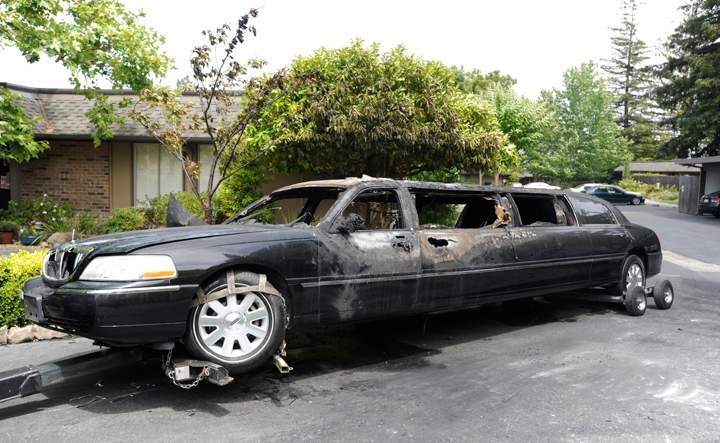
SAN FRANCISCO – Ten women – some of them in their 90s – escaped unharmed from a limousine that began smoking and caught fire in Northern California just more than a month after five nurses were killed while trapped inside a burning limousine on a nearby bridge.

The women were celebrating one of their 90th birthdays and were in the vehicle outside the birthday woman’s home – where they had gathered shortly after 11 a.m.- when white smoke drifted out of the partition between the driver’s compartment and the passenger compartment, Mary Chapman, one of the passengers, said Monday.
The limousine was idling, but the doors were open. Chapman, 63, said she got out and the other women -some of whom relied on walkers and canes- followed with help from each other and a caregiver.

Get daily National news
“I think that’s what saved us,” she said. “The doors were not closed, so they weren’t locked.”
Flames erupted about 15 minutes later, she said, although the women were out by then and had moved into the home. Television news footage showed the limo’s passenger and driver’s compartments completely gutted.
The limo fire on the San Mateo-Hayward Bridge over San Francisco Bay last month spread rapidly, engulfing the luxury car in just a few moments.
The five women who died were found pressed up against the 3-foot (one meter) by 1 1/2-foot (0.5 metre) partition, apparently because smoke and fire kept them from the rear exits of the extended passenger compartment.
Four women and the driver escaped. The women were celebrating the wedding of a newlywed friend.
The California Highway Patrol has not concluded its investigation of the May 4 fire.
Industry experts say the stretch limousine industry is poorly regulated because regulatory agencies lack funds to investigate the many small businesses that modify limousines.
U.S. Department of Transportation data shows five people died in three separate stretch limo accidents in 2010, and 21 people died in another three accidents in 2011.
Associated Press Writer Sudhin Thanawala contributed to this report.




Comments
Want to discuss? Please read our Commenting Policy first.