

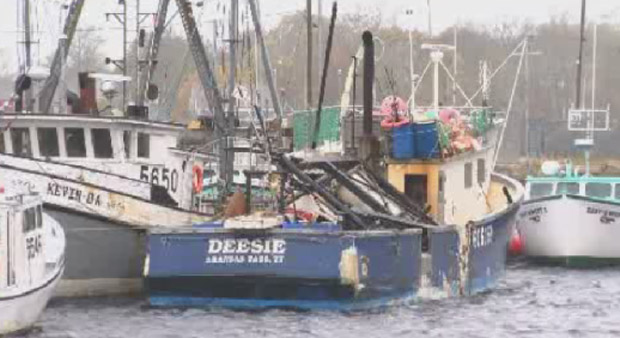
HALIFAX – The crew of an American swordfishing vessel say their battered boat took on 10-metre waves in order to make it to safe harbour in southern Nova Scotia.

The Deesie, with its four-man crew, was returning from its last trip of the season to prime sworfishing grounds off the Grand Banks, to the east of the Flemish Cap, when it met with the stormy seas caused by Hurricane Sandy early Monday.
Matt Collins, one of the deckhands on board, said the seas were rough throughout the 650-kilometre voyage to Shelburne.
But it was in the middle of the night that things took an ominous turn, Collins told Global’s Natasha Pace in an exclusive TV interview.
“It started getting rough out there, we got a bunch of lows in and we were taking on big seas. And then at about 4 o’clock in the morning we took on a big wave,” he said.
Dealing with the fury on the seas was one thing, but The Deesie endured another blow that made coming out of the storm alive seem less likely.
“We went out and checked the A-frame which is, that’s what basically stops us from rolling over,” he said. “It holds out outriggers and there was a crack in it and we basically tried tying it off. At that point it was still up… and basically we just kinda sat around hoping for the best.”
The crew the Texas-registered vessel then had to spend hours cutting off the outriggers with a hacksaw.


“We had a hacksaw with three blades and we had to cut off these big steel outriggers,” Collins said, “because they were putting holes in the side of the boat and there was just, if we didn’t cut those off we never would have made it in.”
Despite the beating Sandy’s winds and waves gave The Deesie, the crew managed to saw off the outriggers – poles used to hold out fishing lines and help stabilize the vessel – and carry on.
“After we cut those off it was a rolly ride all the way in, we’re lucky we made it,” Collins said.

Get daily National news
Swordfishing season is about to wrap up and The Deesie was on its last trip out.
It’s not one that Collins, who is from Massachusetts, is likely to soon forget.
“Each trip we usually gone 30 to 45 days and the last three months we already made two trips,” he said. “This was our last trip and we were on our way back in and this doesn’t compare to other trips.
“It changes everything when you get in a situation like that,” he said.
The crew is on staying put in Shelburne for now, along with about 18 other vessels, waiting for the winds to die down and to see if The Deesie is fit to sail home.
Out to sea can be the safest place to ride out a storm
The story brings back memories of the sinking of the Andrea Gail, with six men on board, during what came to be known as “The Perfect Storm.”
That sad tale unfolded 21 years ago, when Hurricane Grace merged with a non-tropical low pressure system that formed along a cold front moving off the coast.
The Gloucester, Mass. based swordfishing vessel got caught in the storm, and its reported 30-metre waves, after fishing the Flemish Cap.
The last contact anyone had with the boat’s captain, 34-year-old Frank W. “Billy” Tyne, was the evening of Oct. 28, 1991. The ship sank somewhere to northeast of Sable Island, N.S.
One of the last people to hear from Tyne was Capt. Linda Greenlaw, of the Andrea Gail’s sister vessel the Hannah Boden.
Global News contacted Greenlaw, who was the only woman on the U.S. east coast to captain a swordfishing boat, at her home in Isle Au Haut, ME.
She said swordfishermen don’t really talk about “The Perfect Storm” anymore unless it’s an anniversary or journalists ask them about it.
Greenlaw said she was at a safe distance from the worst conditions and had enough warning to avert the life-threatening conditions.


Because swordfishing season generally coincides with hurricane season, there usually is no choice but to go through a storm to get to safer waters.
She said ships are typically safer heading north, away from the Gulf stream where low pressure systems usually feed off warmer water. But, sailors need to have enough warning to do that.
“The Andrea Gail,” she said, “didn’t have the warning, they didn’t have all of this weather information. We’ve been looking at this current storm, Sandy, for weeks. So everyone had plenty of warning about Sandy.”
“It’s a totally different situation than ‘The Perfect Storm,” she said.
When you’re in the thick of it, she explained, there are a lot of factors that come into play when trying to keep a ship afloat.
Mainly it’s the height of the sea, the direction of the waves and the frequency of the swells, but navigating in darkness adds to the uncertainty she said.
“A swordfishing boat, they’re sort of all designed that the safest way, in bad weather, is to jog into it and keep the bow in the wind,” Greenlaw said. “But, it’s hard to keep the bow into the sea if it’s in three different directions.”
“Most of the boats that go to the Grand Banks are, you know, certainly fit for most weather,” she said.
“But if you get a freak storm, like ‘The Perfect Storm,’ you know nothing’s built to sustain something like that without damage. ”
Regardless of the risk, the sea can be the safest place for a vessel to ride out a storm.
Two years ago, she had to go through a hurricane on the Grand Banks. She said all the other boats got to the docks ahead of her and there was no place for the Hannah Boden.
“I was in better shape off-shore than the boats that we’re off the dock,” she said. “I’d rather be off-shore anytime than at the dock, as far as the boat being damaged.
“If you’re a fisherman, and you’re trying to make a living, if you run into shore every time somebody says ‘storm’ you might as well stayed tied to the dock and never leave,” she said adding you’ll never make any money that way.
She likes to think coming out of a storm is more than good luck and it’s the result of doing your job right.
Greenlaw, 52, is fishing tuna closer to home these days, in a smaller vessel called the Hazel Brown.
Comments