



Scientists have found the first complex organic chiral molecule in space, a molecule that will help them understand how life evolved on Earth.

Many organic molecules have mirror images of themselves. You can think of it as a right hand and a left hand. It’s these particular types of molecules that are essential for life. While they are found on Earth, as well as on comets and asteroids, they’ve never been found in interstellar space. Until now.
READ MORE: Meet Mike Brown—Pluto killer and the man who brought us Planet 9
The molecule, called propylene oxide, was found in the centre of the Milky Way in a large star-forming region of dust and gas. Astronomers used the National Science Foundation’s Green Bank Telescope in West Virginia, to detect the molecule and later, several other telescopes were used to make the confirmation.
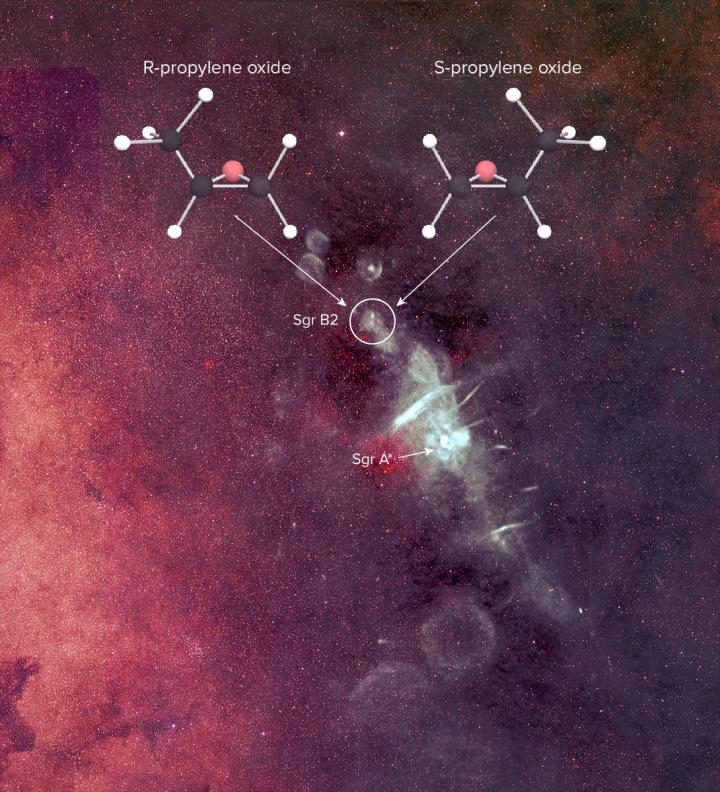
“This is the first molecule detected in interstellar space that has the property of chirality, making it a pioneering leap forward in our understanding of how prebiotic molecules are made in the universe and the effects they may have on the origins of life,” said Brett McGuire, a chemist and Jansky Postdoctoral Fellow with the National Radio Astronomy Observatory (NRAO) in Charlottesville, Virginia.

Get breaking National news
Life on Earth is comprised of just one type of “handedness,” termed homochirality. For example, in our bodies, all of the amino acids are left-handed.
How and why chirality occurs isn’t understood. Finding this organic chiral molecule, could change that, however.
“Meteorites in our solar system contain chiral molecules that predate the Earth itself, and chiral molecules have recently been discovered in comets,” said Brandon Carroll, a chemistry graduate student at the California Institute of Technology in Pasadena. “Such small bodies may be what pushed life to the handedness we see today.”
“By discovering a chiral molecule in space, we finally have a way to study where and how these molecules form before they find their way into meteorites and comets, and to understand the role they play in the origins of homochirality and life,” McGuire said.
Scientists have found more than 180 different molecules in space, just not chiral molecules. They find these molecules using radio telescopes. As molecules move through space, they give off vibrations that can be detected in the radio spectrum. Each molecule’s signature is distinctive, allowing astronomers to classify them.




Comments
Want to discuss? Please read our Commenting Policy first.