


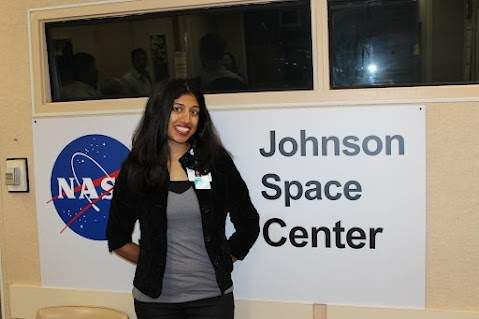
A U of A med student says she’s over the moon after returning from a one-month clerkship with NASA – a dream that was a long time in the making.

“When I was a kid, before I realized I wasn’t American, I wanted to be director of NASA,” Shawna Pandya recalls. “Then I set my sights on wanting to be an astronaut.”
After realizing the job propects for wannabe-astronauts weren’t great, Pandya decided to become a neurosurgeon instead. But this now-fourth-year U of A medical student did apply for a clerkship with NASA, and ended up being one of just five Canadians who got the call.
Her 16-page application to NASA included her prior space-related experience – including a masters from the International Space University in France, and an internship at the European Astronaut Centre.

Get daily National news
“And that kind of led to research in areas that I’m really passionate about,” Pandya says. “So telemedicine, space medicine, technologies that have benefit for medicine on earth in everyday life.”
Pandya calls her month with the American space agency, which she compares to “Disneyland for nerds,” a phenomenal experience.
“Every single day was a new adventure, every single day you’re learning something new,” she says.
The 27 year-old got to see and even sit in the space shuttle and international space station, which she says was “amazing.”
While there, Pandya worked on medical implications during a simulated near-Earth asteroid mission, including designing the contents of the medical kit which would accompany such a mission.
“I also helped design scenarios that would be likely to come up, and what the procedure would be to do if something came up, like a kidney stone, for example.”
She also studied the effects of micro-gravity on the brain, as well as on bone density.
Since astronauts tend to develop osteoporosis very quickly in space, she says studying how bones react and “how we can prevent this and use counter-measures to maintain the strength of these bones and then see how the structure is altered, actually has a lot of very real implications for osteoporosis studies here on Earth.”
Pandya’s trip to NASA’s Johnson Space Center in Houston was funded by The Canadian Space Agency.
With files from Su-Ling Goh, Global News


Comments
Want to discuss? Please read our Commenting Policy first.