


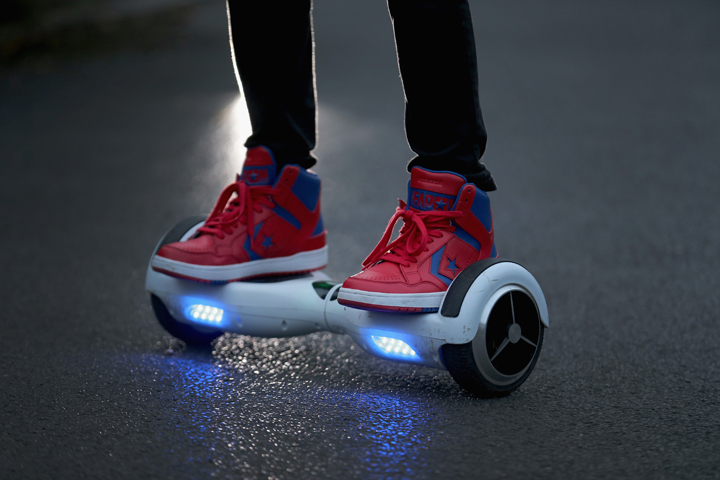
Amazon has removed some hoverboard models from its website amid concerns that not all of the self-balancing scooter models meet safety standards and pose a fire risk.

The e-commerce giant halted sales of many hoverboard models, including some from Swagway – one of the most popular hoverboard manufactures on the market.
According to a statement from Swagway, Amazon sent out a notice last Friday asking all hoverboard makers to “provide documentation demonstrating that all hoverboards you list are compliant with applicable safety standards, including UN 38.3 (battery), UL 1642 (battery), and UL 60950-1 (charger).”
READ MORE: Air Canada will no longer allow you to bring a hoverboard on your flight
“Swagway already meets all those certifications and has already sent the requested information to Amazon,” read a statement issued to Global News.
“As safety is on the forefront for Swagway, we applaud Amazon for taking these steps to weed out the low quality boards.”
Some so-called hoverboard models remain on Amazon’s website, including the IO Hawk Intelligent Personal Mobility Device. It’s unclear whether or not sales of other hoverboard brands, including Swagway, will be reinstated if they meet safety standards.

Get breaking National news
Hoverboards – said to be one of the hottest gifts this holiday season – have been the subject of scrutiny for weeks, after multiple reports of the gadgets bursting into flames across the U.S.
http://www.instagram.com/p/_LKNWHS3XR/
Earlier this month, more than 15,000 hoverboards were seized by U.K. officials due to safety concerns. According to the U.K.’s National Trading Standards board, officials found many concerns surrounding the plugs, cabling, chargers, batteries, or the cut-off switch within the boards, which sometimes fails.
READ MORE: 15,000 hoverboards seized by U.K. customs agents due to fire concerns


Officials said many of the hoverboards that were sent for testing were found to have noncompliant plugs without fuses, which increases the risk of the device overheating, exploding or catching fire.
Last week, Air Canada said travellers will no longer be able to bring small lithium-battery powered vehicles as checked or carry-on baggage due to “potential safety risks associated with the size of the batteries that power them.”
Hoverboards aren’t the first gadgets to cause fire concerns. Over the years, there have been many reports of smartphone batteries catching fire.
When it comes to tech gadgets, in the majority of cases the device’s battery is to blame for any sort of fire, explosion, or melting.
READ MORE: Why lithium-ion smartphone batteries keep exploding
Most smartphones use lithium-ion batteries – the same batteries are found in laptops, cars and even commercial airplanes.
Lithium-ion batteries are widely used by tech manufactures because it’s the least dense metallic element; which means it packs a good amount of power in a lightweight package. But these batteries are also known to explode or produce flames.


Comments
Want to discuss? Please read our Commenting Policy first.