

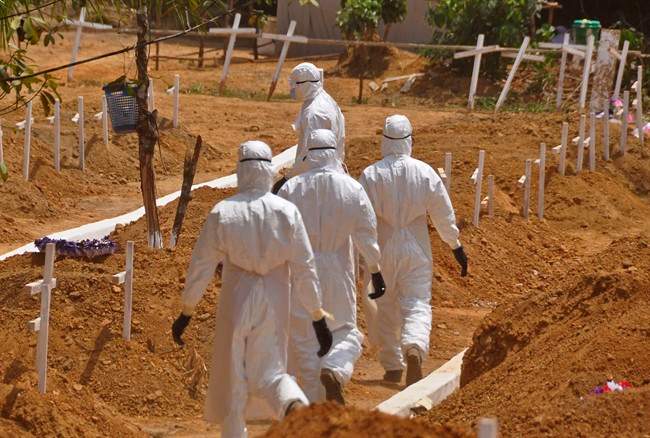
LONDON – The World Health Organization says the year-long Ebola outbreak in West Africa still qualifies as an international emergency even though the number of cases has plummeted.

Last August, the U.N. health agency declared the epidemic of the lethal virus to be a global emergency after the deaths of nearly 1,000 people, mostly in Guinea, Sierra Leone and Liberia.
At the peak last year, hundreds of new cases were being reported every week. In an update this week, WHO reported there were 30 confirmed cases last week in Guinea and Sierra Leone; the last case in Liberia died on March 27.
Dr. Bruce Aylward, who is leading WHO’s Ebola response, said the decline appeared to be real, rather than just “a pothole on the bumpy road to get to zero cases.”

Get weekly health news
To date, Ebola is estimated to have infected more than 25,500 people and killed 10,587, mostly in West Africa.
During a press briefing in Geneva on Friday, Aylward said WHO’s Ebola emergency committee believes the risk of the virus spreading globally appears to be dropping even though officials still don’t know where the virus is spreading in most cases in Guinea and Sierra Leone.
“We are still not controlling the epidemic,” said Brice de le Vingne, director of operations for Doctors Without Borders, who noted past lulls in the outbreak have often been followed by surges in cases. He said the designation of Ebola as a global emergency is also necessary to speed up paperwork for the ongoing experimental drug and vaccine trials in West Africa.


Other experts agreed it’s too early for WHO to downgrade the status of the biggest-ever Ebola outbreak and warned the recent fall in cases may be deceptive.
“It is just that we are used to (seeing) large numbers of cases and deaths,” said Oyewale Tomori, a Nigerian virologist who sits on WHO’s Ebola emergency committee. “These numbers should still frighten us.”
Tomori said that though cases have fallen dramatically, it is too soon to relax. “The three countries had declared themselves (Ebola-free) at one time, only to find dead bodies all over the place later,” he wrote in an email.


Comments
Want to discuss? Please read our Commenting Policy first.