

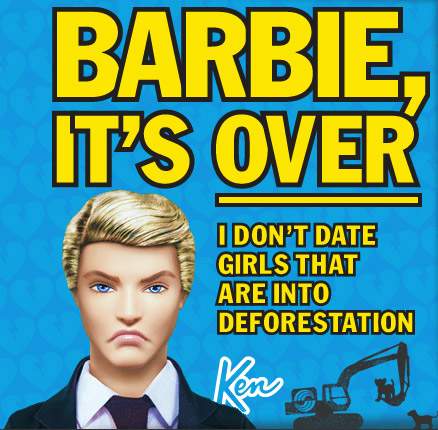
Toy giant Mattel has caved in to pressure from a Greenpeace International campaign targeting its packaging by announcing a new plan to cut out controversial sources of paper from its supply chain.

In a statement released Wednesday, the manufacturer of Barbie said it was introducing new policies for all paper and wood fibre used in its packaging and products.
“We are committed to advancing the use of sustainably sourced paper and wood fibre across our business, beginning with packaging,” said Lisa Marie Bongiovanni, vice-president corporate affairs at Mattel, who also oversees the company’s sustainability initiatives. “In developing these sourcing principles and setting goals, we applied a thoughtful and rigorous approach in evaluating our supply chain and identifying meaningful opportunities for continuous improvement.”
The announcement comes a few months after Greenpeace activists dressed as “Ken” scaled the company’s California headquarters, posting a banner announcing a “breakup” with “Barbie” because her packaging was coming from endangered Indonesian rainforests.
The campaign was singling out Asia Pacific Paper, a global forestry company that owns five mills in Canada. But Greenpeace is now praising Mattel after it agreed to make changes in its supply chain.

Get daily National news
“The rainforests of Indonesia should be for species like the endangered Sumatran tiger, not for throwaway toy packaging,” said Greenpeace’s Indonesian rainforest campaign director, Bustar Maitar. “Mattel’s new paper-buying policy is good news for the future of the forests of Indonesia. This is more evidence for APP that rainforest destruction is bad for business.”
The Forest Stewardship Council, an international certification system “promoting responsible management of the world’s forests,” dissociated itself from APP in October 2007, questioning whether it was “truly committed” to the council’s objectives.
“There is substantial publicly available information that suggests that APP, a Sinar Mas subsidiary, is associated with destructive forestry practices,” the FSC said in a statement at the time. “As a result, the FSC board of directors decided to end the use of the FSC name and trademarks by APP and subsidiaries in which APP is the majority shareholder.”
But a spokesman for APP Canada has denied that its practices are harming pristine rainforests in Indonesia.
Ian Lifshitz, sustainability manager for APP Canada, said in June that the company was “strongly committed to sustainability,” and ensuring it is not engaging in illegal logging.
“We think we go beyond government compliance,” he said. “We have a very strong commitment toward the Indonesian people and sustaining the rainforest.”
mdesouza(at)postmedia.com
Twitter.com/mikedesouza


Comments
Want to discuss? Please read our Commenting Policy first.