

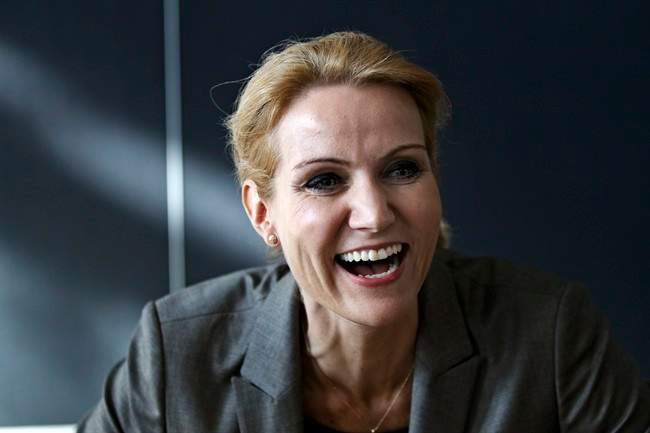
COPENHAGEN – Denmark must make sacrifices to emerge from a sudden economic downturn that struck this year after a long period of prosperity, the country’s new prime minister said Monday as she presented a new coalition government formed after two weeks of difficult negotiations.

Helle Thorning-Schmidt, the country’s first female prime minster, heads an alliance that includes ex-communists and pro-market liberals and has struggled to chart an economic program. Denmark’s economic growth forecast for 2011 has been reduced to 1.3 per cent growth, down from a previous forecast of 1.9 per cent.
The aging work force is also putting a greater burden on the budget, which is projected to reach a deficit of 3.8 per cent of gross domestic product in 2011 and 4.6 per cent in 2012 after years of surplus.
Danish media have reported, citing unidentified officials familiar with the negotiations, that Thorning-Schmidt’s plans for tax hikes on wealthy Danes and banks apparently were scrapped after vehement opposition from the pro-business Social Liberals.
Danish media also reported that the coalition has agreed on boosting Denmark’s economy with 10 billion kroner ($1.8 billion) in public investments.

Get daily National news
“The government platform will show the way out of the crisis,” Helle Thorning-Schmidt said as she presented a new three-party alliance, including both ex-communists and pro-market liberals.
“We cannot emerge from the crisis if everyone doesn’t co-operate and we don’t make unpleasant decisions,” she said. The government planned a news conference Monday to present the coalition’s platform.
Thorning-Schmidt’s alliance between Social Democrats, the Socialist People’s Party and Social Liberals secured a narrow majority of 92 seats in the 179-member Folketing in last month’s election.
-
![]() Canada, France, U.K. slap trade sanctions on Israeli settlements in occupied West Bank
Canada, France, U.K. slap trade sanctions on Israeli settlements in occupied West Bank -
![]() Health Matters: Indonesia school meals linked to 2,000 illnesses
Health Matters: Indonesia school meals linked to 2,000 illnesses -
![]() Germany’s far-right AfD says it has ‘clear mandate’ after winning state election
Germany’s far-right AfD says it has ‘clear mandate’ after winning state election -
![]() ‘Warzone’: Storm rips through Winnipeg leaves thousands with no power
‘Warzone’: Storm rips through Winnipeg leaves thousands with no power


But attaining compromises will be a struggle for Thorning-Schmidt, who will have to reach out to ex-Marxists – in power for the first time since they were established in 1959 – and pro-market liberals in her government.
The new government includes 14 men and nine women, of which Thorning-Schmidt’s Social Democrats will have 13 spots and the two other parties – the Social Liberals and the Socialist People’s Party – six each.
Margrethe Vestager, head of the Social Liberals, was tapped to become economy and interior minister, while the Socialist People’s Party leader Villy Soevndahl was designated foreign minister.
Soevndahl’s working-class party moved away from its Marxist roots following the collapse of the Iron Curtain two decades ago.
Thorning-Schmidt formally presented her government to monarch Queen Margrethe, who appointed her prime minister on Monday. Thorning-Schmidt will address the new Parliament on Tuesday as the assembly reconvenes after summer recess.


Comments
Want to discuss? Please read our Commenting Policy first.