


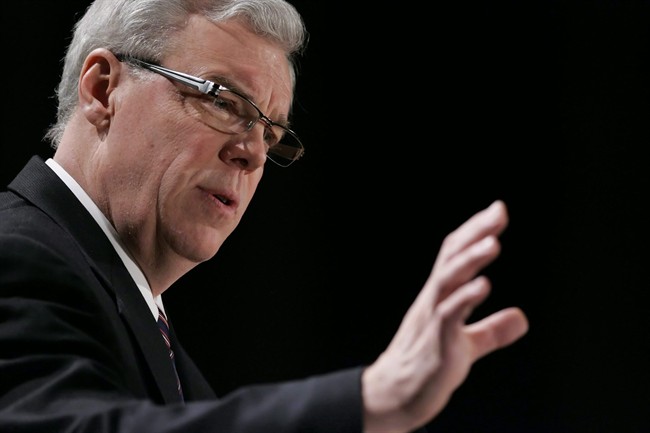
WINNIPEG – Manitoba Premier Greg Selinger has visited the lieutenant-governor’s office to officially launch the Oct. 4 provincial election campaign.

Selinger, a former finance minister, says he feels good going into his first campaign as premier.
The visit was a bit anticlimactic since the parties have been campaigning for weeks now that Manitoba has a fixed election schedule.
All three parties hit the hustings in earnest last week. The New Democrats and the Conservatives even released parts of their election platforms.
The NDP currently holds 36 seats in the 57-seat legislature, Hugh McFadyen’s Tories have 18 and Liberal Leader Jon Gerrard holds the lone seat for his party.
There are two vacancies.
The election will be the first real test of Selinger’s popularity. He was chosen by NDP faithful to succeed Gary Doer when he resigned in 2009 to become Canada’s ambassador to the U.S.
NDP support dipped in opinion polls several months after the transition when the economy appeared set to falter and government-backed projects such as Winnipeg’s new football stadium needed a controversial infusion of cash.
But the most recent polls suggest the New Democrats are running neck-and-neck with the Progressive Conservatives, although the NDP holds a substantial edge in seat-rich Winnipeg.
The province’s economic growth has remained slow but steady, housing prices are stable, unemployment is low and the NHL has returned to Winnipeg, much to the joy of thousands who partied in the city’s streets when the announcement was made
That doesn’t leave a lot of fuel to feed a public appetite for change, one analyst suggested.

Get daily National news
“That’s the typical rule in Canadian politics, that people vote governments out. They don’t vote governments in,” said Jared Wesley, who teaches political science at the University of Manitoba and the University of Alberta.
The NDP has also rejected federal overtures to adopt the harmonized sales tax, so the government is not facing the kind of consumer backlash seen in Ontario and British Columbia.
The opposition has focused much of its energy on accusing the government of bungling the province’s finances as well as some major projects. The Tories pepper their pamphlets and speeches with the word “mismanagement” to describe the NDP’s five straight budget deficits, rising health-care costs and the spiralling cost of a new hydro transmission line called BiPole Three.
Manitoba Hydro, a Crown corporation, wanted to build a short, direct line through the boreal forest on the eastern side of the province. But the government ordered Hydro to reroute the proposed line hundreds of kilometres to the west so as to protect the forest. The Tories say the change will boost the project’s costs by billions of dollars. The government says the additional price will be recouped through export sales.
The Tories will also make crime a campaign issue. They accuse the NDP of failing to stem the province’s high rates of homicide, robbery and assaults. Winnipeg has seen several shootings and fire bombings this summer that police believe are part of turf wars between rival biker gangs. There have also been a rash of arsons.
Gerrard has also signalled he will make an issue of crime. He said before the writ dropped Tuesday that his party would push for more recreation programs for youth to discourage kids from joining gangs.
The NDP has also been criticized for its handling of record flooding this spring along the Assiniboine River. The government was caught off-guard by water levels in May that threatened to swamp Brandon and some smaller communities. The government also came under fire from flooded cottage owners and First Nations residents along Lake Manitoba, who were driven from their homes by rising water. They blamed the province’s decision to divert more water than usual from the Assiniboine into the lake.
The election will hinge on suburban ridings in south and west Winnipeg – traditional Tory seats that have swung to the NDP in the past three elections.
The last vote in 2007 saw the New Democrats capture 36 of the legislature’s 57 seats. The Tories were reduced to 19 and the Liberals won two.
The Tories are hoping for a better result partly because of Doer’s departure. He was the face of the NDP for more than two decades and his outgoing manner and charm resulted in his personal popularity polling above his party’s support level.
Selinger, by contrast, is not as well-known and is more reserved. The former finance minister and academic is more at ease discussing issues in small groups than speaking to a row of television cameras. He is a “policy wonk,” according to Wesley, who may try to change his style for the campaign.
“His strategists have got to make a decision as to whether they want him to act like Greg … or whether they want to push him out of his shell and turn him into something he’s not.”
The Tories have recruited some big-name candidates to run against NDP cabinet ministers in swing ridings. Popular city Coun. Gord Steeves will take on Health Minister Theresa Oswald in Seine River. Former Olympic speedskater Susan Auch is running against Healthy Living Minister Jim Rondeau in Assiniboia.
But the Tories are facing an uphill battle in Winnipeg because of low support for the Liberals. Traditionally, the Tories have formed government whenever the Liberals have been strong enough to drain urban votes from the NDP. But for the last dozen years under leader Jon Gerrard, the Liberals have garnered about 13 per cent of the vote in each election and have not captured more than two seats.


Comments
Want to discuss? Please read our Commenting Policy first.