

Having been around this company for longer than I’d care to admit, I was there not only at the birth of Global National, but in the pre-gestational days.

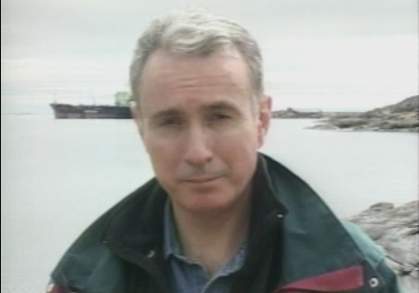
The idea of a national newscast goes back at least 20 years. There were a couple of different versions of a pseudo-national program during the 1990s, the most successful of which was called First National, anchored by Peter Kent.
Not all the stations picked it up and our resources were meager at best, but it was a solid show. Not sure what happened to the anchorman. Rumour has it that he is interested in a political career.
In the spring of 2001, a small group of us was called into a boardroom in Toronto to hear about the concept for the real national newscast that the company was finally launching in the fall. The idea was to deliver something different – not only an early-evening program – but one with an alternative attitude and look.
At the heart of the concept was what was dubbed “truth seekers” – a name that came from our first anchor, Kevin Newman. His idea was to tap into the new availability of compact newsgathering and editing gear; to teach veteran reporters who had never before picked up a camera how to shoot and edit their own stories.
I spent a week in the Ottawa bureau in June, being trained with some of my colleagues on how to use a PD-150 camera, which agencies like CNN had already deployed around the world, and how to edit on a laptop with a program called Final Cut Pro.
The descendants of the PD-150 can now be seen at news events large and small everywhere, and Final Cut Pro is used by everyone from big-budget documentary makers to high school kids. But in those days, PD-150 and Final Cut Pro were new and exotic.
I was given weeks to practice shooting and editing – a rare luxury in the world of private broadcasting – but something I desperately needed.
Given that everyone wanted to make a splash with GN’s debut, there was actually a bit of money in the budget for travel. To my astonishment, news management approved my pie-in-the-sky idea to spend a week in the Arctic shooting a series of features.
So it was that I packed up my little camera and hopped on a plane to Nunavut.
The first stop was Iqaluit, where there was a heart-stopping moment when the wide-eye lens fell off the camera and bounced off a rock, leaving a dent in the side, but otherwise still useable.

Get daily National news
Then there was a stopover in Resolute Bay for a couple of hours. With some time on my hands, I decided to take a short stroll from the village down to the harbour and take some video of this small portion of the fabled Northwest Passage.
As I walked the road, an Inuit boy passed by on his bicycle.
“Hi,” he said.
“Hi,” I replied, appreciating his small-town friendliness.
“Watch out for the polar bears,” he added, in a matter of fact tone.
Now that gave me pause. Although it was early August, the bay was filled with small icebergs. I stood for a moment and stared at those white floaters, to see if any of them were moving.
Nope. I decided to push on, noting that there were several locals along the shoreline and concluding that they must believe it was safe.
I learned later that every morning in Resolute, before the children are allowed to go to school, armed townspeople do a patrol of the village to ensure there are no bears around.
The owner of the guesthouse where I was staying had a stuffed bear in the lounge – not a trophy, but a memento from a close call down at the harbour.
The final stage of my journey came on a twin otter aircraft, headed even farther north.
Until then, my camping experience consisted of pitching a pup tent in my parents’ backyard when I was 10. Now I was en route to camp on Devon Island, the largest uninhabited island in the world, to join a team of researchers who was studying how explorers might live on Mars. The Arctic landscapes are considered similar to the Red Planet.
My tent was a rental, my sleeping bag borrowed. But somehow it all worked. On the first day, adrenaline pumping, I kept shooting and shooting and shooting. It was a glorious summer Arctic day, the treeless landscapes shimmering with a reddish gold light.
I looked at my watch. It was 11:00 PM, and no sign of darkness. Oh yes. This was the Midnight Sun.
After a week in the Arctic, I managed to avoid being attacked by a bear and to shoot five stories that appeared to be mainly in focus and worthy of our shiny new program.
The truth seeker concept envisaged stories that would run up to five minutes long, an eternity for a daily news program. I spent weeks preparing the scripts and painstakingly editing. Our newly-hired Toronto producer pored over each word. There was one particular sound bite in the first story that we wrangled over, one that seemed to sum up the whole point of the story. Ultimately I backed down and put it in the spot she suggested. More than 20 years in the business and I had never taken so long to prepare a daily news item.
Finally, part one was ready to air. It was broadcast on the second Monday of Global National’s existence. As I watched from home, my jaw dropped. Someone in Vancouver had cut out the clip that my producer and I had agonized over. The most important clip.
Blood rushed to my head. Steam must have been pouring out of my ears.
The next morning, I was still breathing fire. As I dressed for work, my mind was racing with the tirade that I was about to unleash on the folks in Vancouver for eviscerating my first truth seeker story.
Then I looked at the TV. Smoke was pouring out of the World Trade Center buildings in New York City.
It was September 11, 2001.
The fate of my story was no longer important. It was two months before the remainder of the Arctic series could be broadcast.
Only a week old, and a seminal event turned Global National on its head. Our small team suddenly had to be on the air all day long.
A few of us continued shooting and editing an occasional story, but the concept of five-minute features quickly proved impractical.
Even though the program has only been on the air for 10 years, it has already gone through a couple of generations of reporters and camera people, editors, writers and producers. The look and the tone have evolved.
But for me, the birth of Global National was all about the chance to stand beneath the midnight sun, drinking in the glorious light and keeping an eye out for hungry polar bears.
Sean is Global National’s Europe Bureau Chief, based in London. Follow him on Twitter: @SMallenGlobal.


Comments
Want to discuss? Please read our Commenting Policy first.